Home
Home
How AI Agents Are Moving Beyond Chatbots to Actually Get Work Done

Artificial intelligence is undergoing a fundamental shift from systems that simply talk to systems that actively do. While the initial wave of generative AI focused on conversational interfaces—chatbots capable of drafting emails or answering questions—the next frontier is defined by the AI agent. An AI agent is a software program designed to perceive its environment, reason through complex problems, and take autonomous actions to achieve specific goals with minimal human intervention.
The primary distinction between a traditional chatbot and an AI agent is agency. A chatbot provides information; an AI agent takes responsibility for executing a task from start to finish. This evolution represents a transition from AI as a consultant to AI as a digital workforce.
The Architecture of Autonomy: The Perception-Reasoning-Action Loop
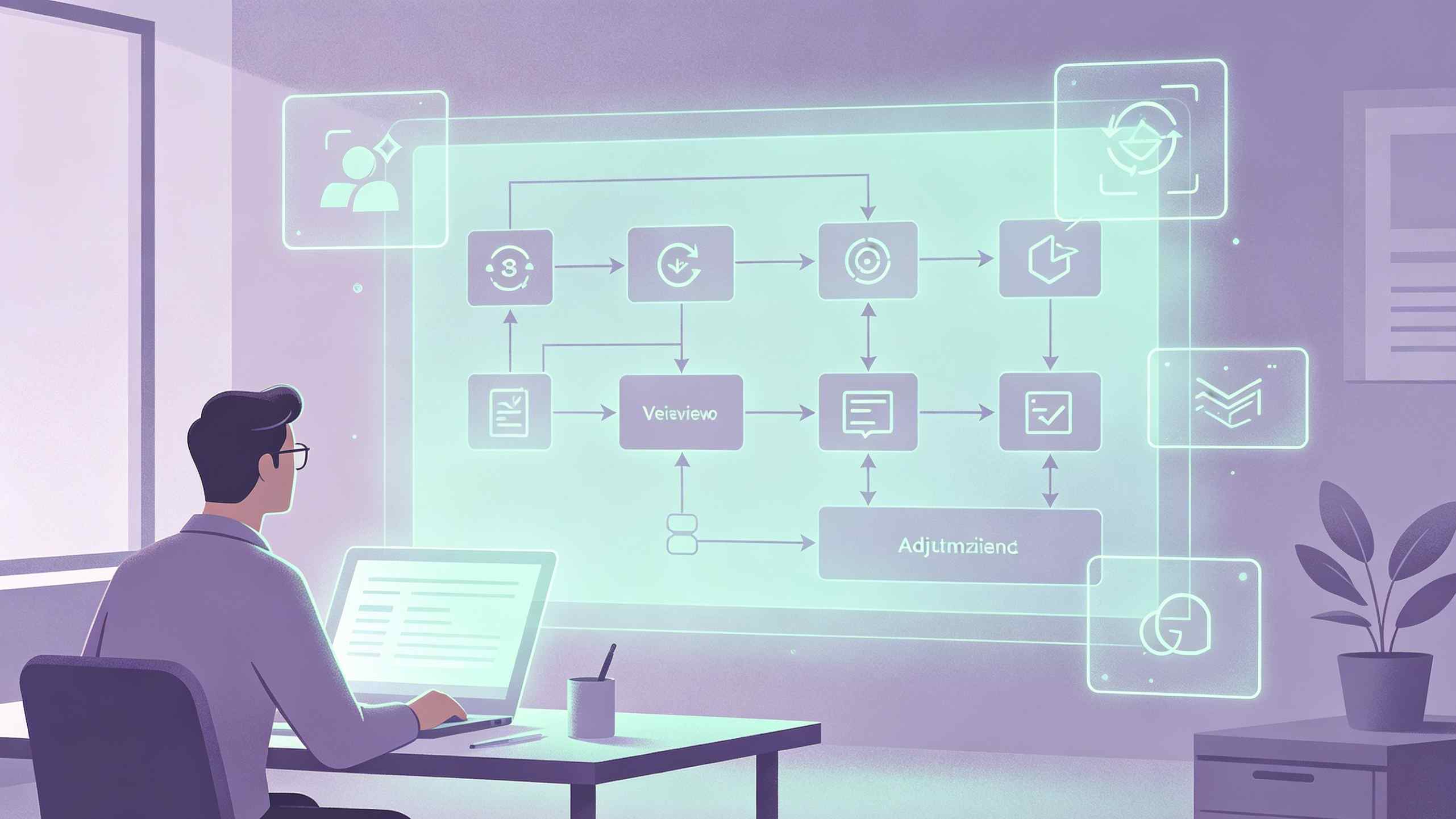
At the heart of every functional AI agent lies a continuous cycle known as the Perception-Reasoning-Action loop. This framework allows the agent to move beyond static responses and engage dynamically with the world.
Perception: Gathering Environmental Data
Perception is the agent's ability to ingest information from its surroundings. This is not limited to text prompts. Modern agents can process multi-modal inputs, including:
- Structured Data: API responses, database records, and spreadsheet rows.
- Unstructured Data: PDF documents, emails, and web content.
- Environmental Sensors: In robotics or IoT applications, this includes visual, auditory, or thermal data.
- User Context: The immediate history of interactions and the specific parameters of the task at hand.
Reasoning: The Decision-Making Core
Once data is perceived, the agent enters the reasoning phase. This is where the Large Language Model (LLM) acts as the "brain." The agent analyzes the perceived data against its predefined goal. It asks: "What is the current state? What is the desired state? What steps are necessary to bridge this gap?"
During this stage, advanced agents employ techniques like Chain of Thought (CoT) to break down a high-level goal (e.g., "Organize a business trip to Tokyo") into manageable sub-tasks (e.g., "Check flight availability," "Compare hotel ratings," "Verify visa requirements").
Action: Executing Through Tools
Action is what separates agents from passive models. After determining the next best step, the agent interacts with its environment via actuators or software tools. This might involve generating a block of code, calling a specific API to book a ticket, or updating a record in a CRM system. The agent doesn't just suggest the action; it executes the command.
Feedback and Adjustment
The loop concludes with feedback. The agent observes the result of its action. If a tool returns an error or a flight is no longer available, the agent perceives this new state, reasons through an alternative, and takes a new action. This self-correcting nature is a hallmark of true autonomy.
The Four Pillars of a Robust AI Agent
To function effectively in professional environments, an AI agent must be built upon four foundational pillars: the brain, memory, tools, and planning.
1. The Brain (The Model)
The choice of model dictates the agent's cognitive ceiling. While general-purpose models like GPT-4o are excellent for conversational tasks, "reasoning models" such as OpenAI’s o1 or DeepSeek’s R1 are increasingly preferred for agentic workflows. These models are trained using reinforcement learning to "think before they speak," allowing them to navigate complex logic gates and multi-step planning with higher reliability. In our testing, using a reasoning-heavy model as the agent core reduces the rate of "logical deadlocks" where an agent gets stuck in an infinite loop of trial and error.
2. Memory: Short-Term vs. Long-Term
A stateless AI is a forgetful one. Agents require memory to maintain context.
- Short-term Memory: This is often managed within the model's context window. It tracks the immediate conversation and the steps already taken in the current session.
- Long-term Memory: This is typically achieved through Retrieval-Augmented Generation (RAG) and vector databases. It allows the agent to store and retrieve historical information, user preferences, and vast knowledge bases that exceed the context window limits. For instance, a data analysis agent remembers the specific formatting preferences a user requested three months ago because it can "query" its own history.
3. Tools (Capabilities)
Tools are the agent's hands. An agent is only as powerful as the interfaces it can access. Common toolsets include:
- Web Browsers: For real-time information retrieval.
- Code Interpreters: For performing complex calculations or generating data visualizations.
- Enterprise APIs: Connections to Slack, GitHub, Salesforce, or Microsoft 365.
- Custom Functions: Specific scripts written by developers to handle niche internal tasks.
4. Planning
Planning is the ability to map out a trajectory toward a goal. Advanced agents use "Reflexion" or "Self-Criticism" modules. Before executing a plan, the agent evaluates its own logic. It might simulate the outcome of a step and, if it identifies a potential failure, revise the plan before a single line of code is run. This foresight is critical for tasks like autonomous software engineering, where one wrong move can break a codebase.
AI Agents vs. Chatbots: Defining the Agency Gap
The industry often confuses chatbots with agents, but the difference is profound. Understanding this gap is essential for businesses deciding where to invest their resources.
| Feature | Chatbot (Conversational AI) | AI Agent (Agentic AI) |
|---|---|---|
| Primary Goal | Communication and information retrieval | Task completion and goal achievement |
| Interaction | Reactive (responds to prompts) | Proactive (takes steps to reach a goal) |
| Human Input | Required for every step | Minimal (only for goal setting/final approval) |
| Capability | Summarization, drafting, Q&A | Planning, tool usage, autonomous execution |
| Outcome | Text/Image output | Changed state in the real world (e.g., a booked flight) |
For example, if you ask a chatbot to "Help me plan a marketing campaign," it will provide a structured outline and some slogans. If you ask an AI agent to "Execute a marketing campaign," it will research the target audience, draft the content, schedule the posts on social media platforms via APIs, and monitor the engagement metrics to suggest optimizations.
The Rise of Reasoning Models in Agentic Workflows
The development of "o-series" or "reasoning-first" models has fundamentally changed the viability of AI agents. Traditional LLMs are designed to predict the next token as quickly as possible. This "fast thinking" is great for creative writing but poor for complex debugging or logical sequencing.
Reasoning models introduce a hidden "Chain of Thought" during inference. They trade latency for accuracy. For an agent tasked with financial auditing, waiting 30 seconds for a model to reason through a transaction ledger is far more valuable than receiving an instantaneous but hallucinated summary. In professional agentic systems, we are seeing a trend of "Model Delegation":
- A fast, cheap model (like GPT-4o mini) handles the initial user greeting and intent classification.
- A powerful reasoning model (like o1) is engaged to build the complex execution plan.
- The fast model returns to report the progress to the user.
Multi-Agent Systems: The Digital Organization
As tasks become more complex, a single agent may become overwhelmed. The solution is Multi-Agent Systems (MAS). In this architecture, specialized agents work together, similar to a human department.
The Manager-Worker Pattern
In a typical MAS, a "Manager Agent" decomposes the high-level goal and assigns tasks to specialized "Worker Agents."
- The Researcher Agent: Scours the web and internal databases for data.
- The Analyst Agent: Processes the raw data into insights.
- The Writer Agent: Formats the insights into a professional report.
- The Editor Agent: Critiques the report and sends it back for revisions if necessary.
This collaborative approach improves accuracy because each agent operates within a narrow "domain of expertise," reducing the cognitive load on any single model.
Practical Implementations: Where Agents Are Winning
AI agents are no longer theoretical. They are currently being deployed in several high-stakes industries:
1. Autonomous Software Engineering
Coding agents like GitHub Copilot Workspace or specialized agents built on the "Swe-agent" framework are moving beyond autocomplete. They can ingest a bug report, navigate a repository of thousands of files, identify the root cause, write a fix, and run the tests to verify it.
2. Intelligent Customer Operations
Beyond the "FAQ bot," customer service agents can now access backend systems to process refunds, change shipping addresses, and apply discount codes based on loyalty status. They operate within strict policy guardrails, ensuring they only perform actions they are authorized to do.
3. Hyper-Personalized Travel and Logistics
Agents can integrate with flight aggregators, hotel APIs, and calendar apps to manage travel end-to-end. If a flight is delayed, the agent can proactively message the hotel about a late check-in and rebook the connecting ground transportation without the user ever opening an app.
4. Scientific Research and Data Synthesis
In the pharmaceutical industry, agents are used to synthesize vast amounts of clinical trial data. They can identify patterns in patient responses that might be missed by human researchers, significantly accelerating the drug discovery process.
Security, Privacy, and the Challenge of Trust
The more autonomy we give to AI agents, the higher the risk. Placing an agent in control of a corporate email account or a financial database requires robust security measures.
Sandboxing and Execution Environments
To prevent an agent from causing system-wide damage, its actions must be confined to a "sandbox"—a secure, isolated environment. For example, a coding agent should run its tests in a Docker container rather than on the host server.
Identity and Access Management (IAM)
Agents must have their own identities and specific permissions. A marketing agent should have the credentials to post on LinkedIn but not the credentials to access the company's payroll system. Implementing "Least Privilege" principles is vital.
The Problem of Hallucinations in Action
While a hallucination in a chatbot is a nuisance, a hallucination in an agent can be a disaster. If an agent "hallucinates" a valid-looking but incorrect bank account number for a wire transfer, the consequences are tangible. This is why "Human-in-the-Loop" (HITL) checkpoints are still recommended for high-impact actions.
The Future: From "Agentic" to "Autonomous"
We are currently in the "Agentic" phase, where AI provides significant assistance and takes on multi-step tasks but still requires oversight. The transition to true "Autonomous" systems will depend on improvements in reliability and long-term planning.
Future agents will likely be "always-on" entities. Instead of waiting for a prompt, they will monitor their environment (like your inbox or a market data feed) and act proactively. A "Financial Agent" might notice a dip in a specific stock and, based on your previously defined risk profile, rebalance your portfolio while you sleep.
Summary
AI agents represent a paradigm shift in how we interact with technology. By combining the reasoning power of LLMs with the ability to use tools and manage memory, these systems are transforming from conversational partners into actionable coworkers. The key to successful implementation lies in choosing the right reasoning models, building secure orchestration layers, and defining clear boundaries for autonomy. As these digital workers become more reliable, the focus will shift from how we talk to AI to what we can empower AI to do for us.
FAQ
What is the difference between an AI agent and an AI assistant?
An AI assistant (like Siri or a standard ChatGPT) is primarily designed to provide information or perform simple, single-step tasks. An AI agent is designed for multi-step execution and autonomy. An assistant tells you it's raining; an agent finds your umbrella, checks the bus schedule, and books a ride if the bus is delayed.
Do I need a specific model to build an AI agent?
While you can build simple agents with models like GPT-4o, complex workflows benefit significantly from "reasoning models" like OpenAI's o1 or DeepSeek's R1. These models are better at planning and following logical constraints, which are essential for agentic behavior.
How do AI agents use tools?
AI agents use tools through a process called "Function Calling." The developer provides the model with a list of available tools and their descriptions. The model then generates a structured request (like a JSON object) indicating which tool it wants to use and what the parameters should be. The orchestration layer executes this request and feeds the result back to the model.
Are AI agents safe for business use?
They can be, provided they are implemented with proper guardrails. This includes sandboxing the environment where the agent operates, using "Human-in-the-Loop" for critical approvals, and strictly managing API permissions to ensure the agent only accesses the data it needs.
What is a Multi-Agent System (MAS)?
A Multi-Agent System is a framework where multiple specialized agents collaborate to solve a problem. This is often more effective than using one giant agent because it allows for specialization, where each agent focuses on a specific part of the workflow, such as research, coding, or quality assurance.