 Home
Home
How to Find and Use an AI Photo Editor Unrestricted by Filters or Sign-Up Requirements
An unrestricted AI photo editor provides two key freedoms: the ability to generate content without restrictive safety filters and the option to edit images without creating an account. For instant, no-sign-up access, tools like EzCreate and Senzia are top choices. For creators requiring zero content censorship, ZenCreator and Raphael AI offer robust ecosystems. For total privacy and zero cost, running Stable Diffusion locally remains the most effective long-term solution.
Why Creators Are Moving Toward Unrestricted AI Tools
In the rapidly evolving landscape of digital art, mainstream platforms like Adobe Firefly, Canva, and DALL-E 3 have introduced significant "safety layers." While these are designed to prevent the creation of harmful content, they often result in "over-sensitive" classifiers that block benign prompts. A creator attempting to design a detailed medical illustration, a historical war scene, or even a stylized tattoo might find their work flagged and rejected by corporate AI filters.
According to research into unrestricted AI ecosystems , there are two primary definitions of "unrestricted" that drive user adoption. The first is freedom from content filters . This allows artists to explore mature themes, political satire, or unconventional aesthetics without a "soft washout" effect—a phenomenon where filtered models intentionally reduce detail in sensitive areas to avoid triggering safety protocols.
The second definition is freedom from friction . Many users are increasingly wary of "Big Tech" data harvesting. The requirement to link a Google or Discord account just to perform a simple background removal is a significant deterrent. Tools that offer a "Guest Mode" or no-sign-up interface prioritize user privacy and data sovereignty. As noted by NanoImage , privacy-conscious users prefer platforms that utilize end-to-end encryption and automatic deletion protocols, ensuring that prompts and generated images are not stored in permanent cloud galleries.
Finally, the move toward unrestricted tools is about creative control . When an AI model is not constrained by a narrow set of "safe" parameters, it can produce more realistic skin textures, complex lighting, and anatomically accurate figures. For professional illustrators, these tools are not about bypassing ethics, but about reclaiming the full spectrum of their artistic vision.
Top-Rated Unrestricted AI Photo Editors for Instant Use Without a Sign-Up
EzCreate: High-Resolution Editing Without an Account
EzCreate stands out as a premier choice for users who need immediate results without the hurdle of a registration form. The platform offers a generous "Guest" allowance, typically providing 8 credits to new visitors without requiring an email address. This is particularly useful for one-off tasks like object removal or quick style transfers.
One of the most significant advantages of EzCreate is its commitment to high-resolution output. Unlike many free tools that limit guest downloads to low-quality thumbnails, EzCreate allows for 4K upscaling. This ensures that the final product is suitable for professional print or high-definition digital displays. The interface is streamlined, focusing on speed and ease of use, making it a top-tier option for those who value their time as much as their privacy.
IObit AI: Browser-Based Convenience for Retouching
For creators focused on traditional photo editing tasks—such as erasing photobombers, enhancing low-light shots, or sharpening blurry images— IObit AI offers a highly capable web interface. It functions entirely within the browser, meaning there is no software to download and no account to manage. It is widely regarded as one of the most accessible tools for quick retouching, leveraging advanced algorithms to identify and remove unwanted elements with minimal artifacts.
Senzia: Prompt-Based Editing for Guests
Senzia takes a different approach by focusing on "unmetered" prompt-based editing. Instead of using complex brushes or selection tools, users can simply type instructions like "change the background to a rainy neon street" or "add a leather jacket to the subject." According to Senzia's documentation , their guest mode allows for significant experimentation without a daily cap, making it a leading choice for iterative creative work where the final vision is still being refined.
Image source: GPT Proto
Top Uncensored AI Editors for Creative Freedom and No Content Filters
ZenCreator: The Unrestricted Ecosystem
When the goal is total creative freedom, ZenCreator is frequently cited as a top-performing platform. It is built specifically to bypass the moralistic filters found in corporate AI. This makes it an excellent choice for mature artistic commissions, horror concept art, or sensitive political commentary. ZenCreator doesn't just offer image generation; it provides an integrated ecosystem where users can generate, edit, and even animate images within the same unfiltered environment.
Raphael AI: Multi-Model Routing and Unlimited Basic Mode
Raphael AI utilizes an intelligent multi-model routing system. Depending on the prompt, the system selects the most appropriate model—whether it's Flux for realism or a specialized Stable Diffusion variant for anime styles. Raphael AI is notable for its "Basic Mode," which offers unlimited generations for free users. While there may be a speed throttle compared to the "Fast Mode," the lack of a hard credit wall makes it a strong contender for power users who generate hundreds of iterations daily.
Viyou: Advanced Image-to-Image Transfers
For users who already have a base image and want to transform it without the "soft washout" common in filtered tools, Viyou provides exceptionally strong image-to-image capabilities. This tool is particularly effective at maintaining the structural integrity of the original photo while applying radical style changes. Whether you are converting a portrait into a hyper-realistic oil painting or a 3D render, Viyou ensures that the fine details—like skin pores and fabric textures—remain sharp and uncensored.
How to Choose the Right Unrestricted Tool for Your Project
Selecting the right tool depends on your specific needs: do you prioritize speed, resolution, or the total absence of filters? The following table breaks down the leading options based on their core technical specifications.
| Tool Name | Primary Model | Filter Level | Sign-Up? | Max Resolution |
|---|---|---|---|---|
| Senzia | SDXL / Flux | None | Optional | 2K (Upscalable) |
| ZenCreator | Flux.1 Uncensored | None | Required | 4K |
| EzCreate | Stable Diffusion | Light | No | 4K |
| Raphael AI | Multi-Model | None | Optional | 2K |
| NanoImage | Custom SD | None | Required | 2K |
How to Run a Truly Unrestricted AI Editor Locally for Total Privacy
While cloud-based tools are convenient, the only way to achieve 100% privacy and zero cost is to host the AI on your own hardware. This is often referred to as "Level 3: Total Freedom." By running models locally, you ensure that no third party ever sees your prompts or images, and you are never subject to subscription fees or credit limits.
Hardware Requirements for Local AI
Running a modern AI photo editor requires a dedicated Graphics Processing Unit (GPU). While some models can run on a CPU, the performance is typically too slow for practical use. For a smooth experience, the following hardware is recommended:
- GPU: NVIDIA GeForce RTX 3060 or higher (AMD GPUs are supported but require more complex setup).
- VRAM: A minimum of 8GB is required for Stable Diffusion XL; 12GB+ is preferred for the newer Flux models.
- RAM: 16GB of system memory.
- Storage: 20GB+ of SSD space for the software and model weights.
Software Options: Automatic1111 and Forge
The gold standard for local unrestricted editing is Stable Diffusion (Automatic1111) . It is a feature-rich web interface that allows for inpainting, outpainting, and the use of "LoRAs" (Low-Rank Adaptation) to achieve specific artistic styles. For users with slightly older hardware, Forge is a notably innovative alternative that optimizes VRAM usage, allowing for faster generations on mid-range GPUs. Both options are open-source and entirely free to use forever.
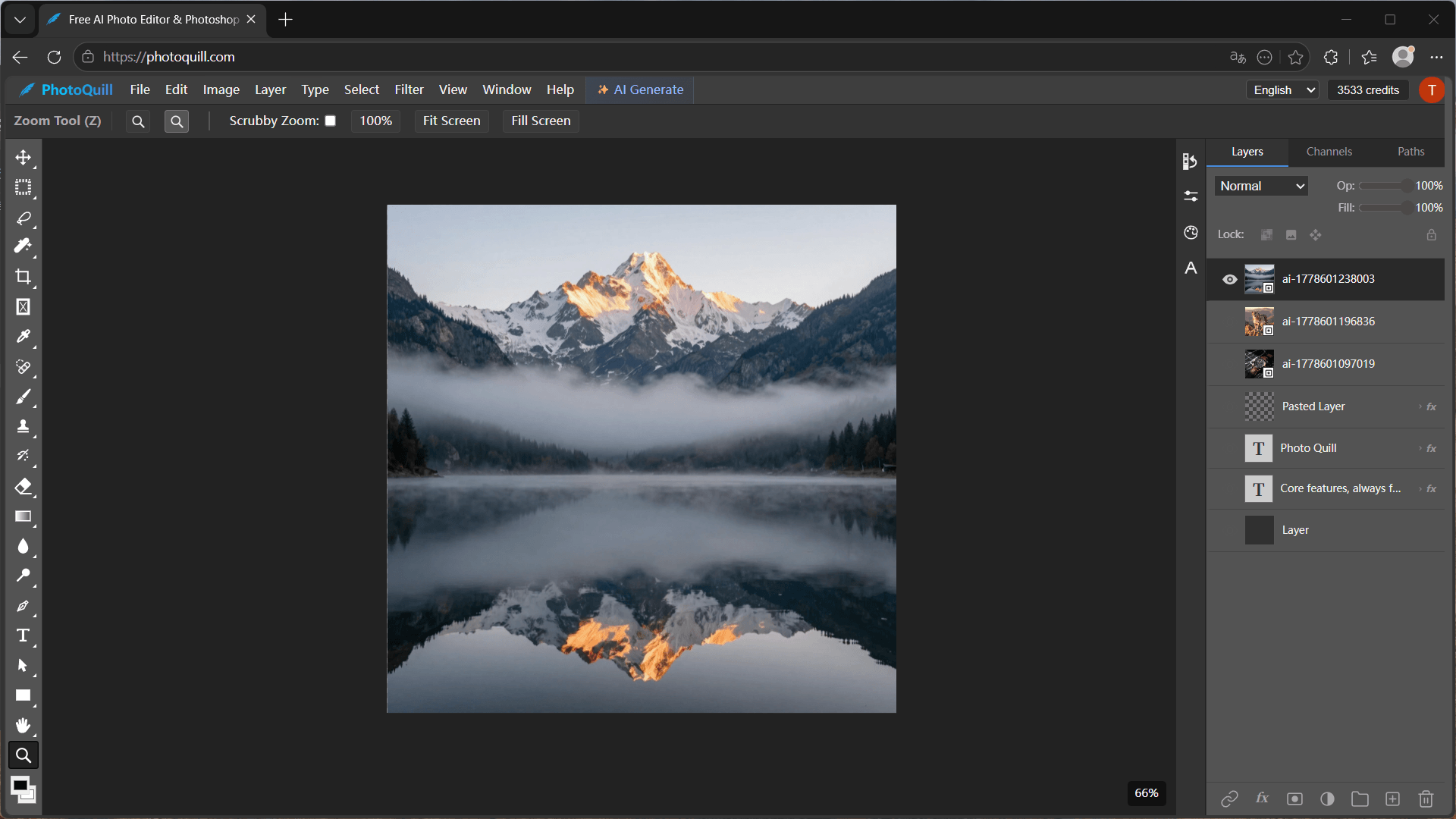
Image source: PhotoQuill
A Multi-Model Strategy to Get Professional Results from Free Tools
You don't have to rely on a single tool to get professional-grade results. By "stacking" different unrestricted models, you can leverage the strengths of each platform. This workflow is a significant advancement over using a single filtered tool.
- Generation in Raphael AI: Start by using Raphael AI's "Basic Mode" to generate dozens of initial concepts. Since this mode is unlimited, you can refine your prompt until the composition is exactly what you envisioned.
- Refinement in Senzia: Once you have a base image, upload it to Senzia. Use their prompt-based editing to change specific elements—such as adjusting the lighting, changing the subject's clothing, or swapping the background—without the need for manual masking.
- Final Polish in EzCreate: Take your edited image to EzCreate and utilize their 4K upscaler. This step adds the necessary pixel density and sharpness to make the image look like a professional photograph or digital painting rather than an AI-generated draft.
Tips for Writing Prompts That Bypass Hidden AI Biases
Even in unrestricted tools, the underlying models (like Stable Diffusion or Flux) have inherent biases based on their training data. To get the most out of these editors, you must learn to communicate effectively with the AI. The Iterative Conversation Method is a top-rated technique where you layer instructions rather than writing one long, complex prompt.
When describing lighting and anatomy, use technical terms. Instead of saying "good lighting," try "cinematic rim lighting, 8k octane render, volumetric fog." For anatomy, using terms like "anatomically correct" or "highly detailed skin texture" helps the model focus on realism rather than the smoothed-out, plastic look common in filtered AI. According to Senzia's prompt guide , avoiding slang and using descriptive, technical language results in much higher detail in unrestricted generations.
- Skin: "visible pores, fine wrinkles, subsurface scattering, realistic skin blemishes."
- Lighting: "golden hour, harsh shadows, ray tracing, soft global illumination."
- Camera: "shot on 35mm lens, f/1.8, deep depth of field, film grain."
Understanding the Legal and Copyright Status of Unrestricted AI Images
The legal landscape for AI-generated content is complex. While most unrestricted tools, such as ZenCreator , explicitly grant you "ownership" of the output in their Terms of Service, this does not necessarily equate to copyright protection. As of 2026, the US Copyright Office maintains that works created solely by AI without significant human intervention cannot be copyrighted.
However, if you use an unrestricted editor to perform heavy manual edits, compositing, or "inpainting" on an original work, you may be able to claim copyright on the final product. For professional creators, it is essential to distinguish between commercial use rights (which these tools provide) and copyright protection (which is a legal gray area). Always check the specific TOS of the tool you are using to ensure your intended commercial application is permitted.
Frequently Asked Questions
Is there a truly free AI photo editor with no usage limits?
While most cloud tools use a credit system, Raphael AI offers a "Basic Mode" that allows for unlimited generations. The trade-off is usually slower processing speeds or a lower priority in the queue compared to paid users. For a completely limit-free experience, running a local install of Stable Diffusion is the only way to avoid usage caps entirely.
What is the best AI photo editor for uncensored image-to-image editing?
Viyou and Senzia are widely considered among the top choices for image-to-image tasks. They allow you to upload a photo and apply radical changes without the safety filters that often blur or distort sensitive content. These tools are particularly effective for style transfers and character consistency in artistic projects.
Are unrestricted AI editors safe to use for private photos?
Safety depends on the tool's privacy policy. Platforms like NanoImage and EzCreate emphasize privacy by using auto-deletion protocols, where images are wiped from their servers shortly after the session ends. However, for absolute privacy, a local installation is the most secure method, as your data never leaves your computer.
Can I remove watermarks for free on these platforms?
Yes, many unrestricted tools like EzCreate and Senzia provide 100% watermark-free downloads even for guest users. Some tools, like Raphael AI, may include a small watermark on their free "Basic Mode" outputs, which can be removed by upgrading or using a separate AI object removal tool.
Do I need a powerful computer to use these tools?
For web-based tools like ZenCreator or EzCreate, you only need a standard internet browser; the heavy processing is done on their server clusters. You only need a powerful computer (specifically an NVIDIA GPU with 8GB+ VRAM) if you intend to run an unrestricted AI editor locally on your own hardware.
Final Thoughts on the Future of Unrestricted AI
The demand for unrestricted AI photo editors reflects a broader desire for creative autonomy and digital privacy. As mainstream tools become more restricted, these platforms provide a vital outlet for artists and creators.
- Unrestricted tools offer freedom from both content censorship and sign-up friction.
- Privacy is best maintained through no-sign-up web tools or local hardware setups.
- Stacking different tools (Generation → Editing → Upscaling) yields the most professional results for free.
- Local hosting with Stable Diffusion is the most advanced way to achieve total creative control.
- Technical prompting is essential to bypass the inherent biases of AI models.
- Legal ownership does not always equal copyright, so use AI outputs carefully in commercial contexts.
Start by testing a no-sign-up tool like EzCreate to see how unrestricted AI can enhance your creative workflow today.















