Home
Home
Why AI Secretaries Are Finally Replacing Manual Admin in 2025

The administrative burden has long been the silent killer of professional productivity. For decades, executives, entrepreneurs, and freelancers have spent upward of 20% of their working hours on low-value tasks: triaging overflowing inboxes, playing "calendar ping-pong" to schedule a single 30-minute call, and manually syncing data across disparate software platforms. While the dream of a personal assistant was once reserved for those with corporate expense accounts, the emergence of the AI secretary in 2025 has democratized executive-level support.
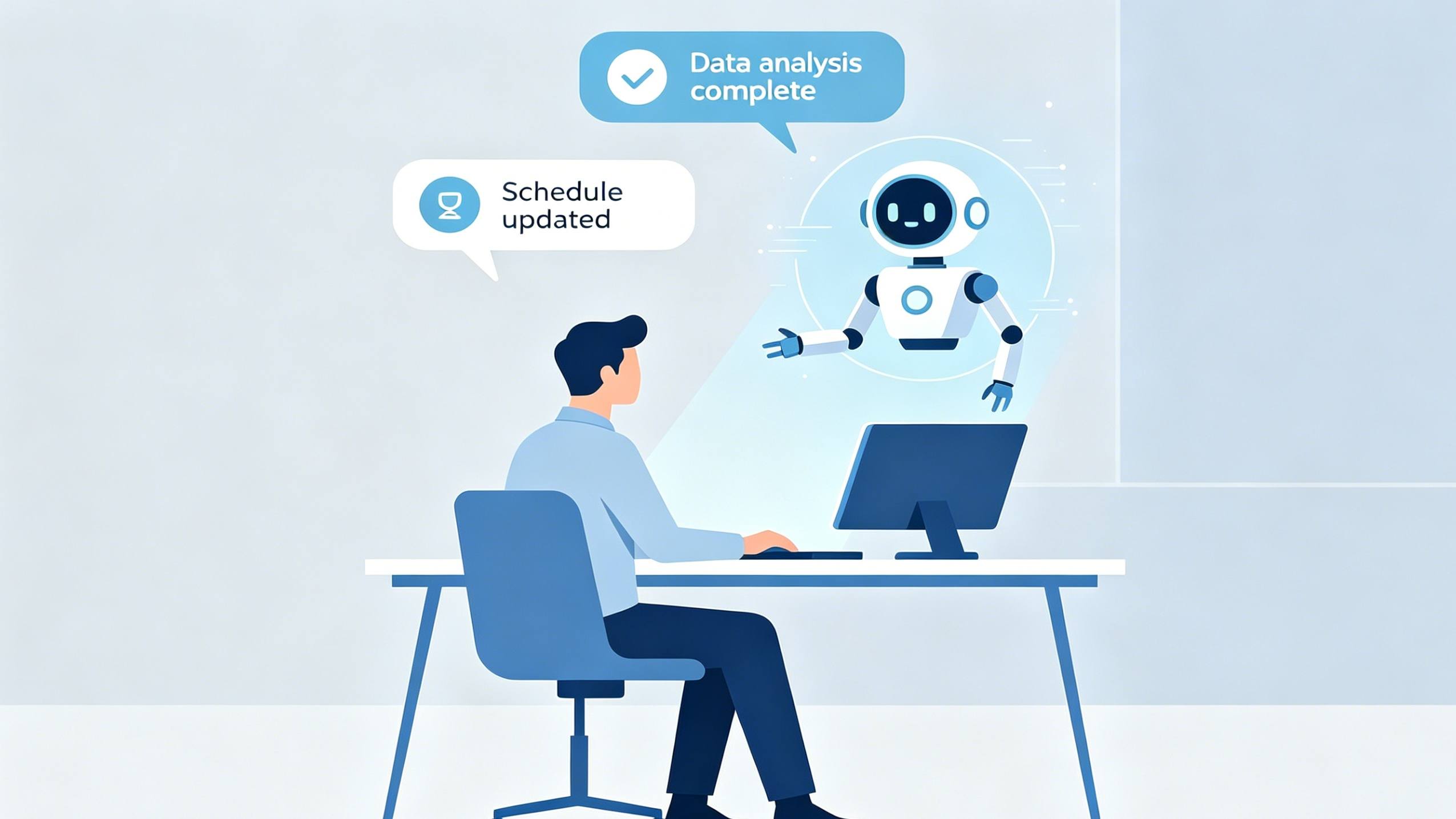
An AI secretary is an autonomous digital agent designed to execute the repetitive, multi-step administrative workflows typically handled by a human assistant. Unlike standard chatbots that require a prompt for every action, these modern agents possess the capability to observe, learn, and act proactively across an individual’s entire digital ecosystem—connecting emails, calendars, CRMs, and project management tools into a unified, self-managing engine.
Defining the AI Secretary: More Than Just a Chatbot
To understand the current landscape, it is essential to distinguish between the different tiers of digital assistance that have emerged over the last few years. The term "AI secretary" is often used loosely, but in a professional context, it refers to a specific level of autonomy and integration.
The Evolution from Conversational AI to Autonomous Agents
The first wave of AI tools, like the early versions of ChatGPT or Claude, were primarily conversational. They could draft an email or summarize a document if asked, but they lacked "hands." They could not see your inbox in real-time or move a meeting on your calendar without manual intervention.
The second wave consisted of single-purpose automation tools. These apps focused on one specific pain point, such as Reclaim.ai for calendar blocking or Otter.ai for meeting transcription. While powerful, they created "automation silos"—you still had to be the human bridge connecting the meeting transcript to the task list and the follow-up email.
In 2025, the true AI secretary operates as an autonomous agent. These systems utilize advanced Large Language Models (LLMs) equipped with "tool-use" capabilities. They don't just talk; they act. By securing OAuth permissions to your professional suite (Google Workspace, Microsoft 365, Slack, Salesforce), they can navigate between apps to complete end-to-end tasks. For example, an AI secretary can attend a Zoom call, identify a commitment to send a proposal, check your calendar for the deadline, draft the proposal in Google Docs, and send it via Gmail—all without being prompted for each individual step.
Key Capabilities of Modern AI Administrative Agents
The value of an AI secretary lies in its ability to handle the "connective tissue" of administrative work. The following core capabilities represent the current state of the art in AI-driven support.
1. Intelligent Communication and Inbox Triage
For most professionals, the inbox is a source of constant anxiety. A modern AI secretary treats the inbox not just as a repository of messages, but as a task queue to be managed.
- Automated Labeling and Prioritization: Beyond simple spam filters, these agents use semantic understanding to categorize emails into "Urgent Action Required," "Informational," and "Low Priority." In practical testing, high-end agents like Lindy or Agensio have demonstrated the ability to identify VIP clients and escalate their requests while archiving newsletters and internal CC-heavy threads that don't require immediate attention.
- Context-Aware Drafting: The AI learns your specific professional tone by analyzing your last 200 to 500 sent messages. When a routine request arrives—such as a request for a quote or a meeting—the agent drafts a reply that sounds indistinguishable from your own writing. These drafts are held in a review folder, allowing for a "human-in-the-loop" check that takes seconds rather than minutes of composition.
- Follow-up Management: One of the most common administrative failures is the "lost follow-up." An AI secretary tracks sent messages and, if no reply is received within a specified window (e.g., three business days), it automatically drafts a polite nudge.
2. Autonomous Scheduling and Calendar Coordination
Scheduling is perhaps the most visible area where AI secretaries outshine traditional software. The "calendar ping-pong"—exchanging five emails to find one hour of mutual availability—is effectively solved.
- Natural Language Coordination: Instead of sending a static booking link, which can sometimes feel impersonal, you can CC your AI secretary (e.g., "AI, please find a time for me and Sarah to meet next week"). The agent then interacts with the other party, checking your real-time availability, protecting your "Deep Work" focus blocks, and negotiating a time that works for everyone.
- Conflict Resolution: If a high-priority meeting is requested during a time occupied by a low-priority internal sync, the AI can proactively suggest rescheduling the internal meeting, handling the communication with both parties to ensure the most important work takes precedence.
3. Comprehensive Meeting Support
The role of a secretary during a meeting is to ensure that the discussion translates into action. AI agents have transformed this from a manual note-taking exercise into a structured data operation.
- Transcription and Summarization: Agents join meetings as silent participants across Zoom, Teams, and Google Meet. They provide high-fidelity transcripts and, more importantly, structured summaries that highlight key decisions, sentiment, and specific action items.
- Task Extraction: Once a meeting concludes, the AI doesn't just store the notes. It extracts the action items and pushes them into your task management software (like Notion, Asana, or Jira). If you promised to send a file to a participant, the agent will have the draft email ready with the file attached by the time you leave the call.
4. Cross-Platform Workflow Automation
The most advanced capability is the ability to operate as a "glue" between different software platforms. This is where the AI acts as a true agent, performing tasks that previously required a human to copy-paste data.
- CRM Updates: After a sales call, the AI can automatically update the lead status in Salesforce or Hubspot based on the transcript, adding notes about the prospect's pain points and budget.
- Invoice and Expense Tracking: By monitoring both email and financial tools like Stripe or Quickbooks, an AI secretary can flag unpaid invoices and send automated reminders, a task that often falls through the cracks in small businesses.
Real-World Scenarios: How AI Secretaries Transform the Workday
To understand the impact of these tools, let’s look at how a typical day changes when an autonomous agent is handling the administrative layer.
The 8:00 AM Morning Briefing
Without an AI secretary, your morning likely starts with 20 minutes of scrolling through emails and Slack messages to figure out what is urgent. With an AI secretary, you receive a single, concise briefing—via email, Slack, or even SMS—at a set time.
- Example Briefing: "Good morning. You have three meetings today. The 2:00 PM with the marketing team currently has no agenda; I have sent a request to the organizer for one. You received 42 emails overnight; I have drafted replies for 8 routine inquiries and flagged 2 urgent messages from the legal team that require your review. Your invoice to Project X is 4 days overdue; shall I send the automated reminder?"
This briefing shifts your mental state from reactive (searching for what to do) to executive (making decisions on prepared options).
The Focus Block Protection
One of the most significant challenges for knowledge workers is maintaining "Flow State." Traditional notifications are the enemy of focus. An AI secretary acts as a gatekeeper. By setting "Focus Modes," you can instruct the AI to hold all non-emergency communications. If a VIP client calls or emails, the AI can use a pre-defined logic to determine if the interruption is warranted, otherwise providing the client with a professional "out of office" message that includes an estimated time for a personal reply.
Choosing the Right AI Secretary Tool for Your Workflow
The market in 2025 is diverse, with tools catering to different technical needs and budget constraints. Below is a comparative analysis of the leading solutions based on recent industry performance.
| Tool | Best For | Key Strength | Integration Depth |
|---|---|---|---|
| Lindy | All-in-one autonomous work | iMessage/SMS integration; cross-tool workflows | Extremely High (1,000+ apps) |
| Gemini (Workspace) | Google Power Users | Native integration with Docs, Sheets, and Gmail | High (Google Ecosystem) |
| Motion | Task & Calendar Management | Algorithm-based auto-scheduling of daily tasks | Medium (Calendar/Tasks) |
| Agensio | SMBs & Freelancers | Affordable, 24/7 inbox and appointment management | Medium (Email/Calendar) |
| Reclaim.ai | Focus & Habit Protection | Protecting time for deep work and personal habits | Medium (Google/Outlook) |
Lindy: The Full Autonomous Experience
Lindy represents the "Agentic" side of the spectrum. It is designed for professionals who want to delegate the entire administrative layer. Its standout feature is the ability to interact with it via SMS or iMessage. You can text your assistant, "Check if I can meet Bob on Friday for lunch," and it will handle the calendar check and the reply to Bob. This reduces the friction of administrative work to a simple conversation.
Gemini and Microsoft 365 Copilot: The Ecosystem Giants
For those whose work lives entirely within a single ecosystem, the native AI secretaries (Gemini for Google, Copilot for Microsoft) offer the best "contextual awareness." Because they live inside the apps where you create documents and spreadsheets, they are superior at summarizing long internal threads and generating drafts based on existing company data. However, they can sometimes struggle with "out-of-ecosystem" tasks, such as updating a 3rd-party CRM that isn't part of their direct parent company.
Motion and Reclaim: The Time Architects
These tools focus less on communication and more on the geometry of your day. Motion, for example, uses an AI engine to constantly rearrange your to-do list based on deadlines and meeting changes. If a meeting runs over, Motion automatically shifts your remaining tasks for the day, ensuring you always know what to work on next without having to manually rebuild your schedule.
The Economics of AI: Comparing AI Secretaries to Human Assistants
The decision to hire an AI secretary is often driven by the dramatic difference in Return on Investment (ROI).
- Human Executive Assistant (EA): In most major markets, a full-time, experienced EA costs between $50,000 and $80,000 per year, plus benefits. Even a part-time virtual assistant (VA) often costs $500 to $1,500 per month for limited hours.
- AI Secretary: Modern autonomous platforms range from $20 to $200 per month.
For the cost of a single human assistant, a firm can deploy AI secretaries to an entire department. While the AI cannot yet run physical errands or handle complex emotional nuances in high-stakes negotiations, it can handle 80% of the routine administrative load that consumes an EA's time. This allows human assistants, where they are still employed, to shift their focus toward higher-value strategic support, project management, and relationship building.
Security, Privacy, and the Human-in-the-Loop Model
As we grant AI agents access to our most sensitive data—emails, financial records, and private calendars—security becomes the paramount concern.
Data Privacy Standards
Reputable AI secretary providers in 2025 have adopted rigorous security protocols:
- SOC 2 Type II Certification: Ensuring the provider handles data securely and protects privacy.
- GDPR/CCPA Compliance: Critical for users in Europe and California, ensuring that data is stored responsibly (often with options for data to remain in specific geographic regions, such as France for Agensio).
- OAuth Security: Professional AI agents use OAuth tokens rather than storing your passwords. This means you can revoke the agent's access to your email or calendar at any time through your Google or Microsoft account settings.
The Necessity of Oversight
Despite their autonomy, AI secretaries are not infallible. They can occasionally misinterpret a nuanced email or fail to recognize a subtle conflict in a schedule. The "Human-in-the-Loop" (HITL) model is the industry standard for professional use.
In this model, the AI performs the heavy lifting—searching, drafting, and organizing—but the human provides the final approval for external-facing actions. For example, the AI drafts the email, but the human clicks "Send." As the AI learns from your edits over time, the need for intervention decreases, but the safety net remains.
How to Onboard Your First AI Secretary: A Step-by-Step Strategy
Transitioning to an AI-managed workflow should be done incrementally. Here is the recommended path for a successful deployment.
Step 1: Identify the "Admin Leak"
Track your time for three days. Identify which administrative tasks are most disruptive. Is it the constant checking of email? The frustration of scheduling? Or the manual entry of data into a CRM? Choose a tool that excels in your specific "leak" area.
Step 2: Grant Focused Permissions
Start by connecting only the most necessary apps. For most, this is Gmail and Google Calendar. Allow the AI to operate in "Draft Only" or "Read-Only" mode for the first week. Observe its summaries and drafts to ensure it understands your context and tone.
Step 3: Brief the AI Like a New Hire
Modern agents respond to plain English instructions. Don't just turn it on; tell it how you work.
- Instruction: "I never take meetings before 10:00 AM. If an email comes from my accountant, summarize the attached PDF and send me a Slack notification immediately. For all other inquiries, draft a reply and leave it in my drafts folder."
Step 4: Expand the Ecosystem
Once you trust the AI with your email and calendar, connect your other tools. Connect Slack for notifications, Notion for task management, and Zapier or Make for complex custom integrations.
The Future of Administrative Work: Multi-Agent Systems
Looking toward the end of 2025 and into 2026, the trend is moving toward "Multi-Agent Orchestration." In this scenario, your personal AI secretary will not work in isolation. Instead, it will communicate directly with the AI secretaries of your colleagues and clients.
When you want to organize a 10-person department meeting, your AI secretary will "talk" to the nine other agents. Within seconds, they will collectively identify the optimal time, book the room, and distribute the agenda, all without a single human-to-human email being sent. This "Agent-to-Agent" (A2A) economy is set to be the next major leap in corporate efficiency.
Summary: The Final Shift in Productivity
The AI secretary represents the final stage of the digital transformation of the office. We have moved from paper to digital files, from mail to email, and now, from manual management to autonomous agency. By delegating the administrative "busy work" to AI, professionals are finally able to reclaim their most valuable asset: their time. Whether you are a solo consultant looking to appear more professional or a CEO looking to scale your impact, an AI secretary is no longer a luxury—it is a competitive necessity.
Frequently Asked Questions (FAQ)
What is the difference between an AI Secretary and a Virtual Assistant?
A Virtual Assistant (VA) is a human who works remotely to handle tasks. An AI Secretary is software that uses artificial intelligence to perform similar tasks. AI Secretaries are significantly cheaper, available 24/7, and can process data instantly, but they lack the complex emotional intelligence and physical execution capabilities of a human VA.
Is an AI Secretary safe to use with sensitive business emails?
Yes, provided you choose a reputable service that is SOC 2 and GDPR compliant. These tools use encrypted OAuth connections, meaning they do not know your passwords. However, it is always recommended to keep "Human-in-the-Loop" settings active for sensitive documents or high-stakes financial communications.
Can an AI Secretary manage my personal life too?
Many AI secretaries can sync with both professional and personal calendars (e.g., Google Calendar and Outlook). They can help schedule doctor appointments, reminders for family events, and personal travel bookings, acting as a holistic life assistant.
How long does it take to train an AI Secretary?
Most modern AI agents can learn your tone and preferences within a few days by analyzing your past communications. The initial setup takes about 10-15 minutes, and the accuracy typically reaches professional standards within the first week of "Human-in-the-Loop" feedback.
Does an AI Secretary work on mobile devices?
Most leading AI secretaries, such as Lindy, offer mobile-optimized web apps or direct integration with messaging services like iMessage, Slack, or Telegram, allowing you to manage your admin via voice or text while on the go.
-
Topic: AI Virtual Assistant: Email, Calendar & Scheduling for SMBshttps://agensio.ai/en/agent-secretaire/
-
Topic: 10 AI Secretary Tools Tested in 2026: The Ones Worth Using | Lindyhttps://www.lindy.ai/blog/ai-secretary
-
Topic: AI Secretary in 2026: The Admin Hire You Can Actually Afford | Lookatmy.aihttps://lookatmy.ai/blog/ai-secretary