Home
Best AI Tools for Customer Service in 2026 Ranked by ROI
Zendesk AI (Memory-Rich Agents)
Intercom Fin ($0.99/Resolution)
Retell AI (Sub-500ms Latency)
Gorgias (Deep Shopify Integration)
As of late 2026, the market has shifted from simple chatbots to autonomous AI agents . The most effective tools now prioritize Autonomous Resolution Rate over simple deflection, with leading platforms achieving over 80% resolution for common queries.
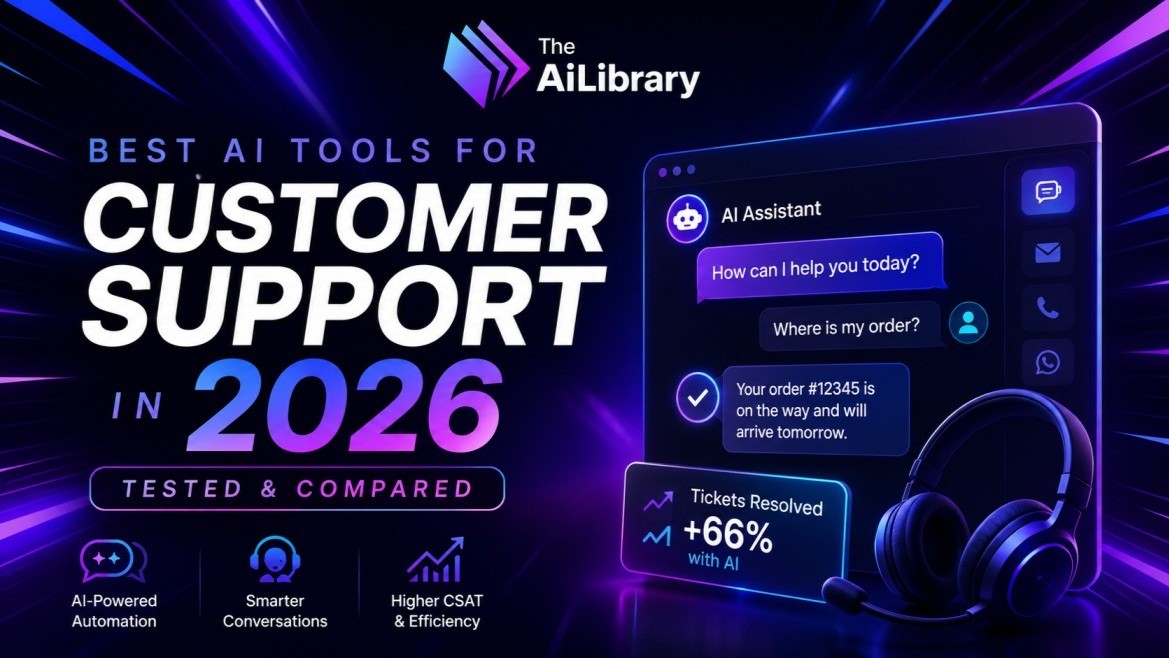
Image source: LinkedIn
How Customer Service AI Evolved from Chatbots to Autonomous Agents
The landscape of customer support has undergone a significant advancement in the last two years. In early 2024, most businesses relied on "deflection-based" chatbots—tools designed to steer customers toward FAQ pages to avoid human interaction. However, as we move through 2026, the industry has embraced the "Agentic Shift."
According to research from Retell AI , the distinction between a chatbot and an AI agent lies in action. While a chatbot might tell you how to process a refund, an autonomous agent actually logs into the CRM, verifies the transaction, and issues the refund without human intervention. This transition has redefined success metrics. "Deflection" is now often viewed as a negative metric if it results in a poor customer experience; instead, Autonomous Resolution Rate has become the gold standard for ROI.
Chatbots primarily served as interactive search bars. Only about 14% of queries were fully resolved through self-service models, leaving a massive "Resolution Gap."
Retrieval-Augmented Generation (RAG) allowed AI to access specific company knowledge bases, significantly reducing hallucinations and improving accuracy.
AI agents now handle 80% of common issues autonomously. They are integrated into back-office systems, allowing for real-time task execution across voice and text.
Gartner predictions from earlier in the decade suggested that by 2026, AI would handle the vast majority of routine interactions. Today, that reality is reflected in the operational costs of top-performing support teams, which have seen up to a 30% reduction in overhead by deploying these notably innovative agents.
Top AI Tools for Enterprise Scale and Complex Workflows
For large-scale organizations, the challenge isn't just answering questions—it's managing complexity across thousands of products and millions of customers. The tools in this category stand out for their ability to integrate with legacy systems and maintain "memory" across long customer journeys.
Zendesk AI
Zendesk remains a top-tier choice for enterprise teams due to its "memory-rich" agents. Unlike basic bots that treat every interaction as a fresh start, Zendesk AI leverages historical data to provide personalized support. According to Zendesk CX Trends , 85% of leaders now prioritize these memory-rich agents to ensure customers don't have to repeat themselves.
Ada
Ada has carved out a niche as a leading option for high-stakes B2B environments. Its platform is designed to handle complex, multi-step workflows that require grounding in deep enterprise knowledge bases. Ada’s strength lies in its reasoning capabilities, allowing it to navigate technical troubleshooting that would typically require a Tier 2 human agent.
Automation Anywhere
While not a traditional helpdesk, Automation Anywhere is a significant step forward for companies needing to connect AI agents to legacy back-office systems. By using robotic process automation (RPA) alongside generative AI, it enables agents to execute tasks in software that lacks modern APIs. This is a top choice for industries like banking and insurance where "old" tech still rules the basement.
Best AI Agents for Ecommerce and High-Volume Retail
Retail support is defined by speed and high volume. Customers in 2026 expect instant updates on shipping, easy returns, and personalized discount codes. The following tools are widely considered among the strongest for retail environments.
Gorgias
Gorgias is a top-rated choice for Shopify and BigCommerce brands. Its AI agents are natively built into the ecommerce stack, meaning they can see a customer's entire order history the moment a chat starts. This allows for "one-click" resolutions for common retail headaches like tracking lost packages or updating shipping addresses.
Yuma.ai
Yuma.ai specializes in LLMs tailored for high-growth Shopify brands. It focuses on maintaining the brand's "voice," ensuring that even autonomous interactions feel consistent with the company's marketing tone. For brands scaling quickly, Yuma offers a way to maintain high CSAT without linearly increasing headcount.
Tidio
Tidio stands out for its ease of setup, often described as "live in hours." For smaller retail teams that don't have weeks of engineering time to spare, Tidio provides a highly effective entry point into AI-driven support. It offers a balance of automated flows and human handoff that is exceptionally strong for mid-market retail.
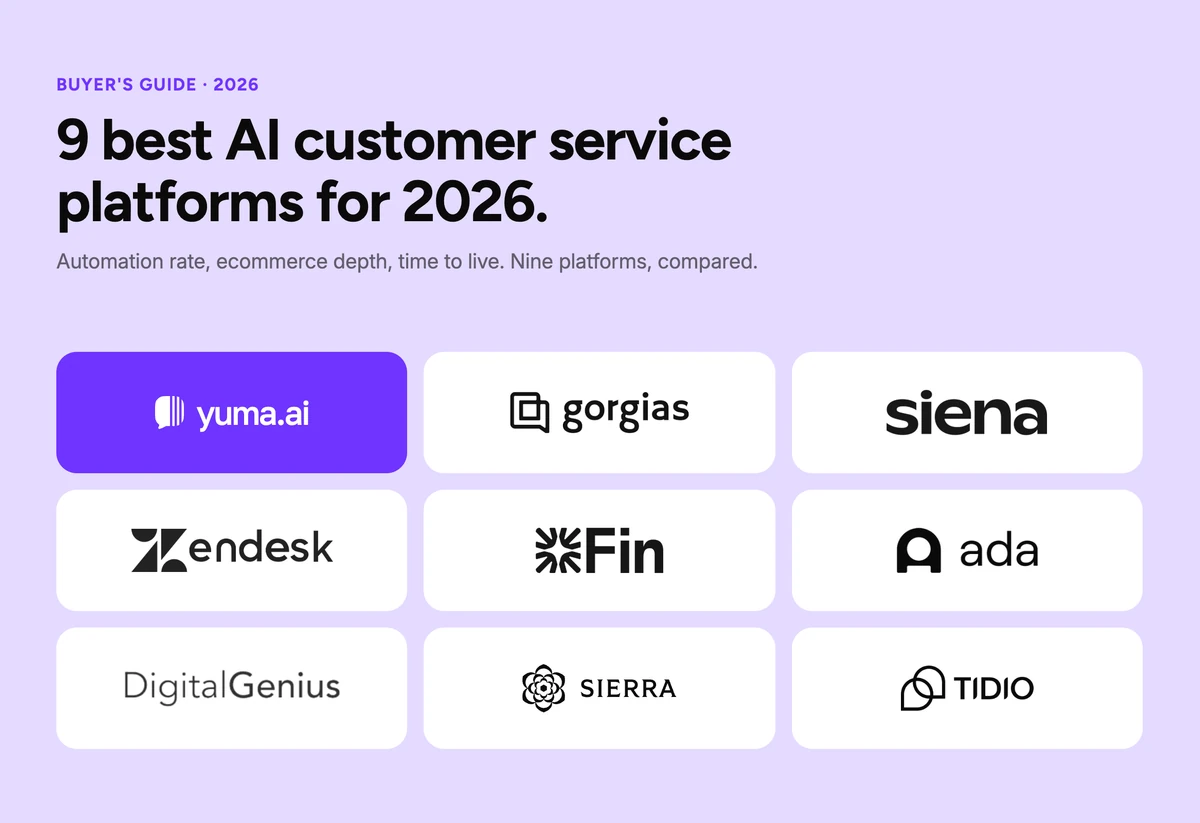
Image source: Yuma AI
Leading Voice AI Tools for Natural Phone Interactions
Voice AI has seen a major improvement in 2026. The "uncanny valley" of robotic phone menus has been replaced by natural, fluid conversation. The key metric here is latency —the delay between a human speaking and the AI responding.
Retell AI
Retell AI is a top contender in the voice space, offering sub-second latency (often under 500ms). This speed is critical for natural turn-taking; if an AI takes two seconds to respond, the human will likely start talking again, creating a frustrating loop. Retell’s ability to handle interruptions and complex emotional cues makes it a top-tier option for phone-based support.
Sprinklr
Sprinklr offers a remarkably strong omnichannel approach. It treats voice as just another data stream, allowing a customer to start a conversation on the phone and move it to WhatsApp without losing context. For global brands, Sprinklr’s multi-language voice capabilities are among the most capable in the market.
| Tool Name | Primary Use Case | Pricing Model | Key Strength |
|---|---|---|---|
| Zendesk AI | Enterprise Helpdesk | Per-Seat ($19+) | Memory-rich customer journeys |
| Intercom Fin | SaaS / Tech Support | Per-Resolution ($0.99) | Predictable ROI on volume |
| Retell AI | Voice / Phone Support | Usage-based (Minutely) | Sub-500ms latency |
| Gorgias | Ecommerce / Retail | Tiered / Ticket-based | Native Shopify integration |
| Botpress | Developer / Custom | Open-core / Usage | Multi-LLM orchestration |
Why Intercom Fin and Botpress Are Changing the SaaS Support Stack
Software-as-a-Service (SaaS) companies have unique needs: technical accuracy is paramount, and users are often highly tech-savvy. Two tools have emerged as top choices for this sector by offering flexibility and innovative pricing.
Intercom (Fin)
Intercom's Fin agent has popularized the Pay-Per-Resolution model. Instead of paying for a seat that might sit idle, companies pay $0.99 only when Fin successfully resolves a customer's problem. This model has been a major improvement for SaaS budgets, as it aligns the vendor's incentives with the customer's success. If the AI doesn't solve the problem, the company doesn't pay.
Botpress
Botpress is widely regarded as one of the strongest platforms for teams that want to avoid vendor lock-in. It allows for Multi-LLM Orchestration , meaning you can use OpenAI’s GPT-5 for complex reasoning and a smaller, cheaper model like Llama 3 for simple routing. According to Botpress research , this flexibility can reduce token costs by up to 40% while maintaining high accuracy.
How to Calculate Your Break-Even Point with Pay-Per-Resolution Pricing
The shift from "Per Seat" to "Per Resolution" billing is one of the most significant advancements in CX procurement. However, it requires a different approach to budgeting. A human agent typically costs between $4.00 and $8.00 per ticket when accounting for salary, benefits, and overhead.
- Fixed monthly cost
- Best for low-volume, high-complexity
- Predictable budget
- Risk of underutilization
- Variable cost based on success
- Best for high-volume, routine tasks
- Direct ROI correlation
- Costs can spike with volume
To find your break-even point, use this formula:
(Human Cost Per Ticket - AI Cost Per Resolution) * Monthly Volume = Monthly Savings
. For a mid-sized company handling 5,000 tickets a month, switching to a $0.99 resolution model can save upwards of $20,000 monthly, provided the AI maintains a resolution rate above 70%.
Why Multi-LLM Orchestration Is the Secret to Lowering Support Costs
In 2026, relying on a single AI model is increasingly seen as a risk. The "Cheap vs. Smart" strategy involves using a hierarchy of models to handle different parts of a conversation.
For example, a "cheap" model (like GPT-4o mini or a fine-tuned small language model) can handle the initial triage: identifying the customer's intent and language. If the query is simple ("Where is my order?"), the cheap model handles it. If the query requires technical troubleshooting, the system "escalates" the prompt to a "smart" model (like Claude 4 or GPT-5). This orchestration ensures you aren't spending premium tokens on basic greetings.
Furthermore, Retrieval-Augmented Generation (RAG) is used to ground these models in your specific data. By feeding the AI only the relevant snippets of your documentation, you significantly reduce the risk of "hallucinations"—where the AI invents policies or features that don't exist.
The Human-in-the-Loop Workflow That Actually Works
Despite the power of AI, human agents remain essential for high-emotion or high-value interactions. The most effective tools in 2026 focus on the handoff experience .
When an AI agent realizes it cannot solve a problem, it shouldn't just dump the customer into a queue. Tools like Botpress and Zendesk now provide Conversation Summaries . When a human agent picks up the ticket, they see a three-sentence summary of what has already happened. This prevents the "empathy-efficiency paradox," where customers become frustrated by having to repeat their story to a human after failing with an AI.
Interestingly, research from Yuma.ai suggests that when AI handles the repetitive drudgery, human agents have more "emotional bandwidth." This leads to higher CSAT scores because the humans are less burnt out and can provide more genuine empathy during complex cases.
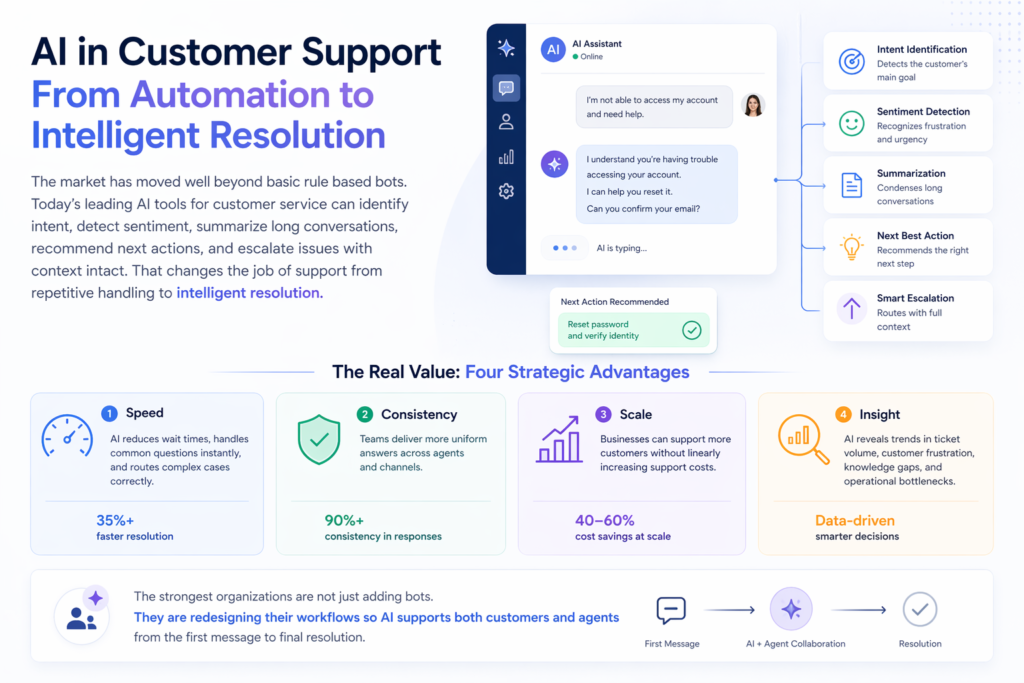
Image source: VoiceDash
Common Pitfalls to Avoid When Deploying AI Agents
While the benefits are clear, many companies stumble during implementation. One of the most common traps is the "Deflection Loop." This happens when an AI is programmed to never admit defeat, leading it to repeatedly send a customer back to the same unhelpful FAQ page.
Another risk is Vendor Lock-in . If you build your entire support logic inside a proprietary platform that doesn't allow you to switch LLMs, you may find yourself stuck with rising costs or stagnating technology. Finally, Over-Automation can damage a brand. Identifying the 20% of cases—such as bereavement, high-value churn risks, or complex technical failures—that should never go to an AI is a hallmark of a mature 2026 support strategy.
Key Takeaways for Your 2026 AI Strategy
- Prioritize Resolution Rate: Move away from deflection metrics and focus on tools that actually execute tasks in your CRM.
- Evaluate Pay-Per-Resolution: For high-volume SaaS and retail, outcome-based pricing often offers a more direct ROI than per-seat models.
- Implement Multi-LLM Orchestration: Use a mix of "cheap" and "smart" models to balance cost with technical accuracy.
- Focus on the Handoff: Ensure your AI provides concise summaries to human agents to maintain customer empathy.
- Ground Your AI with RAG: Use Retrieval-Augmented Generation to prevent hallucinations and keep answers rooted in your documentation.
- Benchmark Voice Latency: If using phone support, ensure your provider offers sub-500ms response times to avoid robotic interactions.
To begin, audit your top 10 most common support tickets and identify which can be fully automated by an agent with CRM access.
Frequently Asked Questions