Home
How Much Does Google Gemini Cost for Personal and Business Productivity?
As of late 2026, Google Gemini pricing is divided into two main tracks: Personal AI and Workspace Business . The entry-level AI Plus plan starts at $4.99/mo, while the AI Pro plan for solopreneurs costs $19.99/mo. For businesses, the Business Standard tier is priced at $14/user/mo, offering deep integration across Docs, Sheets, and Meet. High-compute users can opt for AI Ultra starting at $99.99/mo, which includes the new Gemini Spark autonomous agent.
What Are the Current Google Gemini Pricing Tiers?
Navigating Google's AI ecosystem in 2026 requires understanding the transition from legacy storage-only plans to integrated AI productivity environments. Google has effectively merged its cloud storage benefits with model access, creating a tiered system that scales based on "Usage Multipliers" and model complexity. Whether you are a casual user looking for a smarter Gmail experience or a developer building agentic workflows, the current structure aims to provide a clear path for scaling.
The primary shift in 2026 has been the introduction of the Gemini 4 Argon and 3.6 Flash models across different tiers. According to Google's recent subscription updates , the focus has moved from simple chat interfaces to "agentic productivity," where the AI performs tasks autonomously in the background.
| Plan Tier | Monthly Cost | Core Model | Primary Productivity Hook |
|---|---|---|---|
| Free | $0 | Flash-Lite | Basic chat & 15GB Storage |
| AI Plus | $4.99 | 3.6 Flash | Gemini in Gmail & 400GB Storage |
| AI Pro | $19.99 | 4 Argon | Full Docs/Sheets Integration + 5TB |
| AI Ultra | $99.99+ | 4 Argon (High-Limit) | Gemini Spark Autonomous Agents |
| Business Standard | $14/user | 4 Argon | Pooled Team Storage & Custom Domains |
How Much Do Personal Google Gemini Plans Cost?
For individual users, Google One has evolved into a comprehensive AI hub. The pricing is designed to compete directly with other frontier model subscriptions while offering significantly more storage value. As of October 2026, the personal tiers are structured to reward long-term users with "Cloud Credits" that can be applied toward API usage or high-compute tasks.
The Free Tier and Gemini Flash-Lite
The entry point remains accessible at no cost. The Free tier utilizes the Gemini Flash-Lite model, which is optimized for speed and low-latency responses. While it lacks the deep reasoning capabilities of the Argon models, it stands out as a top choice for basic drafting, summarizing short emails, and simple image generation. Users receive the standard 15GB of shared storage across Google Photos, Drive, and Gmail. According to official Gemini subscription data , this tier is intended for casual users who do not require AI integration directly inside their productivity documents.
AI Plus for Light Users
At $4.99/mo, the AI Plus plan is a significant advancement for those who have outgrown the free storage limit but aren't ready for a $20/mo commitment. This plan includes 400GB of storage and introduces the 2x Usage Multiplier . This means users can send twice as many prompts to the 3.6 Flash model compared to free users before experiencing rate limiting. A key productivity feature here is the inclusion of Gemini in the Gmail side panel and the basic version of Google Vids, allowing for quick video storyboarding.
AI Pro for Power Users and Solopreneurs
The AI Pro tier, priced at $19.99/mo, is widely considered one of the best values for independent professionals. It grants access to the flagship Gemini 4 Argon model and provides a 4x Usage Multiplier . Beyond the 5TB of storage, the real value lies in the full integration of Gemini within Google Docs, Sheets, and Slides. This allows for real-time data analysis in spreadsheets and automated drafting in Docs. Additionally, subscribers receive $10/mo in Google Cloud credits, which can be used for personal development projects or exploring the Google Flow environment.
AI Ultra for Enterprise-Level Individuals
For those requiring high-compute capabilities, the AI Ultra plans scale from $99.99/mo (20TB) to $199.99/mo (30TB). These plans are designed for users who treat AI as a full-time digital employee. It features a 20x Usage Multiplier and includes Project Genie , a tool for creating custom mini-agents. The Ultra tier also provides $40/mo in Google Cloud credits, making it a highly recommended option for developers and data scientists who need consistent access to frontier models without worrying about hourly quotas.
What Does Gemini for Google Workspace Cost Businesses?
Business pricing is handled through Google Workspace, focusing on collaboration, security, and administrative control. Unlike personal plans, business tiers offer pooled storage and "Digital Sovereignty" features that ensure corporate data remains within specific geographic boundaries.
Business Starter for Basic AI Integration
Priced at $7/user/mo, the Business Starter plan is the entry point for small teams. It provides access to the standalone Gemini app (formerly Bard) with enterprise-grade data protections. While it does not include the "Help me write" features directly inside Docs or Sheets, it allows employees to use the AI for research and drafting within a secure environment where data is not used to train Google's models. This plan is a popular choice for businesses that want to provide AI tools to their staff while maintaining a strict budget.
Business Standard for Full Workspace Productivity
The Business Standard plan, at $14/user/mo (with an annual commitment), is the "sweet spot" for most organizations. It unlocks the full suite of Gemini productivity tools, including AI-powered meeting summaries in Google Meet and automated formula generation in Sheets. According to Google Workspace AI solutions , this tier includes 2TB of pooled storage per user, which is often more efficient for teams than individual storage buckets. It ranks among the top options for mid-sized companies looking to enhance their workflow efficiency.
Gemini Enterprise and the Universal Work Agent
For large organizations, Gemini Enterprise offers custom pricing and the most advanced feature set available. The standout feature in 2026 is the Universal Work Agent . As detailed in Google Cloud's Enterprise documentation , this agent can connect to external platforms like Slack, Salesforce, and Microsoft 365. It can retrieve data and perform actions across these platforms without the user ever leaving the Google ecosystem. This tier also includes advanced administrative controls for AI governance and model routing, allowing companies to optimize costs by using smaller models for simple tasks.
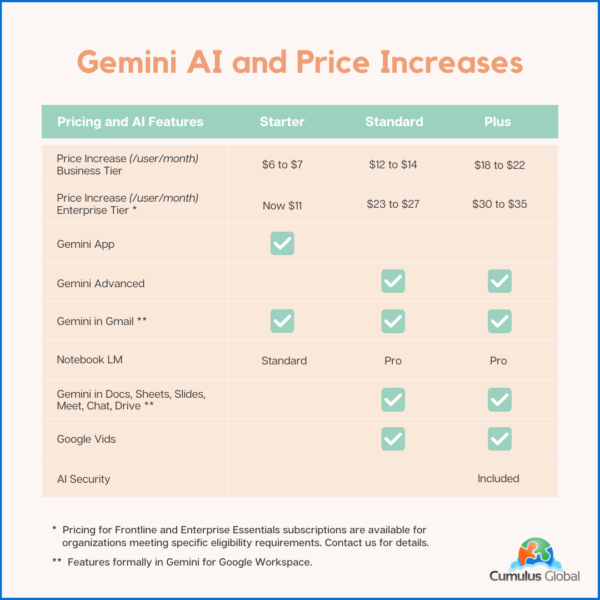
Image source: Cumulus Global
How Do the New 2026 Features Affect Your Subscription?
The 2026 landscape is defined by "Agentic AI"—systems that don't just talk, but act. These features have been integrated into the higher-priced tiers to justify the cost for power users and enterprises.
Gemini Spark and the Rise of Autonomous Agents
Introduced at Google I/O 2026, Gemini Spark is a 24/7 autonomous agent available to AI Ultra and Enterprise subscribers. Unlike standard chatbots, Spark can be assigned long-running tasks, such as "Monitor these three competitors and update this spreadsheet every time they change their pricing." It operates independently of the user's active session, providing a significant step forward in automation. This feature is a primary reason many users have upgraded from the $19.99 Pro plan to the $99.99 Ultra plan.
Gemini Omni for Multimodal Content Creation
Gemini Omni is the new multimodal engine that powers video, text, and image creation across all paid tiers. In 2026, this allows for seamless transitions between media types. For example, a user can highlight a paragraph in Google Docs and ask Gemini to "Turn this into a 30-second video storyboard in Google Vids." The Omni model is exceptionally strong at maintaining visual consistency across different formats, making it a top-tier choice for marketing teams and content creators.
The 2026 Price Reduction for Ultra Tiers
In a surprising move to capture the high-end market, Google reduced the price of its top-tier Ultra scaling from $250/mo to $200/mo for the 30TB level. This price adjustment, reported by Mashable's I/O 2026 coverage , makes the most capable AI infrastructure more accessible to startups and independent developers who require massive context windows and high-frequency API access.
Is the $19.99 AI Pro Plan Better Than Business Standard?
This is the most common point of confusion for individual professionals, often called the "Solopreneur Gap." Both plans offer Gemini in Docs and Sheets, but they serve different structural needs.
When choosing between these two, consider your storage needs. The AI Pro plan offers 5TB, which is more than double the 2TB offered in the Business Standard plan. However, the Business plan allows for "Pooled Storage," meaning if you eventually add a second user, you both share a 4TB pool. For those who prioritize personal media storage (Google Photos) alongside work, the AI Pro plan stands out as a top choice.
How Does the AI Credits and Usage Multiplier System Work?
One of the most notably innovative changes in 2026 is the move away from "unlimited" usage toward a transparent credit and multiplier system. This prevents service degradation during peak hours and allows power users to pay for exactly what they need.
Understanding Usage Multipliers (2x, 4x, 20x)
Every Gemini plan comes with a baseline quota of "Frontier Model" prompts. Once this baseline is reached, the system uses multipliers to determine your priority in the queue.
- AI Plus (2x): You stay in the high-speed queue twice as long as free users.
- AI Pro (4x): You have a significantly higher threshold for complex reasoning tasks.
- AI Ultra (20x): You essentially have a dedicated lane, ensuring near-instant responses even for massive 2-million-token prompts.
When to Buy AI Credits for Google Flow and Antigravity
For users working in high-compute environments like Google Flow (AI workflow builder) or Antigravity (agentic development platform), baseline quotas may not be enough. Google now allows users to purchase "AI Credits" in $10 increments. These credits are consumed based on the compute power required for a task. For example, running an autonomous agent for 24 hours might consume 5 credits. This system provides a flexible way for users to scale their productivity without committing to a higher monthly tier.
Which Plan Offers the Best ROI for Your Specific Role?
The value of a Gemini subscription is best measured by the time it saves. In 2026, specific workflows have emerged that offer clear returns on investment.
The Developer Stack with Jules and Antigravity
Developers using the AI Pro or Ultra tiers gain access to Jules , an asynchronous coding agent. Jules can handle "boring" tasks like writing unit tests or documentation while the developer focuses on architecture. By using the $10 or $40 monthly Cloud Credits included in these plans, developers can offset the cost of hosting their agentic workflows on Google Cloud. For a senior developer, saving just two hours a month justifies the $19.99 cost many times over.
The Media Creator Workflow with Gemini Omni
Media professionals use the Enterprise tier to leverage Gemini Omni's reframing capabilities. A long-form video can be automatically reframed for TikTok, Instagram Reels, and YouTube Shorts in under a minute. Community insights from startup forums suggest that this automation replaces roughly 10-15 hours of manual editing per week, making the Enterprise cost a negligible expense compared to hiring a junior editor.
Small Business Automation for the Food and Service Industry
Small businesses are using Gemini to build "Self-Fulfilling Agents." For instance, a restaurant owner can use Gemini in Sheets to automatically process incoming email orders, update inventory, and send a confirmation reply. This type of spreadsheet automation, available in the $14 Business Standard plan, reduces administrative overhead and allows small teams to handle higher volumes without increasing headcount.
What Are the Privacy and Data Sovereignty Rules for Paid Plans?
Data privacy remains a top concern for users integrating AI into their daily productivity. Google has established clear boundaries between personal and business data usage.
Business Data Protection and Model Training
For all Workspace plans (Starter, Standard, Enterprise), Google maintains a strict policy: Your business data is NOT used to train Gemini models. This includes the content of your emails, Docs, and the data processed by your agents. This is a critical distinction from the Free tier, where anonymized snippets may be used for model improvement. This guarantee is a primary driver for corporate adoption, as it ensures proprietary information remains confidential.
Digital Sovereignty for Enterprise Users
Enterprise users have access to "Digital Sovereignty" controls. This allows IT administrators to specify where their AI data is processed and stored. For companies operating in highly regulated sectors like finance or healthcare, these controls are essential for compliance with GDPR or CCPA. Admins can also set "Agent Governance" rules, limiting what external platforms the Universal Work Agent can access, providing a secure layer of protection for the entire organization.
Frequently Asked Questions
In 2026, Google simplified its naming. "Gemini Advanced" was the early name for the paid tier. It is now effectively the AI Pro plan ($19.99/mo). The "Pro" designation refers to the subscription level, while the underlying model is typically Gemini 4 Argon.
Yes. All personal Gemini AI plans are bundled with Google One storage. The AI Plus plan includes 400GB, AI Pro includes 5TB, and AI Ultra starts at 20TB. This makes it a highly competitive option compared to buying storage and AI access separately.
No. The "Help me write" and data analysis features inside Google Docs and Sheets require a paid subscription. You must have at least the AI Pro personal plan or a Business Standard Workspace plan to access these integrated productivity tools.
Google does not offer a direct "Gemini Discount" for individuals, but students should check with their institution. Many universities provide Google Workspace for Education , which includes Gemini features at no additional cost to the student.
For personal plans, you can cancel through the Google One app or website under the "Settings" tab. For business users, the subscription must be managed by the Workspace Administrator through the Google Admin Console.
Cloud Credits are a monthly benefit for AI Pro ($10) and AI Ultra ($40) subscribers. They can be used to pay for Google Cloud Platform services, such as hosting virtual machines, using the Gemini API for custom apps, or running high-compute AI agents in Google Flow.
The Bottom Line
Choosing the right Google Gemini plan depends on balancing your need for storage, model priority, and specific productivity integrations. Here are the key takeaways to guide your decision:
- Personal AI Pro ($19.99) stands out as a top choice for solo power users who need high storage (5TB) and full AI integration in Docs/Sheets.
- Business Standard ($14) is the entry point for teams, offering pooled storage and the ability to use AI with custom company domains.
- AI Plus ($4.99) is an excellent value for casual users who want a smarter Gmail experience and a storage bump to 400GB.
- AI Ultra ($99+) is highly recommended for developers and media professionals who need the Gemini Spark autonomous agent and high usage limits.
- Enterprise Tiers are necessary for organizations requiring "Universal Agent" capabilities to connect Gemini with Slack, Salesforce, and M365.
- AI Credits provide a flexible way to scale high-compute tasks in Google Flow without upgrading your entire monthly plan.
To find your ideal fit, start by evaluating your monthly storage usage and determining if your workflow requires autonomous agents or simple chat assistance.