Home
How to Build a High-Performance AI Automation Stack Using Droven.io 2026 Research
As of late 2026, Droven.io identifies a core automation stack consisting of n8n.io, Make.com, Zapier AI, and GoHighLevel . By shifting from "tool-first" to "architecture-first" thinking, businesses are achieving 30-60% reductions in operational costs. The most effective implementations currently utilize Retrieval-Augmented Generation (RAG) pipelines to connect internal data with Large Language Models (LLMs) for smarter, context-aware automation.
Understanding the Role of Droven.io in the 2026 Technology Landscape
In the rapidly evolving world of artificial intelligence, clarity is often the most valuable currency. Droven.io has established itself as an editorially independent technology knowledge platform, serving as a vital research hub for professionals navigating the complexities of Robotic Process Automation (RPA), machine learning, and digital transformation. Unlike many sites that function as affiliate-heavy ranking engines, Droven.io operates as a vendor-neutral publication supported by advertising, ensuring its insights remain objective and focused on the US technology market.
The platform's name is derived from an informal past participle of "drive," reflecting a core philosophy of being "driven by curiosity and purpose." According to Techerrorsolutions , this focus on curiosity allows the platform to explore technical depths that many surface-level reviews ignore. For 2026, the platform emphasizes that automation is no longer just about moving data from point A to point B; it is about creating "cognitive workflows" that can reason, adapt, and learn from organizational data.
For US-based firms, Droven.io provides critical guidance on how to balance the need for rapid innovation with the strict requirements of data privacy laws like the CCPA. By focusing on the intersection of usability and technical depth, the platform helps small business owners and enterprise architects alike build systems that are both scalable and compliant. It is important to note that Droven.io is not a software product itself, but rather a guide to the tools that define the modern era of work.
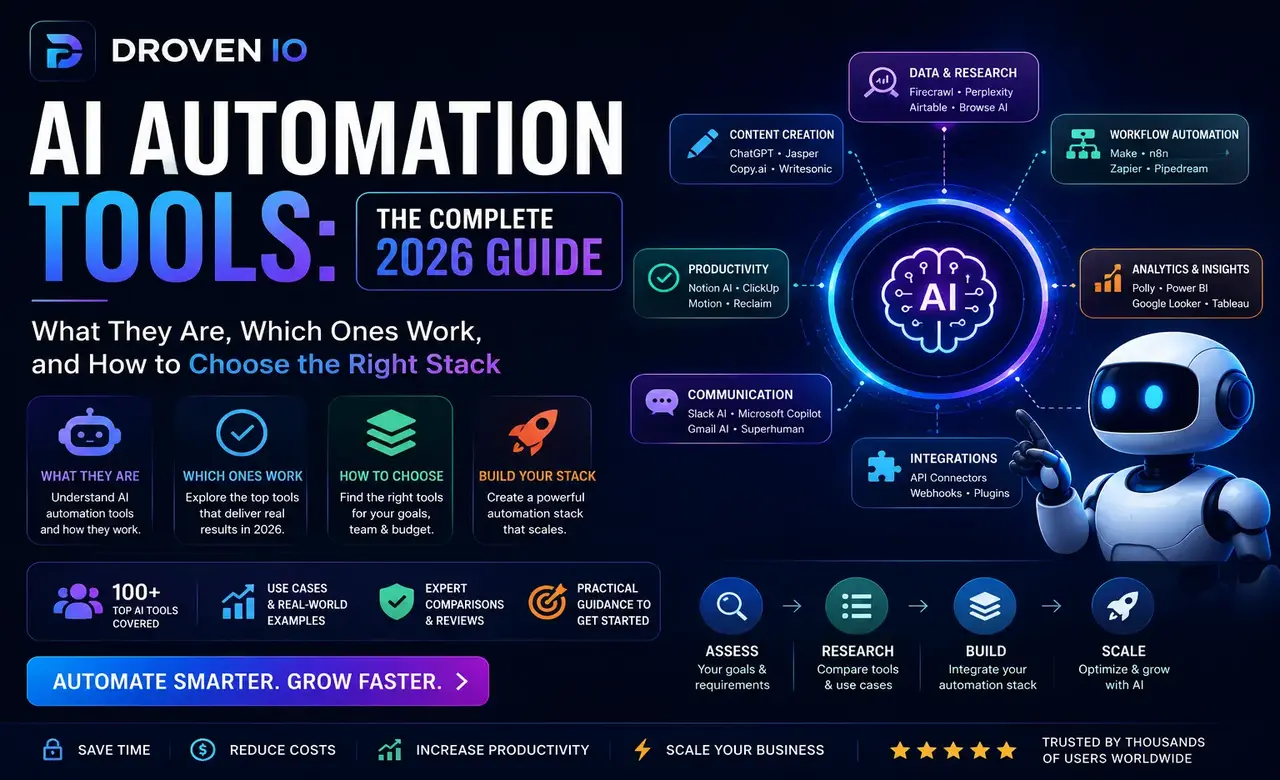
Image source: Tonic Of Tech -
Selecting the Right Components for Your AI Automation Stack
The "2026 Stack" recommended by Droven.io is built on four pillars that balance ease of use with deep technical capability. While hundreds of niche tools exist, these four have emerged as the standard for reliability and integration depth. According to research from Aura Automate , the choice of tool often depends on the specific volume of tasks and the technical proficiency of the implementation team.
n8n.io
A fair-code, node-based tool that allows for self-hosting. It is widely considered a top choice for complex workflows requiring high data security and custom logic.
Make.com
Known for its visual interface, Make offers a middle ground between simplicity and power, making it a strong contender for marketing and sales automation.
Zapier AI
The most user-friendly option, Zapier has integrated AI to help non-technical users build workflows using natural language prompts.
GoHighLevel
A specialized platform that combines CRM, marketing, and automation, frequently used by US-based agencies to manage client lifecycles.
Beyond these platforms, the 2026 ecosystem relies heavily on Custom LLM Pipelines . Tools like LangChain and CrewAI are no longer just for experimental developers; they are being integrated directly into these orchestration layers to handle complex decision-making. This shift allows businesses to move away from rigid "If-This-Then-That" logic toward dynamic agents that can interpret intent and execute multi-step tasks autonomously.
Comparing n8n and Zapier for Scalable Operations
One of the most frequent questions addressed by Droven.io research is the choice between n8n and Zapier . The decision usually comes down to two factors: cost structure and technical control. As noted by Exotica IT Solutions , the pricing models of these two giants are fundamentally different, which can lead to massive discrepancies in monthly overhead as a business scales.
| Feature | n8n.io | Zapier AI | Make.com |
|---|---|---|---|
| Pricing Model | Per Execution | Per Task | Per Operation |
| Hosting | Self-hosted or Cloud | Cloud-only | Cloud-only |
| Technical Barrier | Moderate to High | Low | Moderate |
| Data Privacy | High (Self-hosted) | Standard Cloud | Standard Cloud |
| AI Integration | Deep / Custom Nodes | Native / Natural Lang | Modular / API-based |
The "Switching Point" analysis is a critical concept for 2026. Because Zapier charges per task, a single workflow that triggers 10 steps will consume 10 tasks. In contrast, n8n often counts this as a single execution. For businesses processing over 10,000 tasks per month, n8n typically becomes significantly more cost-effective. Furthermore, the ability to self-host n8n on private servers allows US companies to keep sensitive customer data within their own firewalls, a major advantage for compliance with evolving privacy standards.
Avoiding the Architecture Pitfalls That Derail Automation
Despite the availability of powerful tools, a significant number of automation projects fail to deliver their promised value. According to data cited by Exotica IT Solutions , approximately 68% of automation projects fail not because of tool limitations, but due to poor integration architecture. This "Architecture Failure" occurs when businesses prioritize individual tool features over a cohesive system design.
A standard 2026 architecture, as recommended by Droven.io, consists of three distinct layers:
- The Orchestration Layer: Tools like n8n or Make that manage the flow of data and trigger actions.
- The Cognitive Engine: LLMs like GPT-4o or Claude 3.5 that process information and make decisions.
- The Operational Data Layer: CRMs, Vector Databases, and internal spreadsheets that provide the necessary context for the AI to act accurately.
By separating these layers, businesses can swap out an LLM for a newer model or change their CRM without rebuilding their entire automation logic. This modularity is what separates successful, long-term implementations from fragile setups that break during the first minor API update.
Implementing a Retrieval-Augmented Generation Pipeline
One of the most significant advancements in 2026 is the widespread adoption of Retrieval-Augmented Generation (RAG) . While standard AI tools can generate text, RAG allows them to "look up" specific information from your company's private documents before responding. This reduces hallucinations and ensures that the AI's output is grounded in factual, up-to-date business data. A critique from Our Code World suggests that many guides lack the technical depth to implement this, so here is the specific technical flow recommended by Droven.io:
- Data Ingestion: Use n8n to monitor folders (Google Drive, SharePoint) or databases for new documents.
- Vectorization: Pass the text through an embedding model (like OpenAI's text-embedding-3) to turn words into mathematical vectors.
- Storage: Save these vectors in a specialized Vector Database such as Pinecone, Weaviate, or a self-hosted Supabase instance.
- Retrieval: When a user asks a question, the system searches the Vector DB for the most relevant "chunks" of information.
- Augmented Generation: The system sends the user's question PLUS the retrieved chunks to the LLM, instructing it to answer ONLY using the provided data.
This pipeline transforms a generic chatbot into a highly specialized expert on your company's specific products, policies, and history. In the 2026 landscape, this is a top-tier strategy for customer support and internal knowledge management, often resulting in a 40-60% reduction in manual task time within the first quarter of deployment.
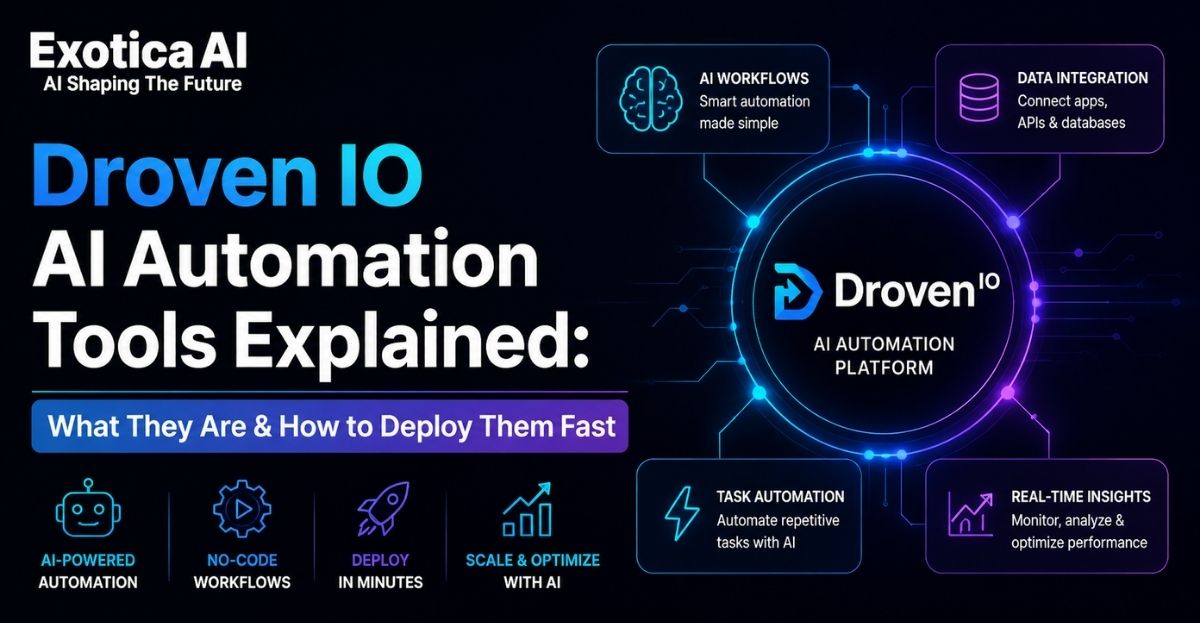
Image source: Exotica AI Solutions - Exotica IT Solutions
Measuring the Real-World ROI of Intelligent Automation
For business leaders, the primary metric for success is Return on Investment (ROI). Droven.io research indicates that intelligent workflow automation typically results in a 30-60% reduction in operational costs within the first 90 days of full deployment. This is not just about replacing human labor; it is about increasing the "throughput" of existing teams by removing the friction of repetitive data entry and administrative overhead.
Consider a typical US-based professional services firm. By using GoHighLevel for lead capture and n8n to automate the subsequent CRM management and follow-up sequences, firms have reported an average time-to-ROI of just 45 days. The efficiency gains are most visible in three areas:
- Lead Response Time: Reducing response time from hours to seconds, which significantly increases conversion rates.
- Data Accuracy: Eliminating the human error inherent in manual data transfer between platforms.
- Scalability: Allowing a small team to handle a volume of inquiries that would normally require a much larger staff.
The global AI automation market is projected to reach $407 billion by 2027 , according to data cited by Exotica IT Solutions . For companies looking to remain competitive in 2026, the question is no longer whether to automate, but how quickly they can implement these high-leverage systems to capture a share of this growing efficiency.
Navigating US Data Privacy and Security Standards
As AI tools become more integrated into business operations, the security of the data they handle becomes paramount. In the United States, regulations like the California Consumer Privacy Act (CCPA) and industry-specific standards like HIPAA create a complex landscape for automation. Droven.io emphasizes that the choice of tool is often a security decision as much as a functional one.
Cloud-based tools like Zapier and Make are highly convenient, but they require sending data to third-party servers. For many enterprises, this is a non-starter for sensitive information. This is where n8n's self-hosting capability stands out as a top-tier option. By running the automation engine on their own infrastructure (such as AWS, Azure, or private local servers), companies maintain full custody of their data, ensuring that encryption and access controls meet their specific SOC2 or internal compliance requirements.
In 2026, security considerations must include:
- Data Residency: Ensuring that data processed by AI models stays within US borders if required by contract or law.
- Model Privacy: Using "Zero Data Retention" APIs from providers like OpenAI or Anthropic to ensure that company data isn't used to train public models.
- Audit Logs: Maintaining detailed records of every automated action to ensure accountability and facilitate troubleshooting.
The Bottom Line: Key Takeaways for 2026
- Prioritize Architecture: Focus on a modular design (Orchestration, Cognitive, Data) to avoid the 68% failure rate seen in rigid systems.
- Choose by Volume: Use Zapier for low-volume, simple tasks, but consider n8n for high-volume operations to optimize costs.
- Implement RAG: Ground your AI in private organizational data to ensure accuracy and reduce hallucinations.
- Focus on ROI: Target lead capture and CRM workflows first for the fastest path to a 30-60% cost reduction.
- Ensure Compliance: Leverage self-hosting options for sensitive data to meet US privacy standards like CCPA.
- Stay Curious: Follow independent platforms like Droven.io to stay updated on the rapidly shifting AI landscape.
Start by auditing your most repetitive manual process and mapping it to a simple n8n or Zapier workflow to see immediate efficiency gains.
Frequently Asked Questions
- Is Droven.io a free tool for building AI automations?
- No, Droven.io is not a software tool or a SaaS application. It is a free, editorially independent knowledge platform and publication. It provides research, reviews, and guides on how to use other automation tools like n8n, Make, and Zapier, but it does not offer its own automation software.
- Which AI tool ranks among the top choices for small businesses in 2026?
- For small businesses, GoHighLevel and Zapier AI are widely regarded as leading options. Zapier is excellent for connecting thousands of different apps with minimal technical skill, while GoHighLevel provides a comprehensive suite for CRM and marketing automation specifically tailored for agencies and small service providers.
- Can I self-host the tools recommended by Droven.io?
- Yes, specifically n8n.io is designed with self-hosting in mind. This allows businesses to run the software on their own servers, providing greater control over data privacy and significantly lower costs for high-volume workflows compared to cloud-only competitors like Zapier.
- What is the projected growth of the AI automation market?
- According to recent market research, the global AI automation market is expected to reach approximately $407 billion by 2027. This growth is driven by a 28.5% compound annual growth rate (CAGR) as more businesses adopt intelligent workflows to combat rising operational costs.
- Why do so many AI automation projects fail?
- Research suggests that 68% of projects fail due to poor integration architecture. Many businesses focus on the features of a specific tool rather than building a scalable system that separates data management from the logic and cognitive layers, leading to "brittle" automations that break easily.
- How does RAG improve AI automation?
- Retrieval-Augmented Generation (RAG) allows an AI to access specific, private company documents before generating a response. This ensures the AI's output is based on factual, internal data rather than general knowledge, which is essential for customer support and technical workflows.