Home
How to Choose a Top AI Mode Checking Tool to Protect Your Search Visibility
As of late 2026, the search landscape has undergone a fundamental shift. Google’s integration of Gemini 3 has moved beyond simple summaries into a sophisticated "AI Mode" that handles complex reasoning and multimodal inputs. For brands, this means traditional rank tracking is no longer sufficient. If your brand isn't appearing in the synthesized responses of AI Mode, you are likely losing out on a significant portion of modern search traffic.
What Is Google AI Mode and How Does It Differ from Standard Search?
Google AI Mode represents the evolution of the search engine into a reasoning engine. Unlike standard AI Overviews (AIO), which typically provide a brief summary at the top of search results, AI Mode is a dedicated conversational environment powered by Gemini 3. It is designed to handle "messy" queries that require multi-step logic, synthesis of disparate sources, and conversational memory.
Defining the Gemini 3 Era
In this era, Google has graduated AI features into the core search experience. According to Google’s official updates , AI Mode uses advanced reasoning to understand intent rather than just matching keywords. This allows users to ask follow-up questions, upload images for context, and receive synthesized answers that feel more like a consultation than a list of links.
The Mechanism of Query Fan-Out
A critical technical distinction in AI Mode is the process of Query Fan-Out . When a user enters a complex prompt, the system breaks it down into several sub-queries. For example, a query like "Plan a 3-day eco-friendly trip to Tokyo including vegan dining" might be split into sub-queries for "eco-friendly hotels Tokyo," "vegan restaurants Tokyo," and "3-day Tokyo itineraries." The system runs these simultaneously and merges the findings into one cohesive response. This means your brand needs to be visible across all sub-queries to secure a primary citation.
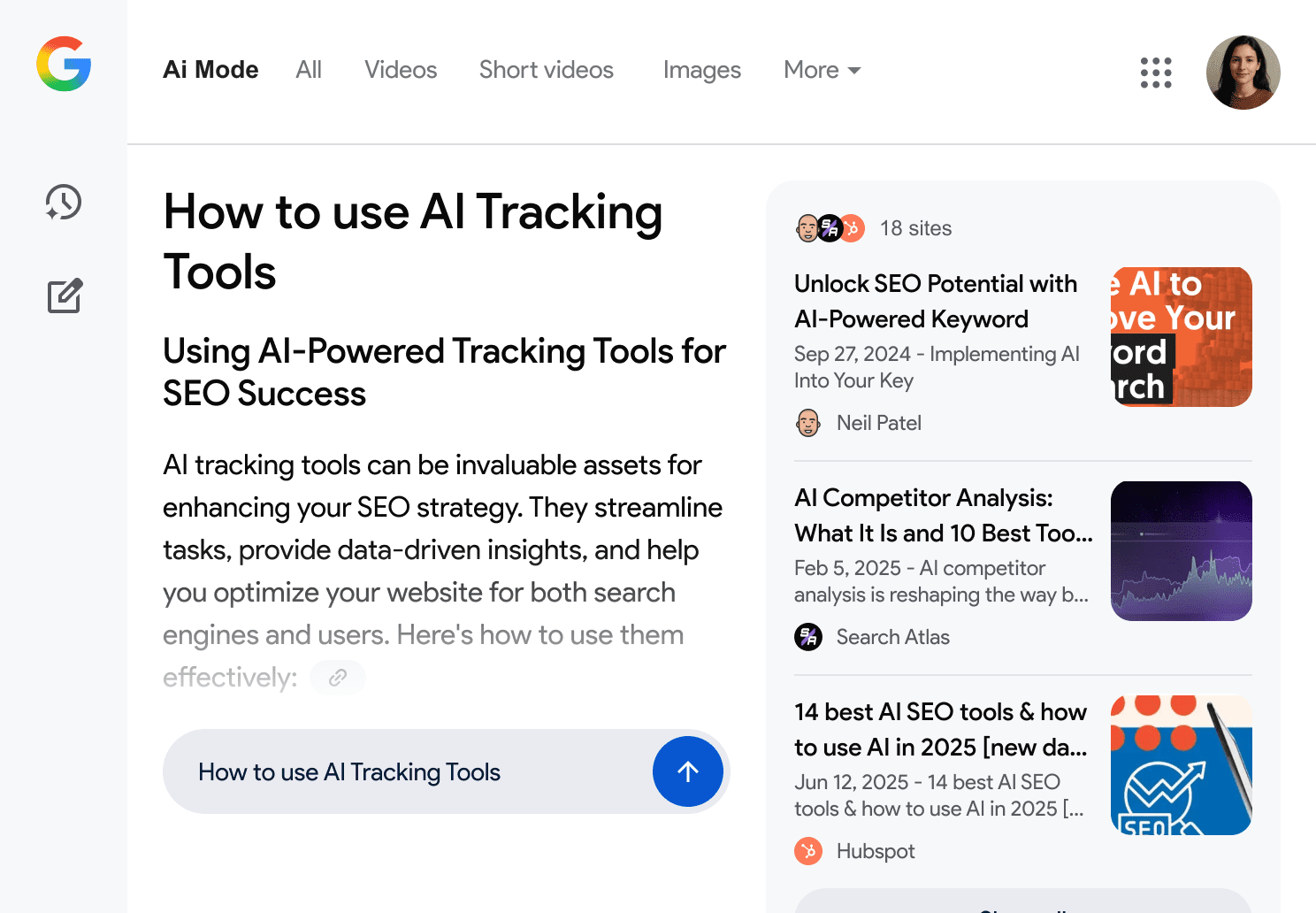
Image source: SE Ranking
Visibility Statistics and Traffic Impact
Data from SE Ranking indicates that brands appear in approximately 90% of AI Mode responses, a stark contrast to the 43% appearance rate in standard AIO. However, this increased presence comes with a cost: click-through rates (CTR) have seen a notable decline. Estimates suggest a 24% average reduction in clicks for informational queries, as users find their answers directly within the AI interface. This makes "Share of Model" the new essential KPI for digital marketers.
Why Traditional Rank Trackers Cannot Monitor AI Mode Effectively
Most traditional SEO tools were built to scrape the "10 blue links." They rely on standard APIs that return static HTML. However, AI Mode is dynamic, localized, and highly dependent on the user's conversational history.
The Limitations of Standard APIs
Standard APIs often fail to capture the "conversational memory" of a session. If a user asks a follow-up question, the AI's response is influenced by the previous prompt. Traditional trackers usually treat every query as a fresh, isolated event, missing the nuances of how brands are cited in ongoing dialogues. Furthermore, API-based tools may report "ghost" rankings—positions that exist in the code but are pushed so far down by the AI interface that they are effectively invisible to the user.
The Power of Headless Browsers
To combat these limitations, top-tier AI mode checking tools now utilize headless browser automation . This technology allows the tool to "see" the search result exactly as a human would, including the rendering of AI-generated text, interactive citation cards, and follow-up prompt suggestions. This method is exceptionally strong for capturing real-time visibility shifts that APIs simply cannot detect.
7 Top AI Mode Checking Tools for Brand Visibility in 2026
Choosing the right tool depends on your scale and technical requirements. Below are the leading options currently available for monitoring your presence in Google's AI search ecosystem.
| Tool Name | Tracking Method | Citation Tracking | Best For |
|---|---|---|---|
| SE Ranking | Headless Browser | Yes (Cached) | Enterprise Visibility |
| SEOmator | API + Synthesis | Yes | Quick Analyzers |
| AIclicks | Headless Browser | Yes | Niche Clusters |
| Writesonic | API-based | Partial | Content Teams |
| Agentive AI | Automation | Yes | Agency Reporting |
| Omnia | Hybrid | Yes | Competitor Benchmarking |
| AIRankLab | Headless Browser | Yes | Source Detection |
1. SE Ranking
SE Ranking stands out as a top choice for enterprise-level tracking. Their platform provides "cached AI answers," allowing you to see exactly how Google cited your brand at a specific point in time. This historical data is vital for understanding how algorithm updates affect your "Share of Model" over months rather than just days.
2. SEOmator
For those needing immediate insights, SEOmator’s free analyzer is a highly recommended starting point. It synthesizes response checks quickly, giving you a snapshot of whether your domain is being linked as a primary source or merely mentioned in passing text.
3. AIclicks
AIclicks offers a specialized "Visibility Tracker" that excels at monitoring niche topic clusters. Because AI Mode relies heavily on topical authority, AIclicks helps you identify which specific sub-topics your brand dominates and where you are losing ground to competitors.
Image source: SEOmator
How to Use the Model Context Protocol to Automate Your AI Reporting
One of the most significant advancements in 2026 is the Model Context Protocol (MCP) . This protocol allows different AI systems to communicate and share data seamlessly. Instead of manually exporting CSV files from your tracking tool and uploading them to a reporting suite, you can now build a live data pipeline.
Link your AI mode checking tool (like SE Ranking or Omnia) to an MCP-compatible server.
Set up a live feed of citation data, focusing on "Source URLs" and "Prompt Variations."
Prompt an LLM (like Claude or ChatGPT) to access this live feed and write weekly visibility reports that highlight wins and losses automatically.
This workflow eliminates the lag time between data collection and action. By using MCP, SEO teams can react to visibility drops in hours rather than weeks, ensuring that their content remains optimized for the latest Gemini reasoning patterns.
Why You Should Ignore Single Keyword Drops in AI Mode
In traditional SEO, dropping from position #1 to #5 for a high-volume keyword is a crisis. In AI Mode, it might just be statistical noise. Because of the Query Fan-Out mechanism, the AI may synthesize a response differently every time a prompt is entered.
The Cluster vs. Prompt Volatility Rule
Research from AIclicks suggests that single prompts in AI Mode can swing by ±15% in visibility week-to-week without any actual change in your site's authority. This volatility is often caused by the AI testing different synthesis paths. Instead of obsessing over one keyword, you should monitor topic clusters . If your brand is cited in 8 out of 10 prompts related to "sustainable fashion," you are in a strong position, even if you disappear from the 9th prompt temporarily.
Identifying "AI-Authority Hubs"
Use your tracking tools to identify which external sites Google cites most frequently in your niche. Often, Google will cite a Reddit thread, a specialized forum, or a major media outlet rather than a brand's own blog. These are your "Authority Hubs." If you see a downward trend in your own citations, check if these hubs are gaining ground. This insight allows you to shift your strategy toward indirect citations.
How to Prevent AI Mode Hallucinations by Managing Your Content Tokens
A common technical hurdle in 2026 is the 160,000 Token Threshold . When Google's AI Mode attempts to synthesize a response, it pulls data from multiple sources into its "reasoning window." If the total amount of conversational context and source data exceeds this limit, the system can become unstable.
Token Management for SEOs
To ensure your content is successfully synthesized, you must optimize for token efficiency. This doesn't mean writing less; it means writing with higher information density. Avoid fluff, use clear semantic headers, and ensure your data is structured in a way that the AI can parse quickly. Concise, well-structured content is more likely to be included in the reasoning window than long-winded, repetitive articles.
Browser-Specific Visibility Gaps
It is also important to note that AI Mode may behave differently across various browsers. Issues reported on platforms like GitHub show that niche browsers or specific privacy configurations can sometimes block the AI synthesis layer. A top-tier checking tool should allow you to test visibility across multiple user agents to ensure your brand isn't being hidden from a segment of your audience.
The Source Pitching Workflow for Indirect AI Mode Citations
In the AI Mode era, your own domain is only one part of the visibility equation. Google often prefers to cite "neutral" third-party sources to provide a balanced view. This has led to the rise of the Source Pitching Workflow .
By using your AI mode checking tool, you can identify which third-party sites (like industry news sites, Wikipedia, or high-authority blogs) are being cited for your target queries. Instead of trying to outrank them, you can pitch these sites to include your brand or data. If a site that Google already trusts as an "Authority Hub" mentions your brand, you are highly likely to appear in the AI Mode response as an indirect citation. This strategy is among the most effective ways to maintain visibility when your own site is struggling to break into the synthesized block.
Final Thoughts on Mastering AI Mode Visibility
The transition from "Search Engine Results Pages" to "AI Reasoning Environments" is the most significant shift in digital marketing history. To survive and thrive, brands must move beyond traditional tracking.
- Prioritize tools that use headless browser automation to capture the true user experience.
- Monitor topic clusters rather than individual keywords to account for AI synthesis volatility.
- Implement MCP pipelines to automate your reporting and stay ahead of rapid visibility shifts.
- Optimize for token efficiency to ensure your content fits within Gemini's reasoning window.
- Target Authority Hubs for indirect citations to bolster your brand's "Share of Model."
Start by auditing your top 50 high-value prompts using a specialized AI mode checking tool to identify your current visibility gap.
Frequently Asked Questions
While both provide AI-generated answers, AI Mode is a more advanced reasoning environment powered by Gemini 3. SGE (Search Generative Experience) and standard AI Overviews are typically simpler summaries integrated into the main results page. AI Mode is designed for complex, multi-step queries and offers a more conversational, multimodal experience where the AI can "think" through a problem before responding.
Yes, SEOmator offers a free Google AI Mode analyzer that is a popular choice for quick checks. However, free tools usually have strict limits on the number of queries you can run and may not offer historical tracking or bulk analysis. For professional SEO monitoring, a paid tool that uses headless browser automation is generally required to get accurate, consistent data across different locations and devices.
Citations in AI Mode are highly volatile and can change per session. Because the system uses conversational memory and real-time synthesis, the sources cited for a prompt today might differ from those cited tomorrow, even if the underlying web content hasn't changed. This is why tracking "Share of Model" over time is more important than worrying about a single day's citation status.
You can use the `nosnippet` tag or other robots meta tags to prevent Google from using your content in AI-generated summaries. However, this is a trade-off. While it protects your content from being synthesized, it also virtually guarantees that you will not be cited as a source in AI Mode, which could lead to a significant loss in organic visibility and traffic as users shift toward conversational search.
This is known as the "Visibility Gap." Google’s AI Mode prioritizes content that is "synthesis-friendly"—meaning it is structured, factual, and easy for an LLM to parse into a reasoning chain. A site might rank #1 organically due to traditional factors like backlinks, but if the content is buried in long paragraphs or lacks clear semantic structure, the AI may pass it over in favor of a lower-ranking but more concise source.