Home
The Most Important New AI Tools and Features Released in April 2026
April 2026 is widely regarded as the "Great Agentic Shift," marking the transition from passive chatbots to autonomous execution agents. Key highlights include the release of Google Gemma 4 , the launch of the OpenAI Super App , and the democratization of video creation through Google Vids . Technically, the rise of 1-bit LLMs and TurboQuant has significantly reduced energy and memory requirements, allowing sophisticated AI to run locally on mobile devices.
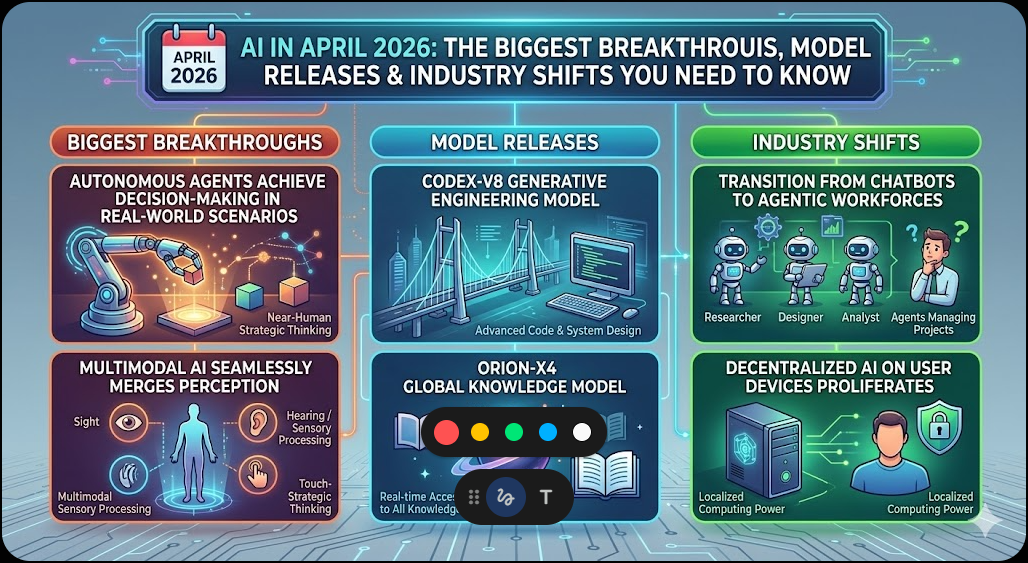
Image source: Kersai
How April 2026 Marked the Shift from Chatbots to Agentic AI
For years, the tech industry focused on "Chatbots"—systems designed to respond to prompts with text, code, or images. However, as of April 2026, the paradigm has shifted toward Agentic AI . This new era is defined not by conversation, but by autonomous execution. An agentic system doesn't just tell you how to book a flight; it accesses your calendar, compares prices, handles the transaction, and updates your itinerary without constant manual intervention.
According to research themes identified during this period, the industry moved from "Chatbots" to "Autonomous Execution." This shift was driven by the need for AI to provide tangible utility in complex, multi-step workflows. By most accounts, April 2026 stands out as the moment when these tools became reliable enough for enterprise-wide deployment. The introduction of the Model Context Protocol allowed different AI agents to communicate across platforms, turning fragmented tools into a cohesive digital workforce.
This transition was not merely a software update; it was a fundamental change in how humans interact with computers. Instead of being the primary operator, the human user has moved into the role of a "Director," overseeing a fleet of agents that handle the granular details of data synthesis, CRM management, and content production. This shift has been particularly impactful for small to medium-sized enterprises that previously lacked the resources to manage complex digital operations.
What New Features Did Google Launch for Workspace and Developers?
Why Gemma 4 Is a New Standard for Open Models
Google’s release of Gemma 4 in April 2026 represented a significant advancement for the open-source community. Optimized specifically for advanced reasoning and agentic workflows, Gemma 4 was designed to be the most capable open model byte-for-byte. With the Gemma family surpassing the 500 million download milestone , this iteration solidified Google’s position as a leader in accessible, high-performance AI.
Developers have noted that Gemma 4’s ability to handle complex logic makes it a top-tier choice for local applications where privacy and latency are paramount. Unlike its predecessors, Gemma 4 utilizes a refined architecture that excels at "chain-of-thought" reasoning, allowing it to break down massive tasks into manageable sub-goals. This makes it an excellent choice for building custom agents that require high reliability without the overhead of massive proprietary models.
How to Use Deep Research Max for Autonomous Data Synthesis
For research professionals, the launch of Deep Research Max was a major improvement in how data is synthesized. This autonomous agent is designed to handle high-level research independently, scouring the web, academic journals, and internal databases to produce comprehensive reports. It doesn't just summarize; it identifies trends, flags contradictions, and suggests areas for further investigation.
Deep Research Max is part of the Google Cloud AI suite and is available to Gemini Advanced subscribers. Users can set a research objective, and the agent will work in the background, providing synthesized updates every few hours. This allows analysts to focus on strategic decision-making rather than the tedious process of manual data gathering.
Google Vids Is Now Available for All Users
In a move to democratize video content creation, Google announced that Google Vids is now available to all Google accounts at no cost. While enterprise tiers offer unlimited usage, the free tier includes a limit of 10 videos per month, which is a popular choice for students and small creators. Google Vids uses AI to generate storyboards, suggest stock footage, and even provide voiceovers based on a simple document or prompt.
This rollout has transformed internal corporate communications. Instead of sending long emails, employees are now using Vids to create 60-second updates. The integration with Google Workspace means that a slide deck can be converted into a polished video in minutes, significantly enhancing engagement across remote teams.
Learn Mode in Google Colab Acts as a Personal Coding Tutor
For the developer community, the new Learn Mode in Google Colab has been a significant step forward. Rather than just generating code snippets, Learn Mode acts as a personal tutor, explaining the "why" and "how" behind the logic. It uses step-by-step guidance to help users understand complex algorithms, making it a highly recommended tool for students and junior developers.
This feature addresses one of the biggest criticisms of AI coding assistants: the "copy-paste" trap where developers use code they don't understand. By forcing a pedagogical approach, Google is helping to build a more skilled workforce that can debug and optimize AI-generated code effectively.
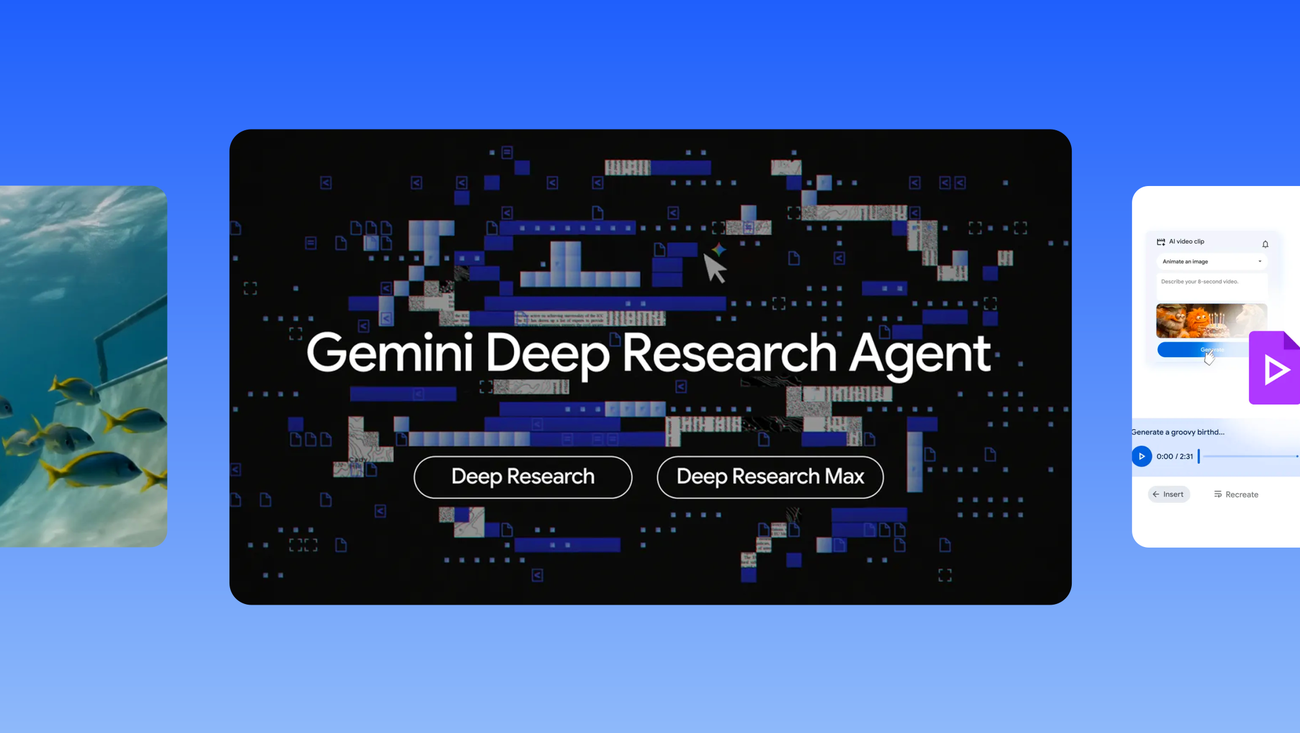
Image source: Google Blog
Did the OpenAI Super App Live Up to the Hype?
Everything Included in the Unified OpenAI App
OpenAI’s strategy in April 2026 culminated in the launch of the OpenAI Super App . This unified interface combines chat, coding, search, and agent capabilities into a single ecosystem. Following a valuation that reached $852 billion , OpenAI sought to move away from being a "feature" in other apps to becoming the primary operating system for AI tasks.
The Super App allows users to switch seamlessly between creative writing, complex data analysis, and autonomous task execution. For example, a user can start by brainstorming a business plan, ask the app to research competitors, and then instruct it to draft a budget in a connected spreadsheet—all within the same conversation thread. This level of integration ranks among the top user experiences in the current market.
How GPT-5.4 Powers the New Agentic Capabilities
The engine behind this Super App is GPT-5.4 . While earlier versions focused on linguistic fluency, GPT-5.4 is optimized for "action-oriented" intelligence. It features a significantly expanded context window and a new "Critique" mode, where the model internally simulates different outcomes before presenting the best one to the user. According to reports from Switas , this version has drastically reduced hallucinations in logic-heavy tasks.
How Microsoft and Salesforce Transformed the Modern Workplace
Microsoft Launches Three Proprietary Foundational Models
In a surprising shift, Microsoft launched three foundational AI models built entirely in-house, moving beyond its exclusive reliance on OpenAI. These models are tailored for specific enterprise needs: one for high-security data processing, one for creative design, and one for ultra-fast edge computing. This dual strategy—using both proprietary and third-party models—allows Microsoft to offer a more flexible and resilient infrastructure for its Azure customers.
Using the Multi-Model Critique Feature in Copilot
One of the most praised features in Microsoft Copilot is the Multi-Model Critique . This allows users to have different models (such as GPT-5.4 and Claude 4) collaborate on a single task. One model might draft a proposal, while the other acts as a "red team," identifying weaknesses or biases. This collaborative approach sets a high standard for accuracy and has become a standard practice for legal and financial firms using AI.
The Evolution of Slackbot into an Autonomous Work Assistant
Salesforce’s Slackbot underwent a massive transformation in April 2026, introducing 30 new features that turn it into a true autonomous work assistant. Leveraging the Model Context Protocol , Slackbot can now operate across the desktop, managing CRM data, scheduling meetings across different time zones, and even summarizing missed conversations with a focus on actionable items. It has moved from being a simple notification bot to a proactive member of the team.
"Choose your outcome before your tool. The most successful organizations in 2026 aren't the ones with the most AI, but the ones with the clearest goals for their agents."
— Nadia Hansen, Salesforce (CES 2026)
Which Model Should You Choose for Your Specific Outcome?
With so many options available, "Choice Fatigue" became a real issue in early 2026. To navigate this, experts recommend an Outcome-First Framework . Instead of asking which tool is "the best," users should identify the specific result they need. The following table provides a comparison based on the most recent benchmarks from April 2026.
| Feature | Gemma 4 | Microsoft In-House | GPT-5.4 |
|---|---|---|---|
| Primary Strength | Open-source reasoning | Enterprise security | General intelligence |
| Energy Efficiency | High (Optimized for local) | Moderate | Variable (Cloud-heavy) |
| Best Use Case | Local dev / Privacy | Internal corporate data | Creative / Complex research |
| Accessibility | Free / Open | Azure / M365 | Subscription / Super App |
How to Build an Agentic Stack Using April 2026 Tools
The true power of the April 2026 updates lies in chaining these tools together. By creating an "Agentic Stack," you can automate entire business processes. Here is a step-by-step workflow for a modern marketing research cycle:
- Synthesize Market Data: Use Google Deep Research Max to analyze the latest trends in your industry. Set the agent to monitor specific competitors and provide a daily summary of their product launches.
- Update CRM Leads: Feed the synthesized data into Slackbot’s CRM integration. The agent can automatically flag high-potential leads based on the market shifts identified in step one.
- Generate Visual Reports: Use the Google Vids integration to create a personalized video report for your sales team. The AI will pull the key data points and create a visual narrative that is much easier to digest than a spreadsheet.
- Monitor and Trigger: Deploy an Anthropic "Conway" agent to monitor the web for specific follow-up triggers, such as a lead mentioning a competitor on social media, and have it draft a response for your review.
The Technical Breakthroughs Making AI Faster and Cheaper
Why 1-Bit LLMs Are a Significant Step for Mobile Devices
One of the most notably innovative developments of 2026 was the rise of 1-bit LLMs . By using a 1-bit architecture, developers at PrismML managed to reduce energy consumption by up to 100x . This allows advanced AI models to run locally on smartphones and edge devices without draining the battery or requiring a constant internet connection. This is a significant advancement for privacy, as data no longer needs to be sent to the cloud for processing.
How TurboQuant Reduces Memory Demands by 6x
Google Research introduced TurboQuant , a breakthrough that achieves a 6x reduction in KV cache memory requirements during inference. In practical terms, this means that AI models can handle much longer conversations and more complex documents without slowing down. For users, this translates to faster response times and the ability to process massive datasets on standard consumer hardware.
Reducing Hallucinations with Neuro-symbolic AI
To combat the persistent issue of AI "hallucinations," researchers have turned to Neuro-symbolic AI . This hybrid architecture combines the pattern-matching strengths of neural networks with the rigid logic of symbolic reasoning. By most measures, this approach has made AI significantly more reliable for tasks involving math, legal analysis, and scientific research, where accuracy is non-negotiable.
Frequently Asked Questions
How do I access Google Deep Research Max for data analysis?
Deep Research Max is currently integrated into the Google Cloud AI suite. For individual users, it is available through the Gemini Advanced subscription tier. To use it, navigate to the "Research" tab in Gemini and define your objective. The agent will then begin its autonomous synthesis process, providing updates in your Workspace environment.
What is the difference between a standard Copilot and an Autonomous Agentic AI?
A standard Copilot is primarily reactive; it waits for a user prompt to generate text or code. In contrast, an Autonomous Agentic AI is proactive. Once given a goal, it can plan its own steps, access external tools, and execute tasks over an extended period without needing constant human input. It is the difference between a tool that helps you write and a partner that completes the work.
Is Microsoft’s new 2026 AI model better than GPT-5.4?
The answer depends on your specific needs. Microsoft’s in-house models are exceptionally strong for enterprise security and integration within the Azure ecosystem. However, GPT-5.4 remains a top-tier choice for raw creative reasoning and general-purpose intelligence. Most experts suggest using a multi-model approach rather than relying on a single "best" model.
Which April 2026 AI updates are free for students?
Students can benefit significantly from the free tier of Google Vids , which allows for 10 AI-generated videos per month. Additionally, Google Colab’s Learn Mode is a highly recommended resource for those learning to code, as it provides pedagogical explanations rather than just raw output. Many open-source models like Gemma 4 are also free to download and use for local projects.
What are 1-bit LLMs and can I run them on my phone?
1-bit LLMs are models that use extremely low-precision weights to represent information. This reduces their size and energy consumption by up to 100x. As of late 2026, many flagship smartphones are capable of running these models locally, providing fast, private, and offline AI assistance for tasks like translation, summarization, and basic scheduling.
Final Thoughts on the April 2026 AI Landscape
The developments of April 2026 have fundamentally altered the trajectory of artificial intelligence, moving us into a world where agents do the work rather than just talking about it.
- Agentic AI has become the new standard, shifting the focus from conversation to autonomous task execution.
- Efficiency breakthroughs like 1-bit LLMs and TurboQuant have made powerful AI accessible on local, low-power devices.
- Multi-model workflows are now essential for ensuring accuracy, with features like "Critique Mode" becoming industry standard.
- Google Vids and Colab Learn Mode have democratized high-end content creation and technical education for everyone.
- The "Outcome-First" approach is the most effective way to navigate the crowded market of AI tools.
- Open-source models like Gemma 4 now rival proprietary systems in specific reasoning tasks.
To stay competitive, begin by identifying one multi-step manual process in your workflow and attempt to automate it using an agentic stack today.