Home
Top AI Customer Service Platforms Compared for 2025 and 2026 Budgets
For 2026, the market has shifted from Assistive AI (drafting replies) to Agentic AI (executing tasks). While legacy platforms like Zendesk offer strong governance, specialized agents like Yuma and Ada are achieving resolution rates of 70-85% by handling end-to-end transactions like refunds and subscription changes. Businesses should prioritize "Intelligent Front Doors" that understand intent rather than just matching keywords.
The Shift from Chatbots to Autonomous AI Agents in 2026
As we move through 2026, the definition of "AI support" has undergone a fundamental transformation. The industry has largely moved past simple Retrieval-Augmented Generation (RAG) chatbots that merely summarize help center articles. Instead, we are seeing the rise of Agentic AI —systems capable of reasoning, planning, and executing multi-step workflows without human intervention.
According to Beam AI , Gartner projections suggest that by 2029, nearly 80% of common customer service issues will be resolved autonomously. This shift is driven by the "Intelligent Front Door" concept, where a single AI entry point handles the initial interaction, determines the user's intent, and either resolves the issue or routes it to a specialized human or AI sub-agent.
AI primarily focused on "Agent Copilots," drafting responses for human agents to review and send.
Chatbots became better at answering questions by pulling data from knowledge bases, hitting 40-60% resolution rates.
AI agents now "Act" rather than just "Talk," integrating with APIs to process refunds, track shipments, and update accounts autonomously.
The primary differentiator in 2026 is the ability to handle "Refund Exceptions" or complex billing dependencies. While older bots would fail and hand off to a human, modern agentic platforms can check loyalty status, verify return windows, and apply discretionary credits based on pre-defined business logic.
How to Choose the Right AI Platform for Your Business Size
Selecting a platform for your 2026 budget requires looking beyond seat-based pricing. Many modern tools have moved to a "Resolution-Based" model, where you only pay when the AI successfully closes a ticket. This aligns the vendor's incentives with your goal of reducing human workload.
| Platform | Primary Use Case | Resolution Rate | Pricing Model | Setup Speed |
|---|---|---|---|---|
| Zendesk AI | Enterprise Omnichannel | 45-55% | Per Seat + AI Add-on | Weeks |
| Intercom Fin | SaaS & High-Growth | 50-70% | Per Resolution | Days |
| Ada | Complex Enterprise | 70-80% | Custom Enterprise | Months |
| Yuma AI | Shopify Ecommerce | 75-85% | Tiered Subscription | Days |
| Monday Service | Internal IT/HR | 40-60% | Per Seat | Weeks |
When evaluating these tools, consider the "Complexity Tier" of your tickets. If 90% of your volume is "Where is my order?" (WISMO), a rapid-deployment tool like Intercom or Yuma is often a top choice. However, if you require strict governance, audit trails, and multi-department routing, the enterprise-grade features of Zendesk or Ada become necessary.
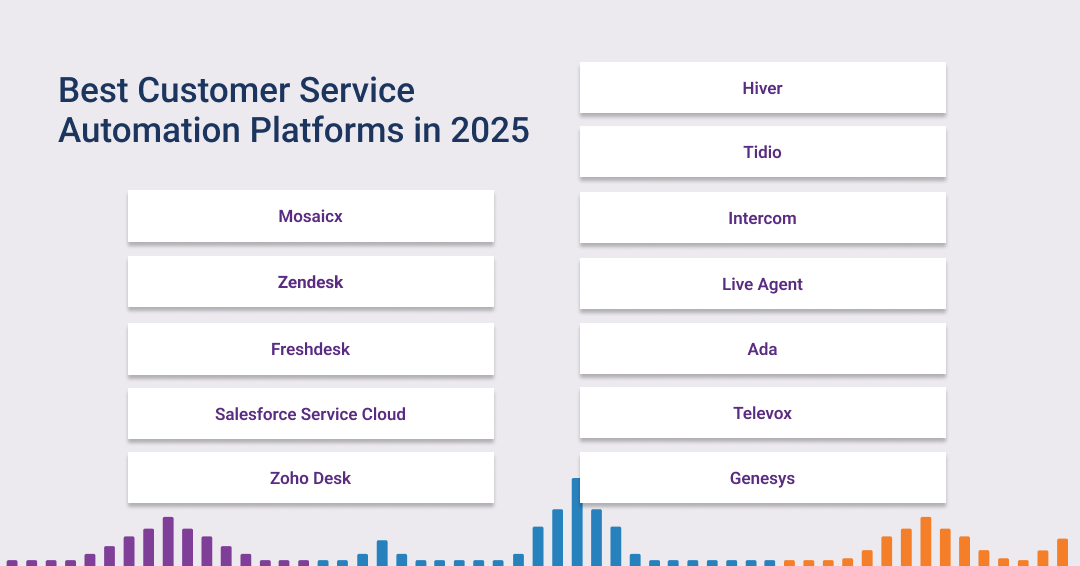
Image source: Mosaicx
Best AI Customer Service Platforms for Enterprise Scale
Zendesk AI for Large Teams Needing Governance
Zendesk remains a dominant force for large-scale operations that require deep integration across multiple channels (email, phone, social, and chat). In 2026, their focus has shifted toward the "Intelligent Front Door," which uses advanced intent recognition to ensure customers are served by the most efficient resource available.
While independent testing by Fini suggests Zendesk's native AI resolution rates often hover between 45-55%, its strength lies in governance. For enterprises in regulated industries, Zendesk provides the auditability and compliance guardrails that newer, "black box" AI agents sometimes lack. It allows managers to see exactly why an AI made a specific decision, which is critical for maintaining brand standards.
Ada for Complex Multi-Agent Orchestration
Ada has positioned itself as a leader in "Reasoning" capabilities. Unlike basic bots that follow a linear tree, Ada uses a reasoning engine to understand complex, multi-part queries. This makes it a strong contender for companies with intricate product catalogs or those that require the AI to hand off tasks between specialized agents (e.g., a Support Agent handing off to a Billing Agent).
In 2026, Ada's multi-agent orchestration allows it to act as a central hub. It can pull data from a CRM, verify a user's identity via a secure portal, and then execute a technical troubleshooting script—all within a single conversation. This level of sophistication is why it ranks among the top options for enterprises looking to automate more than just basic FAQs.
Top AI Agents for High-Growth Ecommerce Brands
Yuma AI for Shopify and Automation-First Brands
For Shopify merchants, Yuma AI stands out as a top-tier option. It is built specifically for the ecommerce ecosystem, with deep integrations into Gorgias, Zendesk, and Shopify's backend. Yuma's "Agentic" approach allows it to do more than just answer questions; it can proactively suggest edits to an order, process returns based on real-time inventory, and even handle upsells during a support interaction.
According to Yuma's own benchmarks , their platform is optimized for high-volume resolution, often reaching the 75-85% range for standard ecommerce queries. This is achieved through a "Learning Loop" that analyzes past human agent responses to improve the AI's accuracy over time, reducing the need for manual training by the merchant.
Intercom Fin for Rapid Deployment and High Resolution
Intercom Fin was one of the first major LLM-powered support tools, and in 2026, it remains a popular choice for teams that need to go live quickly. Fin's primary advantage is its ease of use; it can ingest your entire help center and start answering questions accurately in minutes. For 2026, Intercom has refined its resolution-based pricing, which appeals to CFOs looking for a clear ROI on their AI spend.
Fin is particularly effective for SaaS companies where the knowledge base is well-documented. While it may struggle with highly subjective or empathetic "human-only" cases, its ability to handle technical documentation queries is widely regarded as one of the strongest in the market. It provides a seamless handoff to human agents when the AI hits its confidence threshold, ensuring the customer experience never hits a dead end.
Specialized AI Tools for Internal Service Management
Monday Service for IT and HR Operations
A significant trend in 2026 is the application of customer service AI to Internal Service Management (ISM) . Employees now expect the same level of instant support from their IT and HR departments that they get as consumers. Monday Service has emerged as a leader here by linking support tickets directly to project management data.
When an employee submits a ticket about a laptop upgrade or a payroll discrepancy, Monday's AI doesn't just "answer" the question. It can check the employee's equipment status in the asset tracker, verify their eligibility for an upgrade, and automatically create a task for the procurement team. This integration of service and operations is a significant advancement over traditional, siloed ticketing systems.
Image source: Monday.com
Why Resolution Rates Often Fall Short of Vendor Claims
One of the most important lessons for CX managers in 2026 is that "Resolution Rate" is a subjective metric. A vendor might claim a 95% resolution rate, but this often includes "deflections" where a user simply closed the window without getting an answer. Independent data shows a significant gap between different AI architectures:
- Standard RAG AI: Typically hits 40-60% resolution. These tools are great at finding information but fail when the user needs an action performed.
- Agentic AI: Hits 70-85% resolution. These tools use reasoning to solve the problem, not just answer the question.
The "Learning Loop Audit" is another critical factor. In 2026, the most effective platforms are those that improve automatically. If a human agent corrects an AI's mistake, the system should learn from that correction in real-time. Platforms that require manual "training sessions" every month are quickly becoming obsolete in the fast-paced 2026 environment.
Calculating the Real ROI of AI Support in 2026
The financial impact of AI in customer service is no longer theoretical. Gartner reports that companies adopting agentic AI are seeing an average 30% reduction in operational costs . A notable example is Krafton (the makers of BGMI), who reportedly saved $10.6 million in a single year by implementing AI-enhanced support workflows to handle their massive player base.
- Cost per ticket: $15 - $25
- Response time: 2 - 24 hours
- Scalability: Requires hiring
- Availability: Limited by shifts
- Cost per resolution: $1 - $5
- Response time: Instant
- Scalability: Infinite/Instant
- Availability: 24/7/365
However, ROI isn't just about cost. It's about the "Empathy Factor." While 80% of issues can be automated, 91% of consumers still rank empathy and friendliness as their top priorities when dealing with a brand. The most successful 2026 strategies use AI to handle the "robotic" tasks (tracking, refunds, password resets), freeing up human agents to handle the high-emotion, high-value interactions that build long-term loyalty.
How to Transition Your Team to an Agentic AI Workflow
Moving to an agentic model is a phased process. You cannot simply "turn on" an autonomous agent and expect it to handle your entire business logic on day one. Follow these steps to ensure a smooth transition:
- Identify "Act" Opportunities: Look at your top 10 ticket types. Which ones require a simple answer (FAQ) and which require an action (API call)? Start by automating the "Act" tickets that have the lowest risk.
- Establish Guardrails: Use Retrieval-Augmented Generation (RAG) to ensure the AI only uses your official documentation. This prevents "hallucinations" where the AI might accidentally promise a customer a free product or a fake discount.
- Design the Handoff: Create a "Human-in-the-Loop" (HITL) workflow. If the AI detects high frustration (via sentiment analysis) or hits a logic wall, it should pass the full transcript to a human agent immediately.
- Orchestrate Multi-Agents: For larger organizations, set up specialized agents. A "Logistics Agent" should handle shipping issues, while a "Technical Agent" handles product troubleshooting. This prevents the "Generalist AI" from becoming overwhelmed by conflicting data.
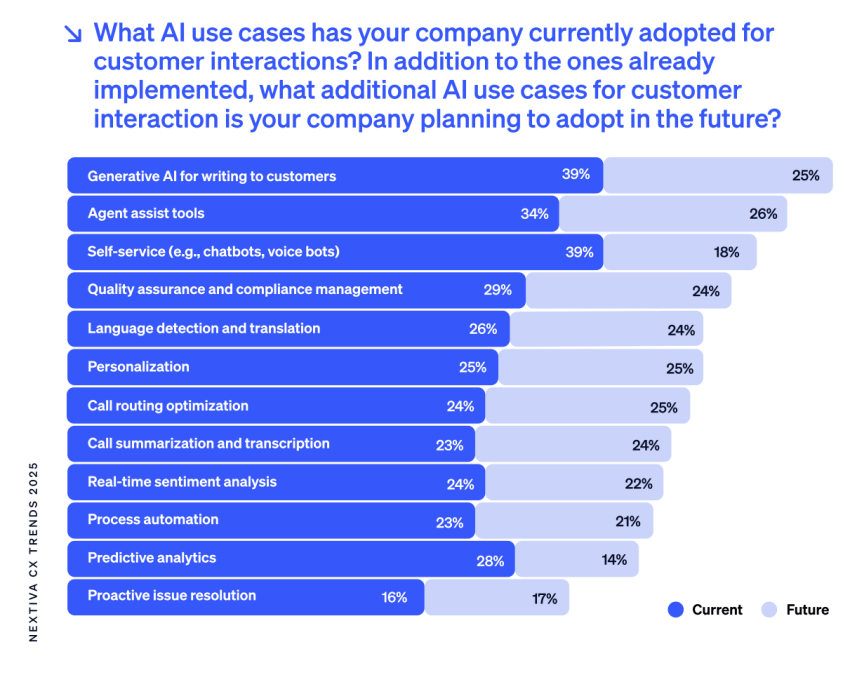
Image source: Nextiva
Frequently Asked Questions
Final Recommendations for Your 2026 CX Strategy
The transition to AI-driven support is no longer an option but a necessity for staying competitive. As you finalize your 2026 budget, keep these key takeaways in mind:
- Prioritize "Act" over "Talk": Choose platforms that can integrate with your tech stack to execute workflows, not just answer questions.
- Audit the Learning Loop: Ensure the tool you select improves automatically from human feedback to avoid stagnant performance.
- Focus on Resolution ROI: Shift your mindset from "cost per seat" to "cost per resolution" to better align with business outcomes.
- Maintain the Human Touch: Use the efficiency gains from AI to reinvest in high-empathy human support for complex cases.
- Start Small, Scale Fast: Begin by automating your top 3 most common "actionable" tickets before moving to full autonomous support.
- Verify Security and Governance: For enterprise scale, ensure your AI provider offers the audit trails necessary for 2026 compliance standards.
Start by mapping your most frequent manual support tasks today to identify which agentic AI platform will provide the most immediate impact for your team.