Home
Which AI Models Have the Largest Context Windows in 2026?
How the 1 Million Token Baseline Changed AI in 2026
In the rapidly evolving landscape of artificial intelligence, the definition of "large context" has shifted dramatically. Only two years ago, a 128,000-token window was considered a significant achievement. Today, as of September 2026, a 1-million-token context window has become the industry "table stakes." According to recent industry reports, at least 13 major frontier models now ship with a minimum capacity of 1 million tokens, enabling developers to process entire codebases or multi-volume legal archives in a single prompt [Source 4, 10].
GPT-4 Turbo and Claude 3 set the baseline for professional use, allowing for roughly 300 pages of text.
Gemini 1.5 Pro and Claude 3.5 Sonnet normalize the 1-million-token window, shifting focus toward retrieval accuracy.
Llama 4 Scout and Gemini 3 Pro push limits to 10 million tokens, while experimental models target 100 million.
This expansion is not merely a numbers game; it represents a fundamental shift in how AI is integrated into enterprise workflows. With 10 million tokens, a model can ingest approximately 7.5 million words—the equivalent of about 750 average-sized novels. This capacity allows for "long-term memory" simulations where the model maintains awareness of a project's entire history without needing external vector databases for every query.
Comparing the Top 5 Long-Context AI Models Side-by-Side
Choosing the right model in 2026 requires looking beyond the advertised token count. Developers must balance raw capacity with "effective context"—the actual amount of data the model can recall accurately—and the cost of processing such massive inputs. The following table compares the leading options based on the latest BenchLM scores and market data.
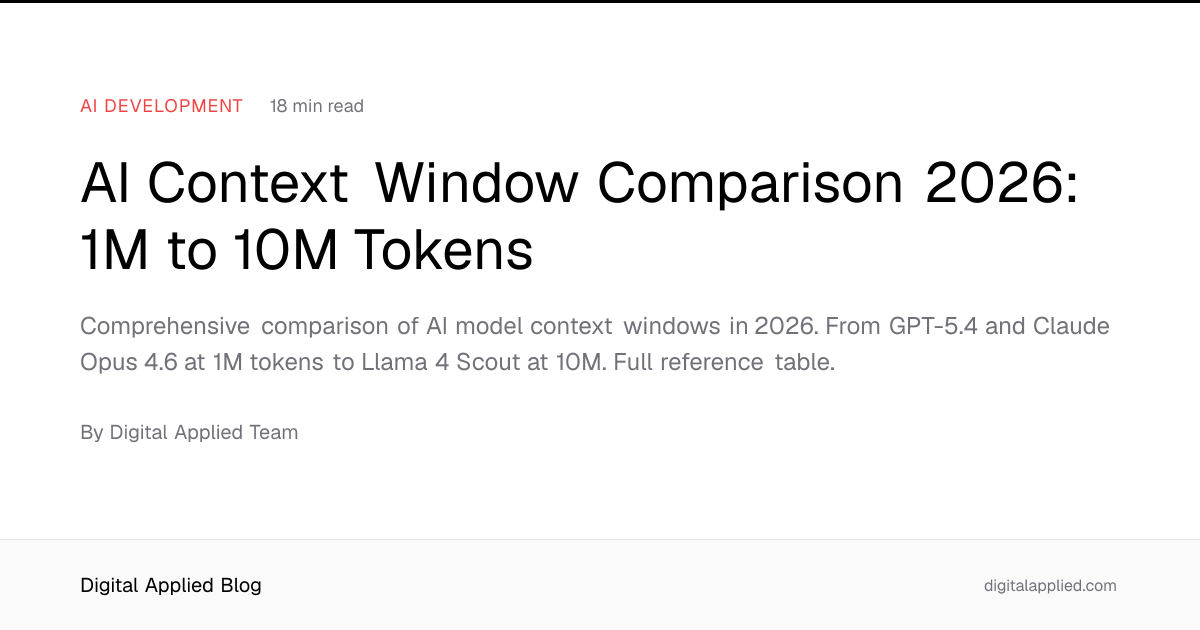
Image source: Digital Applied
| Model Name | Advertised Context | Effective Context (BenchLM) | Output Cap | Price (per 1M tokens) |
|---|---|---|---|---|
| Claude Fable 5.1 | 1 Million | 84.6 High | 128K | $10.00 |
| GPT-6 Astra | 2 Million | 84.1 High | 128K | $8.00 |
| Gemini 3 Pro | 10 Million | 79.8 Mid | 64K | $2.50 |
| Llama 4 Scout | 10 Million | 78.2 Mid | 128K | $0.50 (Local) |
| DeepSeek V4 | 1 Million | 76.5 Mid | 384K | $0.14 |
As shown, while Gemini and Llama offer the largest raw windows, Claude Fable 5.1 maintains a slight edge in reasoning accuracy within its 1-million-token limit. Conversely, DeepSeek V4 stands out as a top choice for value, offering a 71x cost reduction compared to premium frontier models [Source 4, 10].
Why Advertised Context Windows Often Differ from Real-World Performance
A common pitfall for developers in 2026 is assuming that a 10-million-token window is fully "usable." In practice, several technical factors degrade performance as the prompt grows. Understanding these bottlenecks is essential for building reliable AI agents.
The Tokenizer Tax and Why 1 Million Tokens Isn't Always the Same
One of the most significant advancements in 2026 is the introduction of highly efficient tokenizers, but they are not standardized. For instance, Claude Fable 5.1 uses a specialized tokenizer that, while excellent for code, can consume up to 35% more tokens for the same block of text compared to GPT-6 Astra [Source 4]. This "tokenizer tax" means that a 1-million-token window in Claude may actually hold less information than a 1-million-token window in a competing model. When calculating capacity for large datasets, it is vital to test your specific data against each model's tokenizer.
Why Your Model Might Be Losing Information in the Middle of a Prompt
The "Lost in the Middle" phenomenon remains a challenge even in 2026. Research indicates that most models experience a sharp drop in retrieval accuracy when the target information is located between 60% and 70% of the total prompt length [Source 9, 10] . This U-curve of performance means the model is highly attentive to the beginning and end of the input but may "forget" details buried in the center. To mitigate this, many developers are now using "context shuffling" or multi-pass retrieval strategies.
The YES/NO Asymmetry in Long-Context Retrieval
Technical analysis of long-context models has revealed a curious "YES/NO Asymmetry." Models are statistically more reliable at rejecting false information (Verify NO) than they are at confirming the presence of true information (Verify YES) within a massive haystack [Source 7] . Confirming a specific fact requires the model to find a single "needle," whereas rejecting a false claim only requires the model to spot a lack of evidence or a direct contradiction. Claude Fable 5, for example, scores 94% on "Verify NO" but drops to 90% on "Verify YES" at 850,000 tokens.
Deep Dive into the 2026 Market Leaders
The 2026 market is divided between "Frontier Reasoning" models and "Massive Scale" models. Each serves a distinct purpose in the AI ecosystem.
Claude Fable 5.1 and the Gold Standard for Long-Context Reasoning
Anthropic’s Claude Fable 5.1 is widely regarded as one of the best options for complex reasoning over large datasets. While its 1-million-token window is smaller than Gemini’s, its reliability is remarkably high. A key feature of Fable 5.1 is its integration with "Claude Code," which uses tool-assisted retrieval to manage latency. Instead of reading the entire 850K+ haystack into active memory for every sub-task, the model can intelligently query specific segments, maintaining a 90-94% reliability rate [Source 1, 7] .
Meta Llama 4 Scout and the 10 Million Token Local Breakthrough
Llama 4 Scout represents a significant step forward for open-source and local AI. Utilizing a 109B parameter Mixture-of-Experts (MoE) architecture, Scout can handle a 10-million-token window on a single NVIDIA H100 GPU . This is achieved by only activating 17B parameters at any given time across 16 experts [Source 2, 4] . For organizations with strict data privacy requirements, Llama 4 Scout is a top-tier choice for processing massive internal documents without sending data to the cloud.
Gemini 3 Pro and the Tiered Access Limits
Google’s Gemini 3 Pro remains a dominant force in the long-context arena, though its limits can be confusing. Depending on the access tier (API vs. AI Studio), users may see limits ranging from 2 million to 10 million tokens [Source 9, 10] . Gemini 3 Pro is particularly noted for its "Flash" variant, which uses FlashAttention-3 to achieve 1.3 PFLOPs/s on H100 hardware, significantly reducing the latency typically associated with multi-million token prompts.
Magic.dev LTM-2 and the Unverified 100 Million Token Claim
The most ambitious claim in the 2026 market comes from Magic.dev, whose LTM-2-Mini model advertises a 100-million-token window . This would theoretically allow the model to hold the equivalent of 750 novels in active memory. However, it is important to note that as of late 2026, there is no external verification of this capacity in standard benchmarks [Source 2, 4] . It remains an experimental option for those pushing the absolute boundaries of AI memory.
The Hidden Bottleneck of Output Token Limits
While the industry has focused heavily on input windows, the output token limit is often the real bottleneck for developers. If you are using an AI to refactor a massive codebase, a 10-million-token input window is useless if the model can only generate 4,000 tokens of code at a time.
In 2026, DeepSeek V4 leads the market with a 384,000-token output cap. In contrast, industry leaders like Claude Fable and GPT-6 Astra generally hover around 128,000 tokens [Source 4]. This makes DeepSeek a highly impactful tool for generating long-form technical documentation or entire software modules in a single pass.
What Does It Actually Cost to Fill a 10 Million Token Window?
The economic spread in the 2026 AI market is vast. There is currently a 71x cost difference between the most affordable and most expensive ways to process 1 million tokens. Filling a 10-million-token window with Claude Fable 5.1 would cost approximately $100.00 per request, whereas the same volume on DeepSeek V4 Flash would cost only $1.40 [Source 4, 10].
Furthermore, pricing structures have shifted. In early 2026, Anthropic dropped its "long-context surcharge," moving to a flat rate. However, Google and Alibaba continue to use tiered pricing, where the price per token increases once the prompt exceeds the 1-million or 5-million token threshold. Developers must carefully calculate their expected usage to avoid unexpected "bill shocks" when scaling long-context applications.
Frequently Asked Questions
In 2026, 10 million tokens is roughly equivalent to 7.5 million words. For context, this is about 750 average-sized novels or approximately 30,000 pages of standard single-spaced text. This allows for the ingestion of massive technical manuals, entire legal discovery corpora, or the complete version history of a large software project in a single prompt.
Yes, Llama 4 Scout (109B) is designed to run its 10-million-token context on a single NVIDIA H100 (80GB) or equivalent hardware. This is possible due to its Mixture-of-Experts (MoE) architecture, which only activates 17 billion parameters for any specific calculation, and advancements in 4-bit quantization and FlashAttention-3, which significantly reduce the VRAM footprint of the KV cache.
This is likely due to the "Effective Context Threshold." While a model may accept 1 million tokens, its retrieval accuracy often drops significantly after 60–70% utilization. Furthermore, models suffer from "recency bias," where they over-weight information at the very end of the prompt and neglect the middle. Using "needle-in-a-haystack" testing can help you identify the reliable limit for your specific model.
DeepSeek V4 currently holds the record for the largest verified output limit at 384,000 tokens. This is nearly three times the capacity of Claude Fable 5.1 or GPT-6 Astra, which are both capped at 128,000 tokens. This makes DeepSeek particularly useful for tasks that require generating massive amounts of text or code in a single response.
As of late 2026, the industry is split. Anthropic has moved to a flat pricing model for Claude Fable 5.1, meaning you pay the same rate per token regardless of prompt length. However, Google (Gemini) and Alibaba (Qwen) still utilize tiered pricing, where the cost per token can increase by 2x or more once you cross the 1-million-token threshold.
Key Takeaways for 2026 AI Context Windows
- 1M tokens is the new standard for frontier models, with 10M tokens representing the current high-end verified limit.
- Account for the Tokenizer Tax , as models like Claude can use up to 35% more tokens for the same text than competitors.
- Prioritize output caps if your goal is code generation or long-form writing; DeepSeek V4 leads this category with 384K tokens.
- Local models are viable for massive scale, with Llama 4 Scout supporting 10M tokens on a single H100 GPU.
- Reliability is not linear ; expect performance to degrade once you exceed 70% of a model's advertised context limit.
- Cost varies by 71x across the market, making "Flash" models essential for high-volume, long-context tasks.
To ensure the best results, always benchmark your specific data against the BenchLM scores rather than relying solely on advertised token limits.