Home
Which AI Overview Checking Tool Should You Use to Track Your Search Visibility?
In 2026, tracking search visibility requires moving beyond standard rank tracking to Citation Share and Mention Rate . For enterprise-level accuracy, Omnia and Ahrefs stand out as top choices due to their real browser simulation and search-backed prompt methodology. If brand reputation is your priority, GetMint offers specialized sentiment analysis that few competitors match. For most SEO teams, integrating Semrush’s visibility score provides a balanced view of traditional and generative search performance.
Why Tracking AI Overviews Is Now More Important Than Traditional Rankings
The search landscape has undergone a fundamental transformation. As of late 2026, the traditional "blue link" is no longer the primary destination for informational queries. Instead, Google’s AI Overviews (AIO) have claimed "Position Zero," synthesizing complex answers directly at the top of the Search Engine Results Page (SERP). According to official Google data , these snapshots are now active in over 120 countries, fundamentally changing how users interact with information.
This shift has birthed the "Citation Economy." Research indicates that an average AIO cites approximately 8 sources, though this can range from 6 to 14 depending on the complexity of the query. For SEOs, this means that being the #1 organic result is no longer enough; if your brand isn't cited within the AI snapshot, you are effectively invisible to the 88% of users performing informational searches. The goal is no longer just a single rank position, but a high Citation Share across the generative landscape.
Furthermore, the "non-deterministic" nature of AI results presents a massive challenge for manual tracking. Unlike traditional rankings, which remain relatively stable across a region, AIOs can change based on the specific device, the time of day, or even the subtle phrasing of a follow-up question. This volatility makes automated, professional checking tools a necessity rather than a luxury. Without them, you are essentially flying blind in a search environment that updates in real-time.
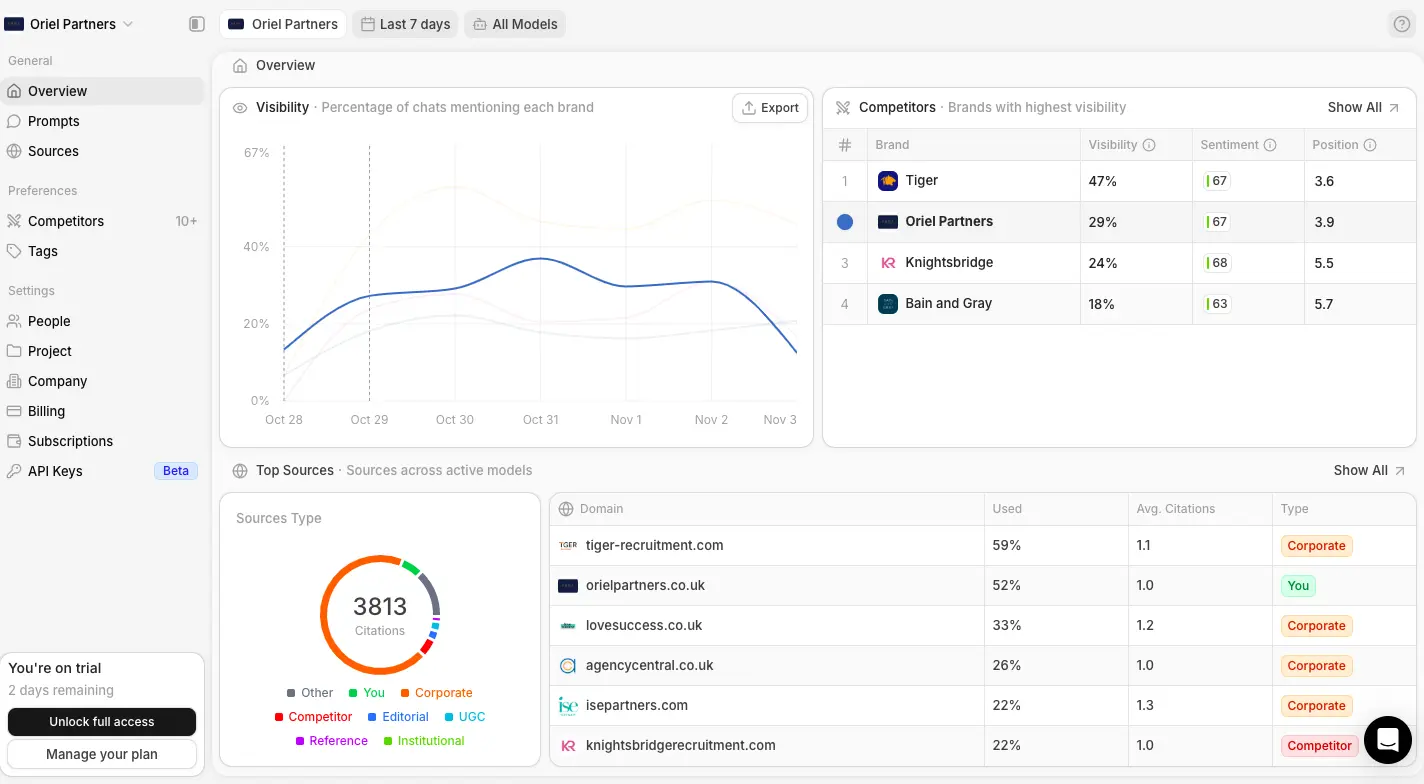
Image source: Position Digital
5 Best AI Overview Checking Tools for Professional SEOs
How Semrush Tracks Your Brand Visibility Across the AI Snapshot
Semrush has integrated AI tracking directly into its core Position Tracking tool, making it a seamless transition for existing users. Their "AI Overviews Visibility Checker" focuses on a proprietary Visibility Score . This metric doesn't just tell you if you are present; it calculates your brand's weight relative to competitors within the snapshot. By aggregating data across thousands of keywords, Semrush allows teams to see macro trends in their generative search presence.
One of the most useful features for smaller teams is their limited free "instant" checker. This allows for one-off URL testing to see how a specific page is performing in the AIO. For enterprise users, the ability to integrate this data into standard PDF reporting is a significant advantage, ensuring that stakeholders understand the value of "Position Zero" wins alongside traditional organic growth.
Why Ahrefs Uses Search-Backed Prompts for More Realistic Data
Ahrefs has taken a distinct methodological approach with its AI Visibility Checker . Rather than testing visibility against synthetic or "made-up" prompts, Ahrefs utilizes "search-backed prompts." This means they track how AI responds to real user queries that have actual search volume. This ensures that the data you receive is grounded in real-world behavior rather than theoretical AI interactions.
Their "Brand Radar" feature is particularly noteworthy. It automates the extraction of citations, identifying not just when your link is present, but when your brand is mentioned as an authority without a direct link. Given that AIOs appear for approximately 64% of informational keywords, having this level of granular data helps SEOs identify which content clusters are most likely to trigger a generative response.
How GetMint Analyzes the Sentiment of Your AI Mentions
While many tools focus on the "if" and "where," GetMint focuses on the "how." In the age of generative search, a mention isn't always a win. If an AI snapshot summarizes your brand in a neutral or negative light, it can be more damaging than not appearing at all. GetMint is widely regarded as a leader in Sentiment Analysis for AIOs, categorizing mentions as positive, neutral, or negative.
This tool is essential for PR and reputation management teams. It provides a "Mention Rate" vs. "Citation Share" breakdown, allowing you to see if you are being cited as a source of data or mentioned as a recommended solution. For brands in sensitive industries like finance or healthcare, monitoring the sentiment of AI-generated summaries is a critical component of modern brand health.
Why Omnia Stands Out for Real Browser Simulation
Technically speaking, Omnia is often cited as a top-tier option for those who require the most accurate data possible. Many tools rely on API-based scraping, which can sometimes return "sanitized" data that doesn't reflect the ad-heavy, messy reality of a real user's screen. Omnia uses Real Browser Simulation , capturing exactly what a human sees in their specific geographic location.
Perhaps its most vital feature is the Timestamped HTML Snapshot . Because AIOs are non-deterministic and can disappear or change within minutes, having an archival proof of the DOM structure is the only way to debug why a citation was lost or to prove a win to a client. As Daniel Espejo, CEO of Omnia, has noted, citation extraction is the "make-or-break" feature for any serious AIO tracking strategy.
Sitechecker and Thruuu for Budget-Friendly Monitoring
For freelancers or smaller agencies, enterprise tools might be cost-prohibitive. Sitechecker and Thruuu offer excellent alternatives that focus on the essentials. These tools provide clear citation tracking and visibility reports without the complex data density of Semrush or Ahrefs. They are particularly useful for those new to Answer Engine Optimization (AEO), offering cleaner interfaces that highlight the most actionable data points first.
How to Choose the Right Tool Based on Your Specific Needs
| Tool Name | Primary Strength | Tracking Method | Sentiment Analysis | Best For |
|---|---|---|---|---|
| Semrush | Ecosystem Integration | API + Hybrid | Basic | Full-stack SEO Teams |
| Ahrefs | Search-Backed Prompts | Real Query Data | Moderate | Keyword Researchers |
| Omnia | Browser Accuracy | Real Simulation | Advanced | Enterprise/Technical SEO |
| GetMint | Brand Reputation | API + NLP | Exceptional | PR & Brand Managers |
| Sitechecker | Ease of Use | API | None | Small Teams/Beginners |
- If you need to prove ROI to stakeholders: Choose a tool with Timestamped Snapshots (Omnia).
- If you are managing a brand's reputation: Choose a tool with Sentiment Tracking (GetMint).
- If you are doing deep keyword research: Choose a tool with Search-Backed Prompts (Ahrefs).
Technical Features That Separate Professional Tools from Basic Checkers
The Difference Between API Data and Real Browser Rendering
When selecting a tool, the underlying technology matters more than the UI. API-based tools are faster and cheaper, but they often miss the nuances of the "Search Generative Experience." APIs can provide a "clean" version of the AI response that ignores the presence of competing ads, local map packs, or shopping widgets that might push the AIO further down the page. Real browser rendering, while more resource-intensive, ensures you are seeing the actual layout, including how much "above-the-fold" real estate the AI snapshot is actually occupying.
Geographic Spoofing and Regional Rollouts
Google’s rollout of AI Overviews has been uneven. While it is available in over 120 countries, specific regions like the European Union have faced delays due to regulatory frameworks like the DMA and GDPR. A professional tool must be able to accurately spoof geographic locations to show you what a user in London sees versus a user in New York. If your tool doesn't account for these regional discrepancies, your global visibility reports will be fundamentally flawed.
Why You Need Timestamped HTML Snapshots to Prove Your Results
Volatility is the defining characteristic of AI search. A citation that appears at 9:00 AM might be gone by 10:30 AM as the model refreshes or the search intent shifts. For agencies, this creates a "trust gap" with clients. Timestamped HTML snapshots allow you to archive the exact state of the SERP at the moment of the check. This isn't just for reporting; it's a diagnostic tool. By analyzing the cached DOM structure, you can see if a competitor's new header or a specific schema markup change allowed them to leapfrog your citation.
How to Build an Answer Engine Optimization (AEO) Workflow
Step 1: Identify Citation Gaps
Use your chosen tool to audit high-volume informational keywords. Look for instances where your competitors are cited in the AIO but your domain—despite ranking in the top 5 organic results—is missing. These are your primary opportunities for optimization.
Step 2: Analyze Source Patterns
Examine the types of sources the AI prefers for your niche. Is it citing Reddit threads, niche blogs, or high-authority news sites? Understanding the "source profile" helps you tailor your content strategy to match the AI's current preference for authority versus community consensus.
Step 3: Content Refinement
Update your content to be more "digestible" for LLMs. This includes using clear H2/H3 headers, bulleted lists for processes, and concise summary paragraphs. Many tools now offer "Action Recommendations" that suggest specific structural changes to improve your chances of being cited.
Finally, monitor your Mention Rate . In 2026, search engines are increasingly moving toward "unlinked mentions" as a signal of authority. If the AI describes your brand as a leader in a specific category but doesn't provide a link, it still contributes to your brand's overall authority and user trust. Tracking these mentions allows you to measure the full impact of your AEO efforts beyond just click-through rates.
Frequently Asked Questions
How do I check if my website is in Google AI Overviews?
You can use free tools like SEO.com or the Semrush instant checker for one-off URL checks. However, for a comprehensive view, you should use an automated tracker that monitors your target keyword list daily, as AIO results are highly volatile and may not appear every time you manually refresh the page.
Are there free AI overview rank trackers available?
Yes, several providers offer limited free tiers. SEO.com currently allows for 3 free checks per day, and Ahrefs provides a limited free visibility checker to capture leads. While these are useful for occasional testing, they lack the historical data and automated tracking required for a professional SEO strategy.
How accurate are AI visibility checkers in 2026?
Accuracy varies based on the tracking method. Tools that use real browser simulation (like Omnia) are widely considered the most accurate because they capture the exact visual state of the SERP. API-based tools are generally reliable for broad trends but may miss specific layout nuances or localized variations.
What is the difference between a standard rank tracker and an AIO tracker?
A standard rank tracker measures your position in the "blue links" (e.g., Position #3). An AIO tracker measures your presence within the generative snapshot, focusing on metrics like Citation Share, Mention Rate, and Sentiment, which are not captured by traditional ranking software.
Can these tools track visibility on ChatGPT and Perplexity too?
Many leading tools, including Omnia and Ahrefs, are expanding their capabilities to include "Answer Engine" tracking across platforms like ChatGPT Search and Perplexity. This allows SEOs to monitor their brand's visibility across the entire generative search ecosystem, not just Google.
Final Recommendations for Your AIO Strategy
Navigating the shift to generative search requires a blend of traditional SEO excellence and new technical monitoring capabilities. Here are the key takeaways for 2026:
- Prioritize Citation Share: Being cited by the AI is the new "Position #1." Focus on earning multiple citations per query.
- Use Browser Simulation: Ensure your tool uses real browser rendering to avoid the "sanitized data" trap of basic APIs.
- Archive Your Wins: Use timestamped snapshots to prove visibility to stakeholders and debug fluctuations in the non-deterministic SERP.
- Monitor Sentiment: Use tools like GetMint to ensure the AI's summary of your brand is positive and accurate.
- Optimize for Informational Intent: Since 88% of AIOs trigger for informational queries, focus your AEO efforts on top-of-funnel content.
- Watch Regional Rollouts: Adjust your tracking strategy based on where AIO is currently active, especially if managing international domains.
As Google's generative features continue to evolve, the most successful SEOs will be those who treat AI Overviews as a primary visibility channel rather than a secondary feature. Choose a tool that provides the technical depth and archival proof needed to navigate this volatile new era of search.