Home
Best Tools for Ranking in Google AI Overviews and Winning at GEO in 2025 and 2026
Ranking in Google AI Overviews (AIO) requires a shift from traditional keyword targeting to Generative Engine Optimization (GEO) . As of late 2026, Semrush and SE Ranking are the leading choices for tracking AIO visibility, while specialized tools like Omnia and Otterly.AI provide deep insights into multi-engine citations. Success now depends on securing "Citation Cards" rather than just narrative mentions, with 40% of sources coming from pages ranked in positions 11-20.
The New Reality of Search Where AI Overviews Dominate the Fold
In late 2026, the search landscape has fundamentally shifted. The traditional "ten blue links" model is no longer the primary way users interact with information. According to recent industry data, the zero-click rate has reached a staggering 83% when an AI Overview is present [Source 4] . This means the vast majority of users find their answers directly within the Google interface without ever visiting a third-party website.
For SEO professionals, this represents a crisis of visibility. Organic click-through rates (CTR) have dropped by approximately 61% on queries featuring an AIO. When an AI summary is generated, users click on traditional organic links in only 8% of searches, compared to 15% when the summary is absent [Source 1]. This shift has forced a transition from standard SEO to Generative Engine Optimization (GEO) , a discipline focused on influencing the LLMs (Large Language Models) that power these summaries.
The prevalence of AIO triggers has jumped significantly, rising from 16% in late 2025 to 25% of all searches by Q1 2026. In high-value commercial sectors, nearly half of all searches now feature an AI-generated response. To survive this "Survivalist Era" of search, brands must move beyond tracking positions and start tracking sentiment share and citation frequency .
How Google AI Overviews Change the Way We Track Rankings
Traditional rank tracking is binary: you are either at position #1 or you aren't. In the world of Gemini-powered search, visibility is nuanced. You must now distinguish between two primary types of AI presence:
- Narrative Mentions: Your brand or content is mentioned within the AI's written response, but no direct link is provided.
- Citation Cards: Your website is featured in the linked carousel or "source" cards, providing a direct path for user traffic [Source 5] .
The Position 11-20 Opportunity for Citation Theft
One of the most surprising developments in 2026 is the "democratization" of citations. Research indicates that approximately 40% of AIO sources originate from pages ranking in positions 11 through 20 on traditional SERPs [Source 2] . This creates a massive opportunity for "Second Page Optimization." If you can format your content to be more "digestible" for Gemini than the top 3 results, you can effectively "steal" the citation card without needing to climb the traditional rankings.
Image source: OMNIUS
Top All-in-One SEO Suites for AI Overview Tracking
For most marketing teams, integrating AIO tracking into existing workflows is the most efficient path. The major SEO suites have updated their infrastructure to handle generative search data.
Semrush: The Practical Choice for Integrated Teams
Semrush has maintained its position as a top-rated choice for professional SEOs by rapidly deploying AIO tracking features. Starting at $139.95/mo , it allows users to filter keywords by "AI Overview" presence. This helps teams identify which parts of their keyword portfolio are most at risk of traffic loss and which present new citation opportunities. Its strength lies in its ability to show historical AIO data, allowing you to see when Google began triggering summaries for specific high-value terms.
Ahrefs Brand Radar for Enterprise Visibility
Ahrefs has taken a more brand-centric approach with its "Brand Radar" feature. Priced at $199/mo per index , this tool is designed for enterprise-level monitoring. It doesn't just track if you rank; it tracks how often your brand is mentioned in the generative narrative compared to your competitors. This is vital for measuring "Share of Model" (SoM), a new metric that is becoming as important as Share of Voice (SoV) [Source 1].
SE Ranking: Strongest Value for Professional SEOs
For those seeking a robust feature set at a more accessible price point, SE Ranking stands out as a top contender at $95.20/mo . It provides detailed tracking for all Google SERP features, including the specific citation cards within AIOs. Many users find its interface more intuitive for tracking the specific "Second Page" opportunities mentioned earlier.
Specialized Tools for Generative Engine Optimization
While the big suites are excellent for general tracking, specialized GEO tools offer deeper technical analysis of how LLMs perceive your content.
- Otterly.AI for Entry-Level Monitoring: At just $29/mo , this is a highly recommended starting point for smaller teams. It focuses specifically on AIO visibility and provides alerts when your brand is cited or dropped from a generative response.
- AIOverview.com for Free Multi-Engine Analysis: This tool provides a baseline understanding of how Google's Gemini compares to other engines like Perplexity or ChatGPT Search. It is one of the few free options that offers a side-by-side comparison of generative responses [Source 4] .
- Profound for Enterprise-Grade GEO: Priced at $399/mo , Profound is built for serious competitors. It analyzes the "reasoning path" of the AI, helping you understand why a competitor was cited over you. It provides actionable recommendations on semantic density and structured data improvements.
- Omnia for Multi-Platform Audits: As search fragments across Gemini, ChatGPT, and Perplexity, Omnia helps ensure your brand narrative remains consistent. It tracks visibility across all major generative engines, not just Google [Source 7] .
Comparison of the Top AI Overview Tracking Tools in 2026
| Tool Name | Starting Price | Google AIO Support | Multi-Engine Support | Primary Use Case |
|---|---|---|---|---|
| Semrush | $139.95/mo | Full | Limited | Integrated SEO Workflows |
| Ahrefs | $199.00/mo | Full | Limited | Enterprise Brand Monitoring |
| SE Ranking | $95.20/mo | Full | No | High-Value Rank Tracking |
| Otterly.AI | $29.00/mo | Full | No | Entry-Level GEO Tracking |
| Omnia | Custom/High | Full | Yes (ChatGPT/Perplexity) | Multi-Platform Audits |
| Profound | $399.00/mo | Deep | No | Advanced GEO Strategy |
| AIOverview.com | Free | Basic | Yes | Baseline Comparisons |
How to Use These Tools for Citation Theft and Ranking
Ranking in AIO isn't about keyword stuffing; it's about information density and formatting . Google’s Gemini model now performs "multi-step reasoning," meaning it can answer layered queries in a single block. To win the citation, you must follow the "First 50 Words" rule.
Google’s AI prefers content that provides a direct, concise answer within the first 2-3 sentences (approximately 50 words). Use your tracking tools to identify keywords where the current AIO answer is vague, then update your content to provide a superior "Direct Answer" block at the very top of your page [Source 2] .
Additionally, implementing Key Takeaway Blocks is a significant step forward for visibility. These summary sections, often placed after the introduction, act as "hooks" for the AI to scrape. By using tools like Profound to audit these blocks, you can ensure they contain the specific semantic entities Gemini is looking for.
Technical SEO Tactics to Control Your AI Presence
While most SEOs want to rank in AIO, there are times when you may want to protect proprietary data from being summarized. Google has introduced "Preview Controls" that allow for defensive SEO.
Using Preview Controls Defensively
You can use the
nosnippet
and
data-nosnippet
tags to prevent Google's AI from scraping specific parts of your page. This is particularly useful for proprietary research or data-heavy tables that you want users to click through to see. However, be aware of the
Visibility Trade-off
: Google has explicitly warned that more restrictive preview permissions will limit your overall visibility in AI-generated responses
[Source 5]
.
Structured Data for 2026
Schema markup remains a top-tier requirement for AIO inclusion. In 2026, the most influential Schema types for generative search are:
- Product Schema: Essential for appearing in the AIO shopping carousels.
- FAQ Schema: Helps the AI understand the direct relationship between questions and answers.
- Review Schema: Influences the "sentiment" of the AI's narrative about your brand.
Measuring Success Beyond Traditional Rank Tracking
In the GEO era, traffic is no longer the only KPI. You must measure Upstream Purchase Intent . This refers to how AIO visibility impacts the buyer journey before they ever reach a Product Detail Page (PDP). If Gemini recommends your product in a "Best of" summary, the user may already be 90% convinced to buy before they click your link [Source 8] .
Tools like Meltwater are now being used by SEO teams to track Sentiment Share . This involves analyzing whether the AI mentions your brand favorably, neutrally, or negatively. Even if you don't get the click, a positive narrative mention in a high-volume AIO can drive significant brand lift and direct-to-site traffic later.
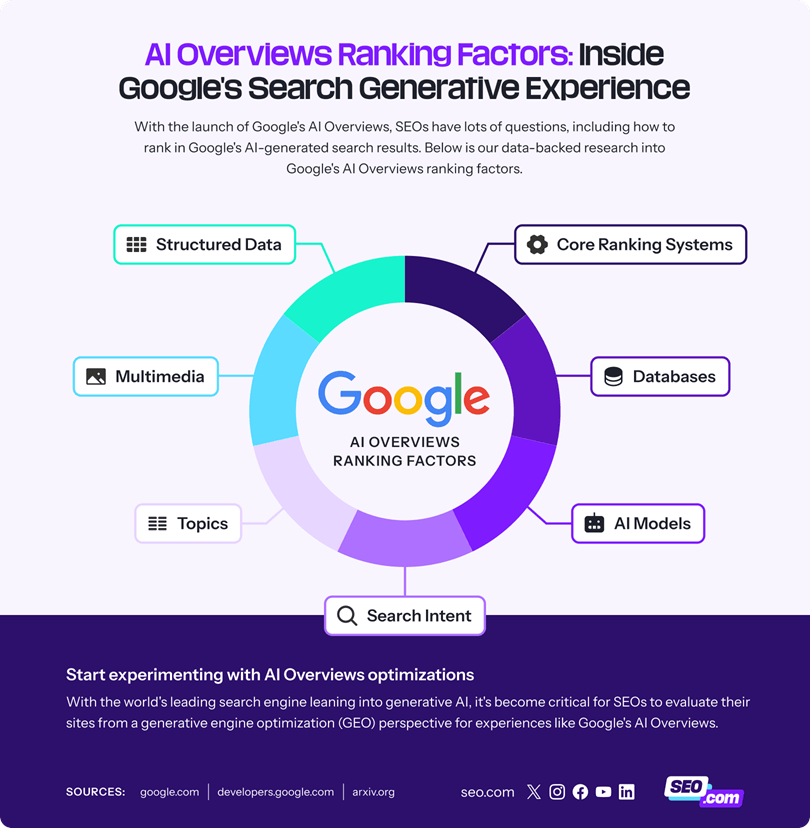
Image source: SEO.com
Frequently Asked Questions
Does Semrush track Google AI Overviews in real-time?
Semrush provides frequent updates, but it is not perfectly real-time for all users. There is typically a data lag of 24-48 hours for standard tracking. However, their "Position Tracking" tool allows for more frequent refreshes on specific high-priority keywords. For true real-time monitoring, specialized tools like Otterly.AI are often preferred by teams managing breaking news or highly volatile markets.
What is the difference between SEO and GEO?
Traditional SEO focuses on keyword matching, backlink profiles, and technical site health to rank in the "blue links." Generative Engine Optimization (GEO) focuses on semantic density , information gain , and formatting to influence the AI's reasoning process. GEO is less about "ranking #1" and more about becoming the "cited authority" that the AI trusts to summarize for the user.
Are there any free tools to track AI rankings?
Yes, AIOverview.com is a popular choice for baseline analysis. It allows you to input a query and see how different generative engines (Google Gemini, Perplexity, etc.) respond. While it lacks the bulk tracking capabilities of paid suites, it is excellent for qualitative research and understanding how your brand is being cited across the generative landscape.
How do I get my product into the AI Overview carousel?
To appear in the AIO carousel, you must prioritize Product Schema and high-quality imagery. Google’s AI heavily favors products that have consistent pricing, availability data, and a high volume of positive third-party reviews. Being featured in "Best of" buying guides on authoritative sites also increases your chances of being pulled into the carousel as a recommended option.
Will using nosnippet hurt my traditional rankings?
According to Google's official documentation, using
nosnippet
or
data-nosnippet
only affects the snippet or AI summary generated for that page. It does not directly lower your traditional organic ranking. However, it will significantly reduce your CTR because your search result will appear as a plain link without any descriptive text, making it much less attractive to users.
Final Thoughts on Navigating the AI Search Era
Success in 2026 requires a fundamental mindset shift. We are moving from an era of "traffic acquisition" to an era of "authority influence." Use this checklist to stay ahead:
- Identify keywords with 25%+ AIO prevalence to prioritize your GEO efforts.
- Audit your positions 11-20 for "Citation Theft" opportunities where the top 3 are failing to provide direct answers.
- Implement the "First 50 Words" rule for all top-performing informational pages.
- Monitor brand sentiment across multiple generative engines using tools like Omnia or Meltwater.
- Leverage structured data (Schema) to give Gemini the technical hooks it needs to cite you.
- Balance visibility with protection by using preview controls on your most sensitive proprietary data.
Start by auditing your top 10 highest-traffic pages today to see if they provide a clear, 50-word direct answer for their primary target query.