Home
How to Choose the Best Google AI Overviews Tracking Tools for Your SEO Strategy
Google AI Overviews (AIO) now trigger for approximately 64% of informational queries , fundamentally altering organic search behavior. While traditional rankings still matter, the real battleground has shifted to citations . Research indicates that while AIOs can cause a 61% drop in organic CTR for standard results, pages cited within the AI summary see a 35% increase in clicks . To maintain visibility, SEOs must transition from simple rank tracking to comprehensive Answer Engine Optimization (AEO) monitoring using specialized tools like SE Ranking, Semrush, and thruuu.
Why Traditional Rank Tracking Fails in the Age of Google AI Overviews
For decades, the SEO industry relied on a simple metric: the blue link position. If you were in Position 1, you captured the lion's share of traffic. However, the integration of Gemini-powered AI Overviews has disrupted this linear relationship. Traditional rank trackers, which primarily scrape static HTML, often fail to capture the dynamic, JavaScript-heavy rendering required to trigger an AI Overview. This creates a "visibility gap" where a brand might rank first in organic results but remain hidden beneath a massive AI-generated block that answers the user's query entirely.
The technical limitations of legacy scrapers are significant. Tracking AIOs requires sophisticated browser automation that mimics real user behavior to trigger the generative response. Furthermore, AI Overviews are non-deterministic; the same query can yield different summaries or citations based on the user's location, search history, and even the time of day. According to Keyword.com , tracking now requires multi-stage data capture to identify not just where you rank, but whether you are cited as a source within the AI's synthesized answer.
This shift has necessitated the rise of Answer Engine Optimization (AEO). In this new paradigm, "rank" is no longer a static number. Instead, visibility is measured by "Share of Citations" and "Entity Clarity." If Google's LLM cannot clearly associate your brand with a specific factual claim, you will be excluded from the overview, regardless of your traditional SEO authority. Tracking tools must now provide snapshots of these AI responses to help SEOs understand the context in which their content is being presented—or ignored.
Which Google AI Overviews Tracking Tools Provide the Most Accurate Data?
The market for AI visibility tracking is currently split into two distinct categories: legacy SEO suites that have integrated AIO modules and specialized, AI-first platforms designed specifically for the generative era. Choosing the right tool depends on whether you need broad keyword data or deep, technical citation analysis.
SE Ranking and Dedicated AIO Monitoring
SE Ranking has emerged as a top choice for teams requiring high-frequency tracking of AI triggers. Their dedicated AIO tracker is built to monitor the 64% of keywords that typically trigger these summaries. One of their standout features is the ability to track the "AI Overview Trigger Rate" across your entire keyword portfolio, allowing you to prioritize optimization for terms where AI presence is most dominant. According to SE Ranking's research , their tool can also integrate with the Model Context Protocol (MCP), enabling users to pull live tracking data directly into AI assistants like Claude for real-time strategy development.
Semrush and Large-Scale Prompt Databases
As one of the most established names in the industry, Semrush offers a massive database of over 261 million prompts. This scale is their primary advantage. While some tools focus on your specific tracked keywords, Semrush provides a broader view of brand mentions across the entire AI ecosystem. This is particularly useful for enterprise brands that need to monitor how their reputation is being synthesized by LLMs at scale. Their "AI Overview" filter in the Position Tracking tool allows users to quickly isolate keywords where they are—or aren't—appearing in the generative snippet.
Specialized Platforms like thruuu and Ziptie
For content teams, specialized tools like thruuu and Ziptie offer a more granular approach. thruuu focuses on a "Tested" methodology, providing detailed content briefs that highlight the gaps between your content and what the AI Overview is currently citing. Ziptie, on the other hand, excels at technical citation extraction and canonicalization, helping SEOs identify when Google is citing a scraper site or a sub-optimal URL instead of the primary brand page. These tools are often considered among the strongest options for deep-dive AEO audits.
| Tool Name | Primary Focus | Key Metric | Best For |
|---|---|---|---|
| SE Ranking | AIO Trigger Tracking | Trigger Rate % | Daily Monitoring |
| Semrush | Market Intelligence | Brand Mentions | Enterprise Strategy |
| thruuu | Content Optimization | Citation Gaps | Content Teams |
| Ziptie | Technical AEO | Canonical Accuracy | Technical SEOs |
| Omnia | Multi-LLM Visibility | Share of Voice | Cross-Platform AEO |
How to Identify Low-Hanging Fruit Opportunities in AI Citations
One of the most effective strategies for recovering lost traffic is identifying "Low-Hanging Fruit" citation opportunities. This occurs when your domain is already being used as a source (a linked citation) within an AI Overview, but your brand name is not actually mentioned in the generated text. This "Citation-Brand Mismatch" is a common occurrence in the early stages of Gemini's rollout.
To capitalize on this, you must use a tool that tracks both the link and the text sentiment. If you find that you are cited but not named, the optimization hack is to update the cited page with clearer entity associations. This involves using structured data (Schema.org) and clear, declarative sentences that link your brand name directly to the facts Google is citing. For example, instead of saying "Our research shows...", use "BrandName's 2026 research shows...". This forces the LLM to recognize the entity behind the data.
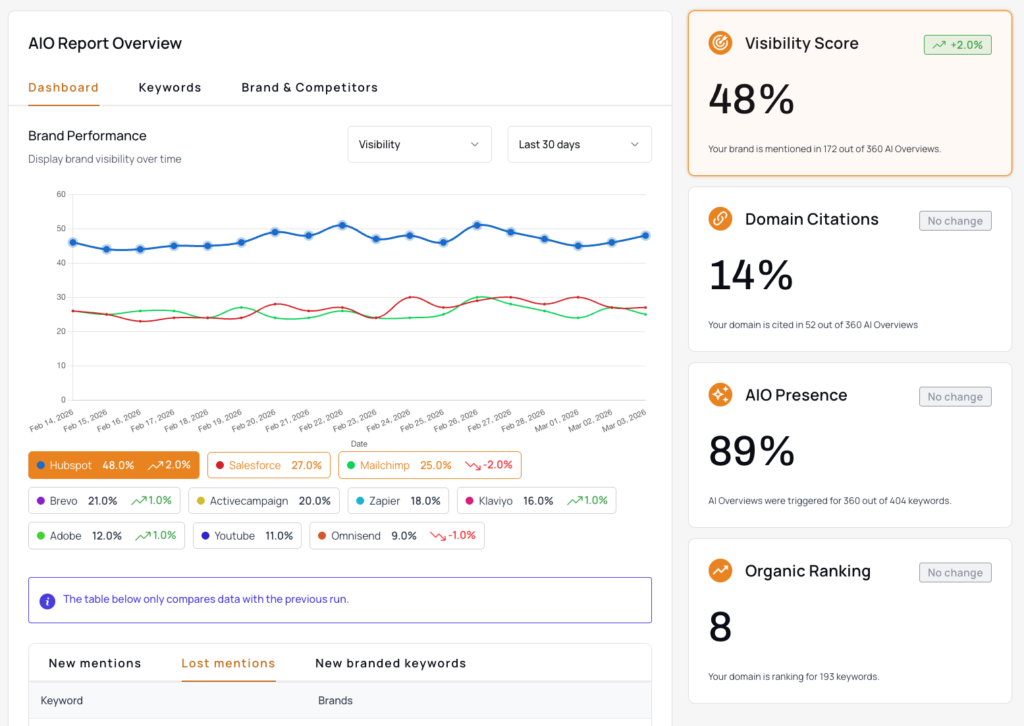
Image source: thruuu
Another key metric to monitor is the "Source Count." On average, Google AI Overviews cite 8 sources per response , though this can range from 6 to 14. If you are consistently the 9th or 10th source, you are on the verge of being excluded if the LLM decides to shorten its response. Tracking your position within the citation hierarchy is just as important as tracking your position in the blue links. Tools like GetMint provide specific dashboards for this "Share of Citations" metric, helping you understand your brand's authority relative to competitors in the AI's eyes.
The Difference Between Tracking AI Overviews and AI Mode Conversions
A common mistake in modern SEO is treating AI Overviews and "AI Mode" (the conversational Gemini interface) as the same thing. They are not. AI Overviews are the synthesized summaries that appear at the top of a standard Search Engine Results Page (SERP). They are relatively static and triggered by the initial query. AI Mode, however, is a multi-turn conversational interface where the user can ask follow-up questions.
Tracking visibility in AI Mode requires a completely different methodology. While an AIO might cite you once, a conversational thread might involve five or six interactions. If your brand is mentioned in the first response but dropped in the second, you have lost the "conversational share of voice." Effective tracking in 2026 requires monitoring the entire chat thread. This involves "Prompt Engineering for Tracking"—running sequences of related questions to see how the LLM's sentiment toward your brand evolves during a conversation.
"The shift from static search to conversational AI means that 'Rank' is no longer a destination; it's a relationship. If the AI doesn't maintain your brand's relevance through the third or fourth follow-up question, your visibility is effectively zero."
Furthermore, the technical pipeline for tracking AI Mode is more complex. It requires browser automation that can handle "multi-turn" states and maintain session context. According to LLMPulse, this is why many traditional rank trackers struggle; they are built for single-request scraping, not session-based interaction. When choosing a tool, ensure it can handle these conversational nuances, as more users move away from the SERP and into the chat interface.
How to Build an Advanced AEO Workflow Using APIs and MCP
For advanced SEO teams, manual tracking is no longer sufficient. The volatility of AI Overviews—which can change multiple times a day—requires an automated workflow. The most sophisticated approach involves using APIs and the Model Context Protocol (MCP) to build a real-time monitoring pipeline. This allows you to pull live AIO data directly into your own internal tools or even into a custom GPT designed for your brand's strategy.
- Automated Prompt Execution: Use a tool's API to run your target keywords through a headless browser every 6 hours. This captures the volatility that a once-a-week check would miss.
- Citation Extraction & Sentiment Analysis: Feed the captured AI text into a sentiment analysis model. Is the AI describing your brand as a "leader," a "budget option," or not mentioning you at all?
- The Social-to-AIO Pipeline: Integrate social listening data. As noted by Meltwater , negative sentiment spikes on forums like Reddit often precede a brand being dropped from AI Overviews, as LLMs use these platforms for "web-scale" sentiment grounding.
- AIO Debugging: When a citation is lost, use archived snapshots to compare the "before" and "after" SERP. Often, a citation is lost not because your content changed, but because a competitor updated their entity clarity or Google changed the "intent" of the query.
This workflow moves SEO from a reactive state to a proactive one. Instead of wondering why traffic dropped at the end of the month, you can see the exact moment an AI Overview changed its citation list and respond by updating your content or structured data within hours. This level of agility is what defines a top-performing AEO strategy in 2026.
Frequently Asked Questions
How do I track Google AI Overviews for free?
While most professional tools require a subscription, you can perform manual tracking by using "site:" searches or incognito windows to see if your brand appears. Some tools like thruuu offer limited free trials or "pay-as-you-go" credits that allow for occasional audits without a heavy monthly commitment. However, for consistent data, a dedicated tracker is usually necessary due to the high volatility of AI results.
Which tool has the most accurate AI Overview data?
Accuracy is subjective in the AI era because results are non-deterministic. However, SE Ranking is widely regarded for its high trigger accuracy, while Semrush offers the most comprehensive historical database. For technical citation accuracy, Ziptie is often cited as a top-tier choice by technical SEO professionals.
What is the difference between AI Overviews and featured snippets?
Featured snippets are direct excerpts from a single webpage, usually appearing in Position 0. AI Overviews are synthesized responses generated by an LLM (Gemini) that draw information from multiple sources (average of 8). While snippets are "extractive," AIOs are "generative," meaning the AI rewrites the information in its own voice.
Can I track AI Overviews at a local or city level?
Yes, but it requires a tool that supports geo-specific IP proxies. Since Gemini results can vary based on local intent (especially for "near me" queries), tools like SE Ranking and Omnia allow you to set specific zip codes or cities to see exactly what a local user would see in their AI Overview.
How often do Google AI Overviews update?
AIOs are highly volatile and can update in real-time as Google's models are tuned or as new web content is indexed. Unlike organic rankings, which might stay stable for weeks, an AI Overview citation can appear and disappear within the same day. This is why high-frequency tracking (at least daily) is recommended for high-value keywords.
Key Takeaways for Your AI Visibility Strategy
- Prioritize Citations Over Rankings: In the AIO era, being cited as a source is more valuable for CTR than ranking in the traditional blue links.
- Monitor the Trigger Rate: Use tools like SE Ranking to identify which 64% of your keywords are most impacted by AI presence.
- Bridge the Brand-Mention Gap: Identify "Low-Hanging Fruit" where you are cited but not named, and update your content for better entity clarity.
- Track Conversational Share of Voice: Don't just monitor the initial AIO; use tools that can track multi-turn conversations in Gemini's AI Mode.
- Integrate Social Sentiment: Use social listening to predict AIO shifts, as LLMs heavily weight community sentiment from forums and blogs.
- Automate with APIs: Build a proactive AEO workflow using MCP to respond to AIO volatility in real-time rather than monthly.
To stay ahead of the curve, start by auditing your top 100 informational keywords to see how many currently trigger an AI Overview and where your brand stands in the citation hierarchy.