Home
How to Find Cheap AI Overview Rank Tracking Tools That Actually Work
Tracking Google AI Overviews (AIO) requires tools that can extract citations and visual snapshots , as traditional "blue link" tracking no longer captures the full search landscape. For budget-conscious SEOs, Rankscale ($20/mo) and Otterly AI ($29/mo) stand out as top choices for specialized monitoring. If you have zero budget, you can manually track AIOs using a combination of localized VPNs, incognito searches, and Google Search Console CTR analysis.
As Google transitions toward a search experience dominated by generative AI, the definition of "ranking" is undergoing a significant shift. It is no longer enough to know if your URL is in the top ten; you must now know if your brand is being synthesized into the AI-generated answer at the top of the page. This shift has created a demand for specialized tracking tools that don't break the bank.
Why Tracking AI Overviews Is Different From Traditional SEO
Traditional rank tracking is a binary game: you are either on the page or you aren't. AI Overviews change this dynamic by introducing a layer of synthesized content that sits above organic results. According to research from Omnia , AIOs now appear in approximately 13% of global searches, with that number jumping as high as 64% for specific long-tail, informational queries.
The Shift from Links to Citations
In the AIO era, visibility is measured by citations. Google’s Gemini-powered engine pulls data from multiple sources to create a single cohesive answer. Being "ranked" now means being one of the small cards or links cited within that text block. If you are cited, you gain authority; if you aren't, your traditional Position 1 link might be pushed so far down the page that its click-through rate (CTR) collapses.
The Volatility Factor
AI Overviews are non-deterministic. This means that the same search query can produce different results based on the user's location, device, and even the time of day. Unlike traditional SERPs which remain relatively stable for hours or days, an AIO block can vanish or change its cited sources in a matter of minutes. This volatility makes high-frequency, localized tracking a necessity rather than a luxury.
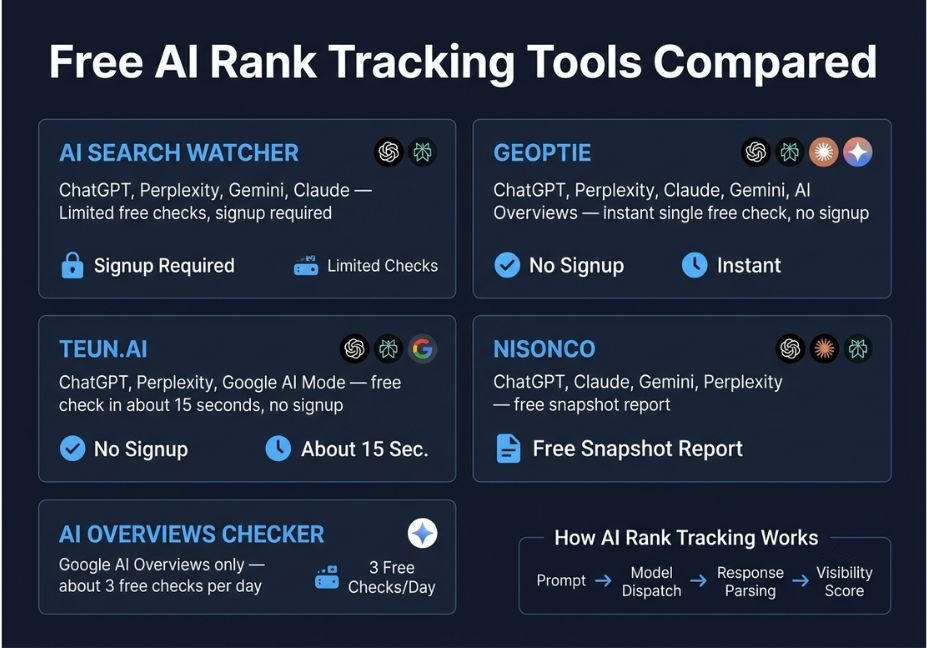
Image source: Agentive AI Agents
The Position 1 Trap and How Tools Report Rankings Differently
One of the most confusing aspects of the current SEO landscape is how different tools report "Position 1." There is a significant discrepancy between visual reality and ordinal ranking data. For instance, a tool might report that your site is in Position 1, but when you look at the actual screen, an AI Overview block and two sponsored ads are occupying the entire first fold of the device.
The Semrush vs. Reality Conflict
Research highlighted by Mission Growth notes that some major platforms, such as Semrush, have historically marked any citation within an AIO as a #1 ranking. While this looks great on a client report, it can be misleading. If the AIO block itself is positioned below a local map pack or a "People Also Ask" section, your "Position 1" citation might actually be visually equivalent to Position 5 or 6 in terms of user eye-tracking.
Visual Position vs. Ordinal Rank
A study by Ahrefs found that roughly 8.64% of AI Overviews sit outside the very top spot, sometimes appearing as low as Position #6. If your rank tracker only looks at the order of links and ignores the visual pixel height of the AIO block, you are missing the most critical data point: Share of Voice . Affordable tools that provide "SERP Snapshots" are essential because they allow you to see exactly where the AI block sits relative to the user's viewport.
Comparing the Top Affordable AI Overview Trackers for Every Budget
Finding a tool that balances cost with the technical requirements of AIO tracking—such as citation extraction and mobile rendering—is a challenge. Below is a comparison of the most effective budget-friendly options available as of late 2026.
| Tool Name | Entry Price | AI Screenshots | Citation Extraction | Best For |
|---|---|---|---|---|
| Rankscale | $20/mo | Yes | Yes | Specialized AI Visibility |
| Otterly AI | $29/mo | Yes | Partial | Brand Mention Tracking |
| Zutrix | $9/mo | No | No | Basic Rank Monitoring |
| LLM Pulse | €49/mo | Yes | Yes | Small Agencies |
| Wincher | $39/mo | Yes | No | Freelancers |
Rankscale ($20/mo)
Rankscale has emerged as a strong contender in the budget space by focusing specifically on "AI Visibility." Unlike legacy trackers that added AIO support as an afterthought, Rankscale was built with the generative era in mind. It provides detailed reports on which keywords trigger an AIO and whether your domain is cited within the text or the accompanying carousel.
Otterly AI ($29/mo)
For those more concerned with brand reputation than just raw rankings, Otterly AI offers a notable approach. It tracks how your brand is mentioned across various LLMs and search engines. It is particularly useful for seeing the context of a mention—whether the AI is recommending your product or simply listing it as an alternative.
LLM Pulse (€49/mo)
While slightly more expensive, LLM Pulse is widely regarded as a top-tier option for small agencies. It offers white-label reporting and deep citation analysis. According to LLM Pulse's own benchmarks , their tool tracks over 16 different AI-related SERP features, making it one of the most comprehensive trackers for the price point.
Practical Steps to Track Google AI Overviews Without Spending Money
If you are operating on a $0 budget, you can still monitor AI Overviews effectively. This requires a manual pipeline that mimics the behavior of automated tools. While it is time-consuming, it provides the highest level of accuracy because you are seeing the results exactly as a user would.
- Set Up a "Clean" Environment: Use a fresh Incognito window and a localized VPN. Google’s AI results are heavily influenced by your search history and IP address. To see "neutral" results, you must strip away these personalization factors.
- Execute Prompt Engineering for SEO: Don't just search for your keyword. Search for the questions your customers ask. AIOs are far more likely to trigger for "How to..." or "What is..." queries than for head terms like "running shoes."
- Document Presence and Citations: Create a Google Sheet with columns for: Keyword, AIO Present (Y/N), Visual Position (e.g., Top, Middle, Bottom), and Cited Domains. This allows you to track trends over time and see if certain competitors are consistently winning the AI slot.
- Infer Impact via Google Search Console (GSC): Look for keywords where your "Average Position" is stable (e.g., 1.2) but your "CTR" is declining. This is a classic indicator that an AI Overview is siphoning off clicks. GSC won't tell you that an AIO exists, but the data patterns will scream it.
Additionally, leverage free tiers from tools like Omnia (which often offers a limited number of free topics) or Rankscale’s trial version to supplement your manual data with automated snapshots.
Using the Listicle Shortcut to Gain Visibility in Search Generative Results
One of the most effective strategies for gaining AIO visibility doesn't involve your own website at all. In many SEO communities, this is known as the "Listicle Shortcut." Google’s AI often prefers to cite aggregated content—like "Top 10" lists or "Best of" reviews—rather than individual brand sites.
Tracking Mentions Instead of Domains
Instead of only tracking your own domain's rank, use your affordable tracker to monitor the visibility of the third-party articles that mention your brand. If a "Best CRM Software" listicle from a high-authority site like G2 or Forbes is being cited in the AI Overview, and your brand is featured in that listicle, you are effectively "piggybacking" on their success.
Why Google Cites Listicles
AI models are trained to provide balanced, comprehensive answers. Citing a single brand can seem biased, whereas citing a comparison list provides the user with multiple options, which aligns better with Google’s helpful content guidelines. By ensuring you are mentioned in the top-ranking listicles for your niche, you increase your chances of appearing in the AIO carousel by proxy.
Image source: Marketing With Dishant -
Essential Features to Look for in an Affordable Rank Tracker
Not all "cheap" tools are created equal. To ensure you are getting actionable data, your chosen tracker should offer at least three of the following four features:
1. SERP Snapshots
As discussed, visual proof is mandatory. A tool that only gives you a number (e.g., "Position 1") is useless if you can't see that an AI block is pushing your link below the fold. Snapshots allow you to diagnose layout changes and see exactly how your citation appears to the user.
2. Citation Extraction
The tool must be able to "read" the AI text and identify which URLs are being linked. This is technically difficult because AIO links are often embedded in small icons or expandable carousels. According to SitePoint , citation extraction is the primary feature that separates modern AI trackers from legacy SEO tools.
3. Mobile vs. Desktop Parity
AI Overviews trigger differently across devices. On mobile, an AIO block can take up 100% of the initial screen real estate. Your tracker must be able to toggle between mobile and desktop crawlers to give you a full picture of your visibility.
4. Mention Quality Analysis
Does the AI describe your product as "affordable" or "premium"? Does it mention your key features? Advanced budget tools are beginning to incorporate sentiment analysis to help you understand not just that you were mentioned, but how you were described.
How to Use Tracking Data for Effective Answer Engine Optimization
Once you have the data from your cheap rank tracking tools, you need to act on it. This process is often called Answer Engine Optimization (AEO). It involves tweaking your content specifically to satisfy the requirements of Google’s generative engine.
Diagnosing Lost Citations
If your tracker shows that you were cited last week but have been replaced by a competitor this week, use "Snapshot Debugging." Look at the competitor’s page. Did they add a clear, concise definition at the top of their article? Did they use schema markup that you are missing? Often, Google swaps citations because another source provided a more "digestible" answer for the LLM.
Content Tweaking for Citations
To win back an AIO slot, try the following:
- The "TL;DR" Header: Add a 2-3 sentence summary at the beginning of your informational posts.
- Structured Data: Use FAQ and How-To schema to make your data easier for the AI to parse.
- Direct Answers: Ensure your H2 headings are phrased as questions and the immediate following paragraph provides a direct answer.
Frequently Asked Questions About AI Overview Monitoring
- Can I track Google AI Overviews for free?
- Yes, you can use manual workflows involving incognito browsing and localized VPNs. Additionally, some tools like Omnia and Rankscale offer limited free tiers or trials that allow you to monitor a small number of keywords without a subscription.
- Why does my rank tracker show Position 1 but I don't see the AI Overview?
- This is due to the non-deterministic nature of AI Overviews. Google frequently tests different layouts for different users. Your tracker might have caught an AIO during its daily crawl, but by the time you checked manually, Google may have rotated the result or removed the block for your specific IP.
- Do standard rank trackers like SERP Robot support AIO?
- Most traditional trackers are adding basic AIO detection (e.g., a checkbox indicating an AIO is present), but they often lack the "citation extraction" needed to tell you if your site is the one being cited. For serious AIO SEO, specialized tools are currently more accurate.
- How often do AI Overview trackers update?
- Most affordable plans offer daily updates. However, because AIOs are so volatile, some high-tier agency plans offer real-time or hourly tracking. For most small businesses, daily updates are sufficient to spot long-term trends.
- What is the cheapest tool for an agency?
- LLM Pulse and Rankscale Pro are generally the most cost-effective for agencies because they offer bulk keyword tracking and white-label reports at a lower per-keyword cost than the "Big Three" SEO suites.
Key Takeaways for Choosing Your AI Rank Tracking Strategy
- Prioritize visual snapshots over simple numerical rankings to understand the true "above the fold" impact.
- Don't trust "Position 1" labels blindly; verify if the tool is counting AIO citations as the top spot.
- Monitor your mention profile across the web, as being cited in a top-ranking listicle is often easier than ranking your own domain.
- Use manual checks periodically to verify the accuracy of your automated tools, especially for high-value keywords.
- Focus on Answer Engine Optimization (AEO) by adding concise summaries and structured data to your content.
- Start with a budget tool like Rankscale ($20/mo) before scaling up to more expensive agency suites.
Start by auditing your top 10 most important informational keywords manually today to see how many are currently triggering an AI Overview.