Home
How AI-Powered Estimating Tools Help Contractors Bid Faster and More Accurately
In 2026, AI-powered estimating tools have transitioned from experimental tech to a standard requirement for competitive bidding. These tools, such as Togal.ai and Beam AI , automate the "grunt work" of quantity takeoffs, allowing contractors to bid up to 7x faster. While AI handles symbol detection and area measurements with roughly 98% accuracy, the most successful contractors use a hybrid workflow , combining machine speed with human logic to ensure project-specific nuances are never missed.
How AI Is Changing the Way Contractors Bid on Projects
The construction industry has long been tethered to manual processes. For decades, estimators spent hours hunched over paper blueprints or digital PDFs, armed with highlighters and click-counters. This manual approach was not only slow but prone to human error—a single missed symbol could result in thousands of dollars in lost profit. As we move through 2026, the shift from manual to machine is nearly complete.
Modern AI-powered estimating tools for contractors utilize computer vision and machine learning to "read" blueprints. Unlike basic automation, which simply follows rigid rules, these tools learn to identify complex symbols, detect scales, and even interpret handwritten notes on drawings. According to Autodesk , the distinction between simple automation and true AI lies in the software's ability to learn from historical data to predict outcomes rather than just performing repetitive tasks.
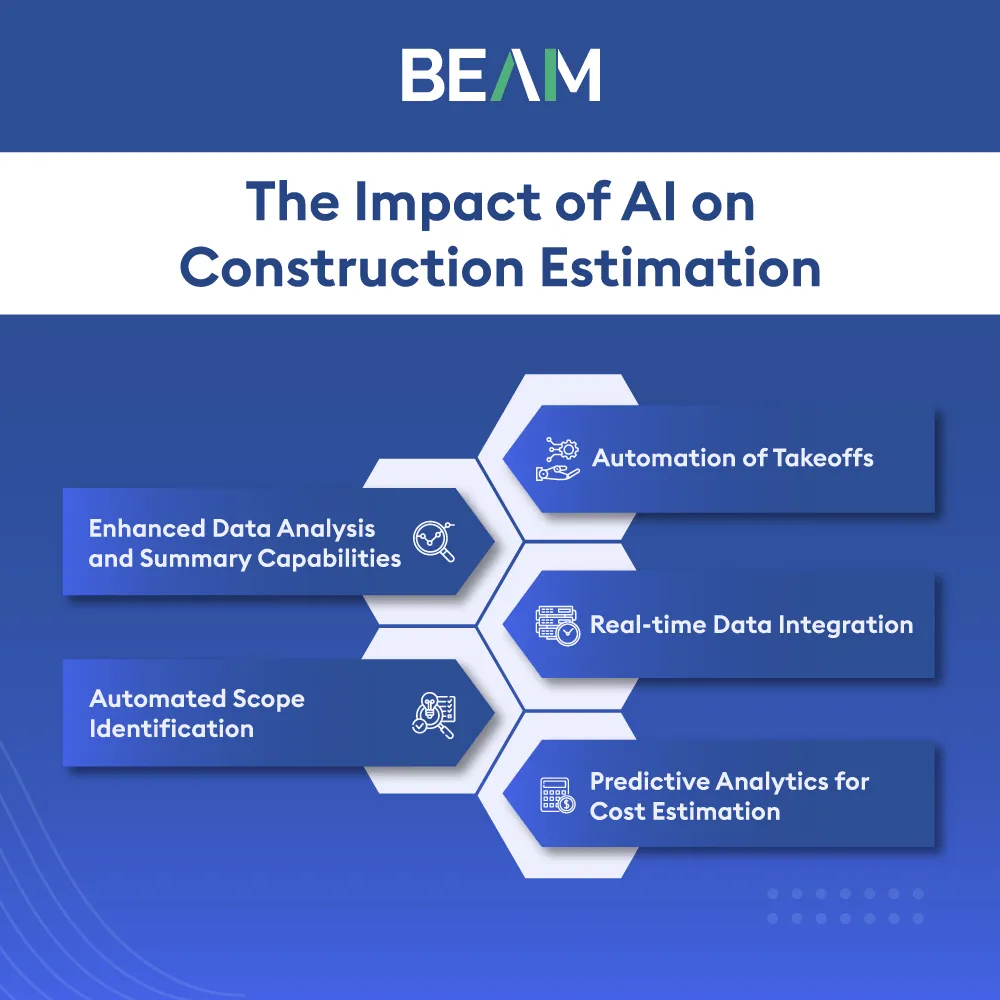
Image source: Beam AI's takeoff
Contractors today are looking for more than just speed; they are looking for a competitive edge. In a high-volume bidding environment, the ability to turn around an accurate estimate in hours instead of days is a significant advancement. However, the fear of losing accuracy remains the primary hurdle for adoption. The 2026 landscape addresses this by offering "Human-in-the-loop" systems that provide the speed of AI with the verification of a professional estimator.
Why Most Contractors Are Switching to AI-Powered Estimating
The adoption of AI in construction isn't just about following a trend; it's about survival in a market where margins are thin and labor is expensive. Several key drivers are pushing contractors toward these notably innovative tools:
- The Speed Advantage: Tools like Beam AI report a 90% reduction in takeoff time, allowing teams to focus on strategy rather than counting.
- Winning More Bids: There is a direct correlation between bid volume and win rates. By completing estimates up to 7x faster, contractors can bid on three times as many projects without increasing their headcount.
- Reducing Human Fatigue: Estimating is mentally taxing. AI handles the "redundant stuff"—renaming pages, extracting tables via OCR, and setting scales—which reduces the likelihood of errors caused by estimator burnout.
- Data-Driven Accuracy: While a human might miss a small electrical symbol on page 40 of a 200-page set, AI systems like Trimble's identify and count over 200,000 objects monthly with consistent precision.
Professional estimators on forums like Reddit often refer to the "Intern Work Problem." They value AI most when it handles the low-level data entry that usually falls to junior staff. By automating these tasks, senior estimators can spend their time on "The Logic"—adjusting for site conditions, negotiating with suppliers, and refining the final bid strategy.
Top AI Estimating Tools for Different Construction Trades
Not all AI tools are created equal. Some are built for massive commercial skyscrapers, while others are tailored for the local home remodeler. Choosing the right tool requires understanding your specific trade's needs and your team's technical comfort level.
| Tool Name | Primary Trade | Key AI Feature | Pricing Model |
|---|---|---|---|
| Togal.ai | Commercial | Togal.CHAT (Conversational Plans) | Per User / Month |
| Beam AI | General / MEP | Human-Verified Takeoffs | Per Project / Subscription |
| Buildxact | Residential | 30-Second Estimate Calculator | Tiered Subscription |
| Trimble LiveCount | MEP / Electrical | Auto-Scale & Symbol Detection | Enterprise License |
| STACK | General / Sub | Cloud-Based Collaboration | Annual Subscription |
Togal.ai for Large-Scale Commercial Takeoffs
Togal.ai stands out as a top choice for commercial contractors dealing with massive plan sets. Its most notable feature is Togal.CHAT , which allows estimators to "talk" to their blueprints. Instead of searching through hundreds of pages for a specific flooring spec, you can simply ask the AI, "What is the total square footage of Grade A carpet in the lobby?" and it will highlight the relevant sections and provide the count.
Togal claims a 98% accuracy rate for its automated symbol detection. For large firms, this means the difference between spending a week on a takeoff and finishing it in a single afternoon. It is widely considered one of the best options for high-volume commercial bidding.
Beam AI for Human-Verified Accuracy
For contractors who remain skeptical of "Instant AI," Beam AI offers a unique middle ground. Rather than just providing a software interface, Beam provides a QA-checked takeoff service . The AI performs the initial extraction, but a human professional verifies the quantities before the data is delivered to the contractor (typically within 24-72 hours).
This model addresses the "trust gap" that many professional estimators feel toward fully autonomous systems. It ranks among the top choices for contractors who need high-precision takeoffs but don't have the internal staff to verify every single AI-generated line item.
Buildxact for Residential Builders and Remodelers
Buildxact is a premier option for small to mid-sized residential builders. Their AI Estimator Calculator is designed for speed, claiming to produce estimates in as little as 30 seconds for standard residential projects. It integrates takeoff, estimating, and project management into a single workflow, making it a strong contender for builders who want an all-in-one solution rather than a specialized takeoff tool.
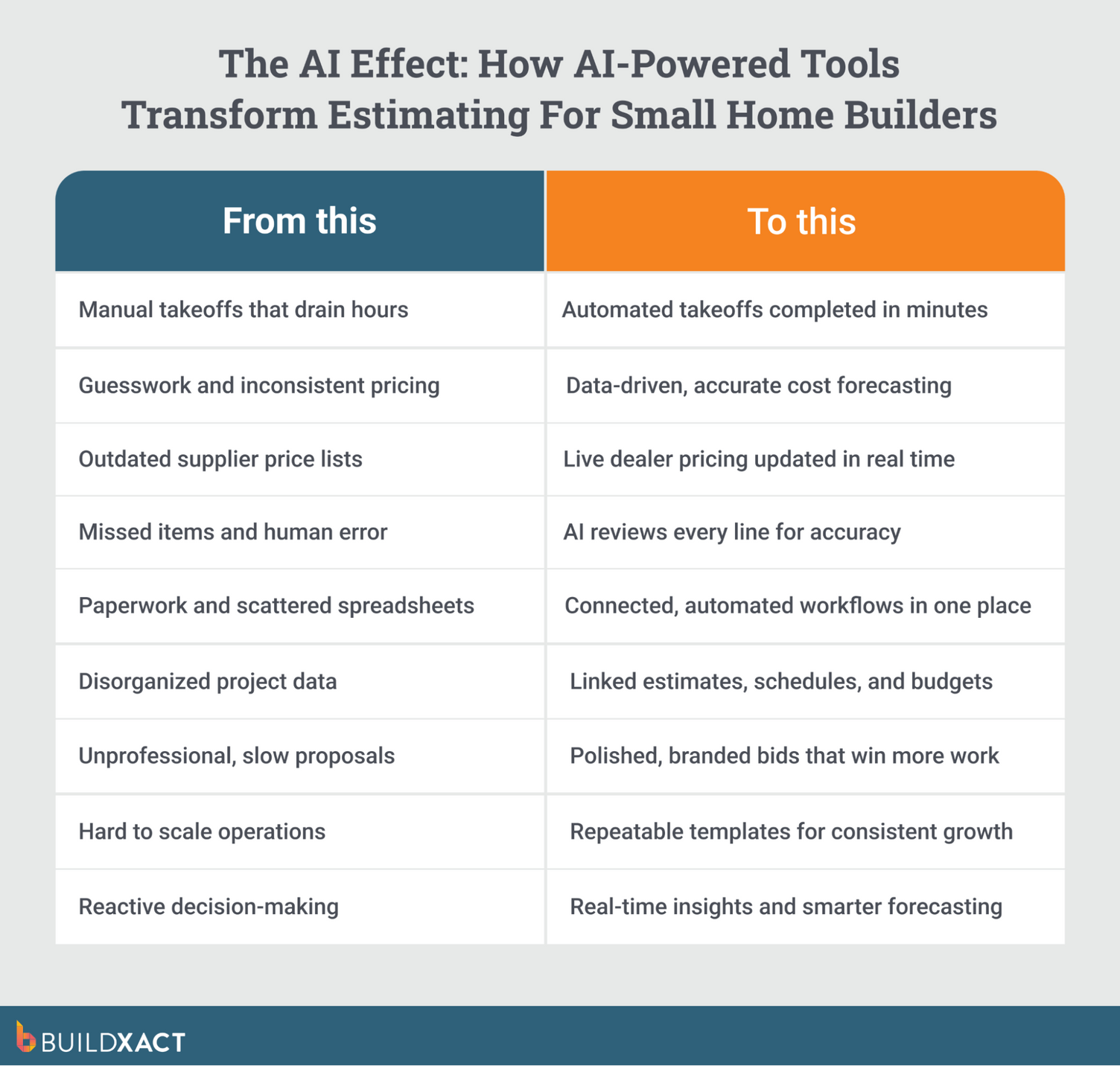
Image source: Buildxact
Trimble LiveCount for MEP and Electrical Specialists
MEP (Mechanical, Electrical, Plumbing) work is notoriously difficult to automate because of the density of symbols on the plans. Trimble LiveCount uses specialized AI to detect scales with 95% accuracy—a critical feature, as an incorrect scale on an electrical plan can lead to massive material shortages. Trimble’s AI is highly capable of identifying complex electrical symbols that general-purpose AI tools might miss.
STACK for Enterprise Collaboration
STACK is a popular choice for large teams that need to collaborate in the cloud. While its AI features are robust, its strength lies in its integration capabilities. It allows multiple estimators to work on the same project simultaneously, with AI-driven quantity updates reflecting across the entire team in real-time. It sets a high standard for enterprise-level takeoff software.
Kreo for Advanced Users
Kreo is often cited by power users as a highly impactful tool due to its deep customization options. However, feedback from the estimator community suggests it has a steeper learning curve than Togal or Buildxact. It is an excellent choice for firms that have dedicated BIM managers or tech-savvy estimators who want to fine-tune how the AI interprets their specific drawing styles.
How to Spot the Difference Between Real AI and Basic Automation
In the current market, many software providers use "AI" as a marketing buzzword for what is actually just basic automation. Understanding the difference is vital for making an informed investment.
- Basic Automation
- Follows a "If X, then Y" logic. For example, if you click a symbol, the software counts all identical pixels. It does not learn or adapt to variations in drawing quality.
- Artificial Intelligence (Machine Learning)
- Learns from historical data. It can recognize a "fire alarm" symbol even if it's slightly rotated, drawn by a different architect, or partially obscured by a line. It improves its accuracy over time.
- The LLM Trap (ChatGPT)
- Many contractors ask, "Can ChatGPT do my estimates?" According to RSMeans (Gordian) , general Large Language Models are not built for estimating. They lack real-time cost databases and cannot "see" blueprints with the precision required for construction. Using them for cost data often results in "hallucinations" or outdated pricing.
The most effective AI tools today are purpose-built. They integrate with cost databases like RSMeans to provide predictive market analytics, forecasting how material prices might fluctuate during the project lifecycle, rather than just providing a static count of items.
The Hybrid Workflow That Combines AI Speed with Human Logic
The most successful implementation of AI in construction follows the 80/20 Rule : AI handles 80% of the grunt work (the count), while the human estimator provides the 20% critical logic (the bid strategy). This hybrid workflow is the most effective way to bridge the trust gap.
- Data Preparation: Before uploading to an AI tool, ensure your PDFs are clean. AI struggles with low-resolution scans or messy hand-drawn blueprints. Getting your "data in order" is a prerequisite for AI success.
- The AI "Count": Let the machine perform the initial pass. It will detect symbols, measure linear runs for piping or wiring, and calculate areas for flooring or roofing.
- The Human "Logic" Review: This is where the estimator shines. You must review the AI's work to account for site-specific variables—such as difficult access, local labor rates, or specific project requirements—that a machine cannot know.
- Verification: Perform a spot-check on the most high-risk items. If the AI counted 500 light fixtures, verify a sample area to ensure the detection logic was sound.
What Do These AI Tools Actually Cost?
Pricing for AI estimating tools varies significantly based on the size of your firm and the complexity of your projects. According to benchmarks from The Digital Project Manager , you can expect the following tiers:
- Entry-Level ($12 - $50 / month): Tools like Monday.com or basic versions of Hover. These offer limited AI features, mostly focused on task management or simple 3D measurements from photos.
- Mid-Range ($129 - $300 / month): Professional tools like Togal.ai or ConstructConnect. These are purpose-built for takeoffs and offer robust symbol detection and cloud collaboration.
- Enterprise ($800 - $2,500+ / year): Comprehensive suites like STACK or eTakeoff. These often include advanced integrations with CRM and accounting software, designed for large teams with high bid volumes.
Be aware of hidden costs, such as training time for your staff and data migration fees. While a tool might seem affordable, the cost of "Free AI" (like using unverified ChatGPT data) can be astronomical if it leads to a massive underbid on a project.
Common Pitfalls to Avoid When Implementing AI in Your Bidding Process
Even the most advanced tools can fail if implemented poorly. Contractors should be wary of the following common mistakes:
"The biggest mistake I see is contractors expecting the software to be a 'magic button.' It's a power tool, not an autopilot system." — Common sentiment among professional estimators on industry forums.
- Over-Reliance on Marketing Accuracy: A "99% accuracy" claim still means 1 out of every 100 items is wrong. On a large project, that 1% can represent a significant financial risk.
- Complexity Overload: Don't buy a tool that is too complex for your team to use. If the software is so difficult that your estimators revert to manual methods, the investment is wasted.
- Ignoring Integration: Your estimating tool should talk to your project management and accounting software. Data silos lead to manual data re-entry, which introduces the very errors AI is supposed to prevent.
- Poor PDF Quality: AI is only as good as the data you feed it. If you upload blurry, low-resolution plans, the AI's detection capabilities will drop significantly.
Frequently Asked Questions
Can ChatGPT actually do construction estimates?
By most accounts, no. While ChatGPT is excellent at drafting emails or summarizing text, it lacks the ability to accurately read architectural blueprints or access real-time, localized construction cost data. Using it for estimating often leads to "hallucinations" where the AI invents prices or misses critical project specs. For accurate bidding, you need purpose-built AI like Togal or Beam.
What is the most accurate AI takeoff software?
Accuracy depends on the trade, but Beam AI is widely regarded as one of the most reliable because it includes a human verification step. For "instant" AI, Togal.ai and Trimble report accuracy rates in the 95-98% range. However, no software should be used without a final human review to ensure project-specific logic is applied.
Are there any free AI tools for small contractors?
Truly "free" AI tools for construction are rare due to the high processing power required for computer vision. However, many top-tier tools like Buildxact and STACK offer free trials or limited versions. Small contractors can also use tools like Monday.com for basic bid tracking, though these lack advanced automated takeoff features.
How does AI handle hand-drawn blueprints?
AI struggles with hand-drawn plans because they lack the standardized vector data found in modern CAD-generated PDFs. While some OCR (Optical Character Recognition) tools can read handwritten notes, the symbol detection accuracy drops significantly. For hand-drawn plans, a manual or semi-automated approach is still recommended.
Does AI estimating software require an internet connection?
Most modern AI estimating tools are cloud-based. This is because the complex machine learning algorithms require significant server-side processing power that most standard laptops cannot handle locally. A stable internet connection is typically required to upload plans and process the AI takeoff.
Final Thoughts on Choosing the Right AI Tool
Transitioning to AI-powered estimating is a significant step forward for any contracting business. To succeed, keep these key takeaways in mind:
- AI is for "The Count," Humans are for "The Logic": Use the machine to handle the repetitive quantity extraction, but never skip the professional review.
- Start with trade-specific tools: If you are an electrical contractor, a tool like Trimble LiveCount will serve you better than a general-purpose residential tool.
- Prioritize integration: Ensure your new tool fits into your existing tech stack (CRM, Accounting, Project Management).
- Verify the data: Always perform spot-checks on AI-generated counts to ensure the scale and symbol detection are accurate for that specific plan set.
- Invest in training: The most capable tool is useless if your team doesn't know how to leverage its advanced features.
- Focus on ROI, not just price: A more expensive tool that saves 3,500 hours a year is far more valuable than a cheap tool that requires constant manual correction.
The bottom line is that AI will not replace professional estimators, but estimators who embrace these tools will certainly replace those who continue to rely on manual methods.
Start by identifying the most time-consuming part of your current bidding process and look for a tool that specifically automates that bottleneck.