Home
March 2026 AI Launch Calendar Tracks Every Major Model and Tool Release
March 2026 is widely considered a pivotal month in artificial intelligence, marked by a "Relentless Week" (March 10–22) of major releases. Key highlights include the rollout of GPT-5.4 with native computer-use capabilities, Gemini 3.1 Ultra featuring a 2-million token context window, and Claude 4.6 introducing adaptive reasoning. Additionally, DeepSeek V3.2 has triggered a global price war with input costs as low as $0.28 per million tokens. This month marks the definitive shift from generative chatbots to autonomous agentic workflows.
The landscape of artificial intelligence has shifted dramatically as of late 2026. What was once a steady stream of incremental updates has transformed into what industry analysts call the "AI Avalanche." According to Switas , March 2026 represents a convergence of hardware breakthroughs at NVIDIA GTC and software milestones from the world's leading labs. This synchronization has compressed product launch cycles from 24 weeks down to a mere 6 weeks, forcing founders and developers to adopt highly aggressive go-to-market strategies.
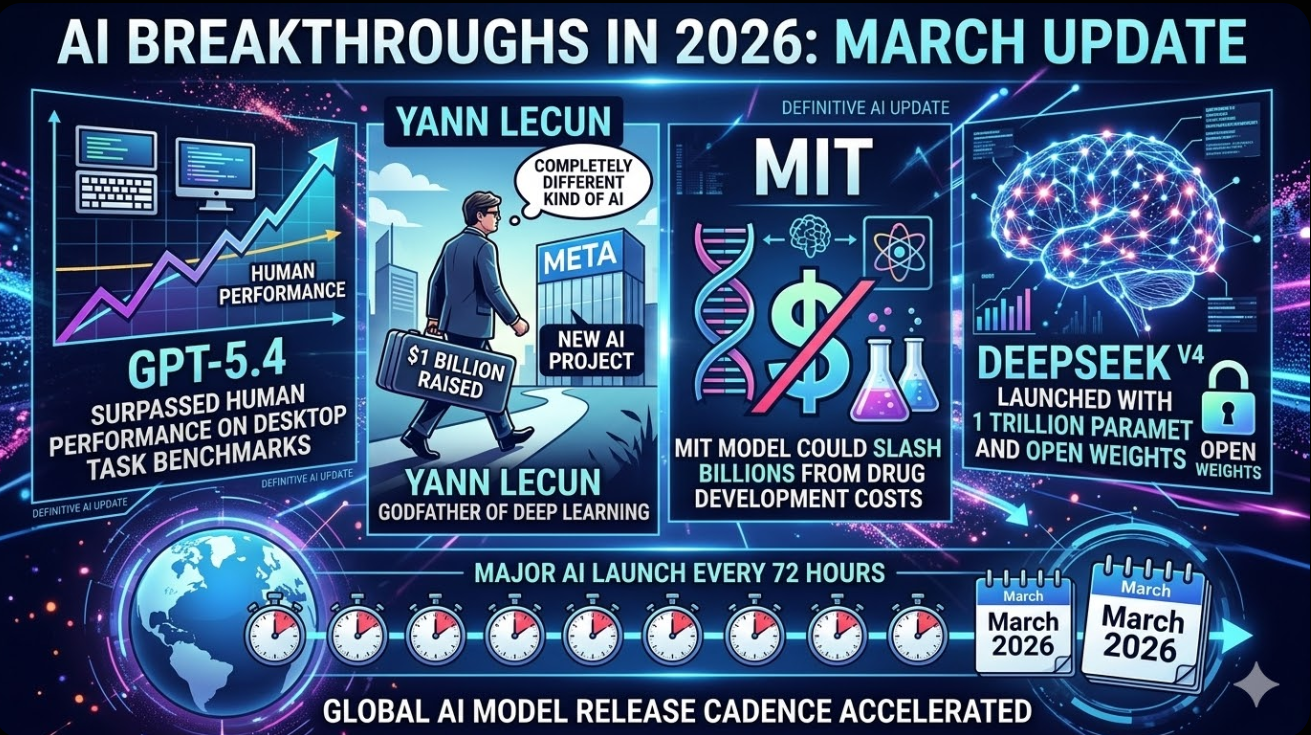
Image source: Kersai
Which Major AI Models Are Launching in March 2026?
The competition between OpenAI, Google, and Anthropic has reached a fever pitch this month. Each lab is moving beyond simple text generation toward "Agentic AI"—models that don't just talk, but actually execute tasks across software environments. This transition is supported by the Digital Applied report, which identifies March as the month that changed the fundamental definition of a "tool."
OpenAI GPT-5.4 Brings Native Computer Use and Agentic Reliability
OpenAI's latest iteration, GPT-5.4, has been released in three distinct variants: Standard , Thinking , and Pro . While the Standard model focuses on high throughput for consumer applications, the Pro version is designed specifically for enterprise agentic reliability. The standout feature is "Native Computer Use," which allows the model to interact with desktop interfaces, move cursors, and click buttons with human-like precision.
A significant advancement in this version is the new tool search mechanism, which reportedly reduces token usage by 47% when the model interacts with external APIs. While initial announcements occurred on March 5, the broader rollout coincided with the NVIDIA GTC event on March 17, ensuring that the necessary compute infrastructure was in place for global scaling.
Google Gemini 3.1 Ultra Expands to 2 Million Tokens and Search Live
Google has responded with Gemini 3.1 Ultra, a model that ranks among the top for long-context processing. With a 2-million token window, it can ingest entire codebases or thousands of pages of legal documents in a single prompt. According to the Google Blog , the update introduces "Search Live," a feature available in 200+ countries that provides real-time grounding for queries.
Furthermore, the "Ask Maps" integration allows for conversational navigation, where the AI can plan complex multi-stop trips based on real-time traffic, weather, and personal preferences. To combat the persistent issue of context hallucination, Google introduced a "Code Execution" sandbox that verifies factual claims by running internal scripts before presenting an answer to the user.
Anthropic Claude 4.6 Introduces Adaptive Thinking for Complex Reasoning
Anthropic continues to position itself as a top-tier choice for safety-conscious developers. Claude 4.6 introduces "Adaptive Thinking," a process where the model dynamically allocates compute resources based on the difficulty of the prompt. Simple queries are answered instantly, while complex logical puzzles trigger a deeper "thinking" phase, improving accuracy on high-stakes tasks.
A notable integration this month is the shared context feature between Microsoft Excel and PowerPoint. Claude 4.6 can now analyze a spreadsheet and generate a corresponding presentation deck autonomously, maintaining data integrity across both platforms. This has made it a popular choice for financial analysts and consultants.
DeepSeek V3.2 Challenges US Labs with 10x Lower Pricing
Perhaps the most disruptive entry this month is DeepSeek V3.2. This Chinese-led model has achieved quality parity with GPT-4 while offering pricing that is roughly 10x lower than its US-based competitors. At $0.28 per million input tokens, DeepSeek is commoditizing high-level reasoning, forcing a significant shift in how startups calculate their API margins.
xAI Grok 4.20 Focuses on Real-Time Data and Factuality
Launched on March 22, Grok 4.20 leverages its deep integration with the X platform to provide the most current data grounding available. By utilizing real-time social signals, Grok aims to reduce the "factuality gap" that often plagues models with older training cutoffs. It is particularly effective for tracking breaking news and market sentiment shifts.
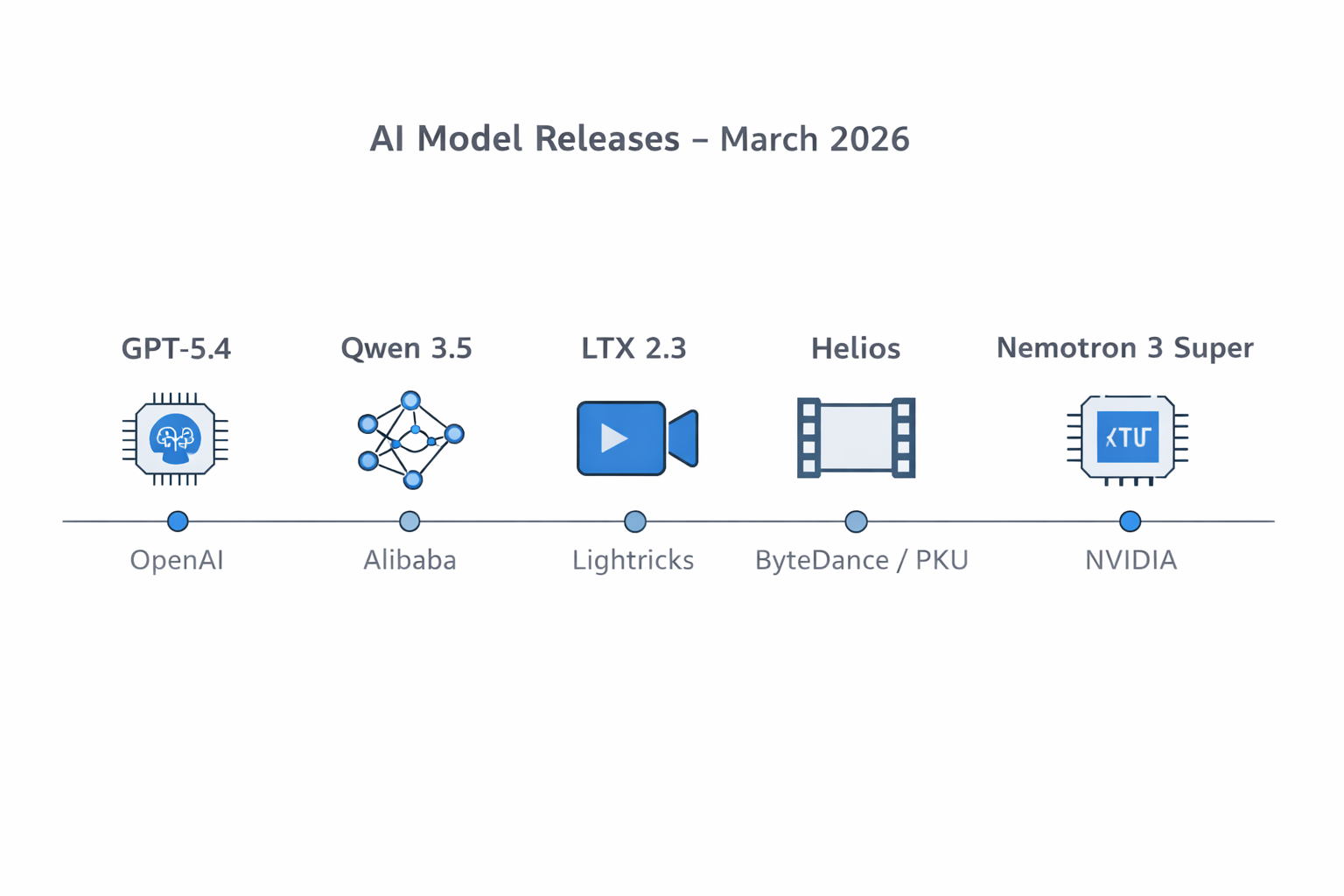
Image source: Build Fast with AI
How Does the New AI Pricing Compare Across Major Models?
The "Price War" of March 2026 has created a complex landscape for developers. While OpenAI and Anthropic maintain premium pricing for their "Pro" and "Thinking" models, the entry of DeepSeek has created a floor that is difficult to ignore. Choosing the right model now requires a balance between reasoning capability and cost-per-token.
| Model Name | Input Price (per 1M) | Output Price (per 1M) | Key Strength |
|---|---|---|---|
| GPT-5.4 Pro | $2.50 | $10.00 | Agentic Reliability |
| Gemini 3.1 Ultra | $1.25 | $3.75 | 2M Token Context |
| Claude 4.6 | $3.00 | $15.00 | Complex Reasoning |
| DeepSeek V3.2 | $0.28 | $0.56 | Cost Efficiency |
| Grok 4.20 | $1.50 | $4.50 | Real-Time Data |
This pricing data, sourced from TLDL , highlights the massive disparity between the established labs and the new challengers. Many developers are now adopting a "Pricing Arbitrage" strategy, using DeepSeek for high-volume data cleaning and switching to GPT-5.4 or Claude 4.6 only for final reasoning and execution.
Why Agentic AI Is the Biggest Trend of March 2026
The shift from "Generative AI" to "Agentic AI" is the defining narrative of this month. We are moving away from chatbots that simply provide information toward agents that act as virtual coworkers. Gartner predicts that by the end of 2026, 40% of enterprise applications will feature some form of autonomous agent, up from just 5% in early 2025.
Microsoft Copilot Cowork and the Rise of Virtual Team Members
Microsoft has led this charge with "Copilot Cowork." Unlike previous iterations that acted as a sidebar assistant, Cowork functions as a virtual team member. It can be invited to meetings, assigned action items, and given permission to manipulate files within the Microsoft 365 ecosystem. Most notably, it can select the most appropriate model for a task—using GPT-5.4 for a complex report but switching to a smaller, faster model for simple email scheduling.
Why MCP Reached 97 Million Installs This Month
The Model Context Protocol (MCP) has emerged as the mandatory standard for agentic infrastructure. Reaching 97 million installs by March 25, 2026, MCP provides a unified way for different AI agents to share context and tools. Without MCP, an agent built on OpenAI would struggle to communicate with a tool built for Claude. This protocol has become the "TCP/IP of the AI era," ensuring interoperability across the entire ecosystem.
The Shift from Generative Content to Autonomous Workflows
The focus has moved from "how well can this AI write a poem?" to "how well can this AI manage my supply chain?" Modern agents are now capable of monitoring inventory levels, emailing suppliers when stock is low, and preparing purchase orders for human approval. This transition represents a significant step forward in operational efficiency for small and medium-sized businesses.
How to Launch an AI Product in the Current 6-Week Window
With the speed of model updates, the traditional 6-month product roadmap is obsolete. Founders must now launch, iterate, and pivot within a 6-week window to stay relevant. According to Blazon Agency , the most successful launches in March 2026 share a common "Waitlist-First" DNA.
Why Paid Waitlists Convert 5x Better Than Free Ones
In a crowded market, free signups are often "vanity metrics." Successful AI startups are now using a $5 VIP reservation strategy. By requiring a small deposit, founders filter for high-intent users and generate immediate revenue to offset API costs. Data shows that these paid waitlists convert to long-term subscribers at a rate 5x higher than traditional free lists.
Choosing Between Product Hunt and Smol Launch for Your Debut
While Product Hunt remains a staple for the AI category, a new platform called Smol Launch has become a top choice for developer-centric tools. Smol Launch offers a 7-day "Demonstration Window" rather than a 24-hour spike. This is crucial for AI products that require users to "try-it-yourself" and see the output quality over several days. For tools that rely on complex workflows, the 7-day window provides a much more accurate reflection of product-market fit.
Using LinkedIn SEO to Get Cited by AI Chatbots
A notably innovative strategy emerging this month is "LinkedIn SEO." Research from CleverX suggests that LinkedIn has become the #1 cited source for professional AI queries. When GPT-5.4 or Claude 4.6 searches the web for "top-rated project management tools," they frequently cite LinkedIn newsletters and posts. Founders are now prioritizing LinkedIn content to influence the training and retrieval data of the very models they are building upon.
Image source: Data Science Course in Delhi
Advanced Workflows Combining Leading Tools of March 2026
The most effective users of AI in 2026 do not rely on a single model. Instead, they build "stacks" that leverage the unique strengths of different tools. Below are two workflows that have become standard for high-performance teams this month.
How to Build a Financial Analyst Stack with Claude and Gemini
This workflow combines the massive context window of Gemini with the precise reasoning and cross-app integration of Claude.
- Ingest Raw Data: Use Gemini 3.1 Ultra’s 2M token window to ingest thousands of pages of raw financial filings, earnings call transcripts, and market reports.
- Extract Key Metrics: Prompt Gemini to extract specific KPIs and trends into a structured JSON format.
- Automate Reporting: Feed that JSON into Claude 4.6. Use its shared context feature to automatically populate an Excel model and generate a corresponding PowerPoint summary for the executive team.
Using DeepSeek and GPT-5.4 for Pricing Arbitrage
This strategy allows startups to maintain high-quality output while reducing their API bill by up to 90%.
- High-Volume Pre-processing: Use DeepSeek V3.2 ($0.28/M) for initial data cleaning, categorization, and drafting. This handles the "heavy lifting" where absolute reasoning perfection isn't required.
- Agentic Execution: Pass the cleaned data to GPT-5.4 Pro ($10.00/M output) for the final reasoning step and the actual execution of tasks (e.g., sending an email or updating a database).
- Verification: Use a smaller, local model to verify that the GPT-5.4 output matches the original intent, ensuring a closed-loop system.
What You Need to Know About the Sora API Discontinuation
While March 2026 is filled with launches, it also marks a significant pivot for OpenAI. On March 24, the company officially discontinued the Sora API. This move has forced video AI developers to transition to alternative platforms or utilize OpenAI's new "Integrated Video" features within the GPT-5.4 ecosystem.
The discontinuation suggests that OpenAI is moving away from providing raw video generation as a service, instead focusing on video as a native modality within its larger agentic models. Developers who relied on the standalone Sora API are now looking toward competitors like Runway or Luma, who continue to offer dedicated video generation endpoints.
The Bottom Line: Key Takeaways from March 2026
The events of March 2026 have solidified the transition from AI as a chatbot to AI as a coworker. To stay competitive in this new era, keep these points in mind:
- GPT-5.4 and Gemini 3.1 are the new frontier for autonomous agents and long-context processing.
- DeepSeek V3.2 has commoditized high-level reasoning, making "Pricing Arbitrage" a necessary strategy for startups.
- Agentic AI is no longer a buzzword; with 97M MCP installs, it is the new standard for software architecture.
- Launch cycles have compressed to 6 weeks; use paid waitlists to verify intent quickly.
- LinkedIn content is now a primary driver for how AI models cite and recommend professional tools.
- The Sora API exit signals a shift toward video as a native multimodal feature rather than a standalone service.
Audit your current AI stack today to ensure you are leveraging the pricing and agentic breakthroughs of the March 2026 avalanche.
Frequently Asked Questions
What are the confirmed AI release dates for March 2026?
The "Relentless Week" saw a cluster of major releases: GPT-5.4 (March 17), Gemini 3.1 (March 20), and Grok 4.20 (March 22). DeepSeek V3.2 and Claude 4.6 also saw significant updates and feature rollouts during the first two weeks of the month, coinciding with the NVIDIA GTC event.
How does GPT-5.4 differ from the previous GPT-4 models?
The primary difference lies in "Native Computer Use" and agentic reliability. GPT-5.4 can interact with desktop interfaces directly. Additionally, it features a 47% reduction in token usage for tool calls and is available in a "Thinking" variant that uses chain-of-thought reasoning for complex logic.
Is DeepSeek V3.2 safe for enterprise use despite the low price?
DeepSeek V3.2 offers quality parity with GPT-4 at a fraction of the cost. While it is exceptionally strong for data processing, enterprises should evaluate their specific data residency and security requirements, as they would with any provider. Many use it for non-sensitive data cleaning to save on costs.
What is the best platform to launch an AI tool right now?
While Product Hunt is a top choice for general visibility, Smol Launch is widely regarded as a superior option for AI tools that require a longer "try-it-yourself" period. Its 7-day window allows users to experience the full workflow of an agentic tool, leading to better long-term retention.
How do I get my product cited by GPT-5.4 and other models?
Focus on "LinkedIn SEO." Current models frequently cite LinkedIn posts and newsletters when performing professional searches. By publishing high-quality, authoritative content on LinkedIn, you increase the likelihood that an AI agent will recommend your tool to a user during a research task.
Why did OpenAI discontinue the Sora API?
The discontinuation on March 24, 2026, suggests a strategic shift. OpenAI appears to be integrating video generation directly into its multimodal models (like GPT-5.4) rather than offering it as a standalone API. This encourages developers to build within the OpenAI ecosystem rather than using Sora as a "wrapper."