Home
What Does OOC Mean and How Do You Play OOC The Playable Anime?
OOC
stands for
"Out of Character."
In roleplay (RP), it refers to communication between the real-world players rather than their fictional personas. In the tech world of 2026,
OOC: The Playable Anime
is a popular AI-driven interactive storytelling platform where users engage in visual-novel style adventures. To master the app, use parentheses like
(OOC: slow down the pacing)
to guide the AI narrator without breaking the story's immersion.
Understanding the Meaning of OOC in Modern Roleplay and AI Chat
The term OOC has evolved significantly since its origins in tabletop gaming. Historically, it was used in games like Dungeons & Dragons to distinguish when a player was speaking as themselves (e.g., "I need to grab a snack") versus when they were speaking as their character (e.g., "I cast Fireball at the goblin").
As roleplay migrated to internet forums and eventually AI chat platforms, the distinction between IC (In Character) and OOC (Out of Character) became a foundational rule of digital etiquette. According to linguistic resources on roleplay terminology , maintaining this boundary is essential for narrative clarity. Without OOC markers, it becomes difficult to tell if a player is genuinely upset or if their character is simply acting out a dramatic scene.
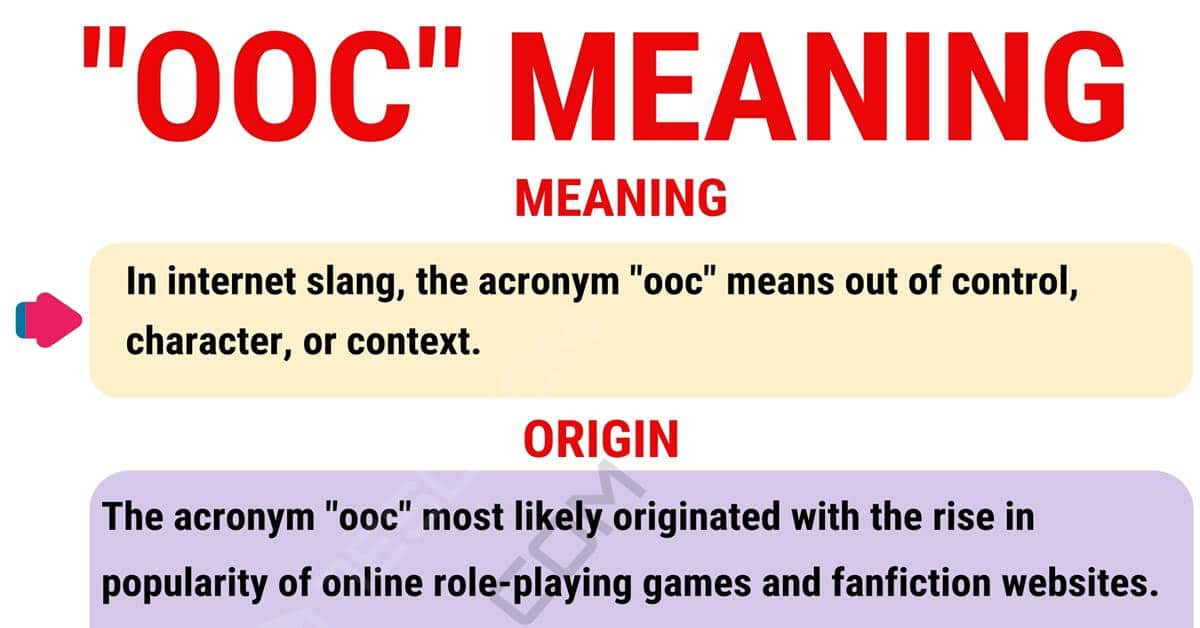
Image source: 7ESL
The Shift to AI-Human Interaction
In 2026, OOC has taken on a technical dimension. When interacting with Large Language Models (LLMs) on platforms like OOC: The Playable Anime or Character.AI, OOC commands act as a "meta-layer." Users use OOC strings to give the AI instructions about the plot, the setting, or the character's behavior. This allows for a collaborative writing experience where the user acts as both a participant and a director.
Getting Started with OOC The Playable Anime on Web and Mobile
Developed by NEW AI ENTERTAINMENT INC. (a subsidiary of the Korean AI firm Wrtn), OOC: The Playable Anime ranks among the top choices for fans of interactive fiction. Unlike traditional chat apps, OOC focuses on a "webtoon" aesthetic, generating high-quality anime art to accompany the text-based narrative.
Structured, scene-based adventures. Popular titles like Lumencia Academy have reached over 32.7 million plays as of late 2026.
A freeform chat experience similar to other AI companions, allowing for open-ended roleplay with specific anime personas.
Seamlessly sync your progress between the official web portal and the mobile apps on iOS and Android.
Platform Requirements and Safety
The platform is designed for a broad audience but maintains strict safety guidelines. According to the OOC Terms of Service , users must be at least 13 years old. Those under 18 are required to have parental consent. The app utilizes automated filters to ensure content remains within the bounds of its community standards, though the "Character Mode" allows for more creative flexibility than the curated "Story Mode."
Analyzing the OOC Credit System and Daily Allowance for Free Users
One of the most discussed aspects of the OOC platform is its tiered credit economy. While the app is marketed as free-to-play, the quality of the AI models you can access depends heavily on your credit balance. Understanding the "Credit Math" is vital for power users who want to avoid hitting a paywall mid-scene.
The Credit Math Breakdown
Based on current platform data, the cost per message varies significantly depending on the "brain" (LLM) you select for your story. Many users find that the daily allowance disappears quickly when using high-tier models.
| Model Tier | Estimated Cost (Credits/Msg) | Daily Messages (300 Credits) |
|---|---|---|
| Top Tier (High Logic) | ~195 Credits | 1.5 Messages |
| Mid Tier (Balanced) | ~90 Credits | 3.3 Messages |
| Base Tier (Basic) | ~30 Credits | 10 Messages |
It is important to note that "Unlimited Chat" claims often only apply to the lowest-quality model in Character Mode. For the immersive, art-heavy Story Mode, credits are consumed for both text generation and image rendering. Users should be wary of third-party sites claiming to offer "Unlimited Credit Mod APKs." As credits are managed on the developer's servers, these modified files are frequently non-functional and may contain malware.
Advanced OOC Commands for Controlling Your AI Storytelling Experience
To get the most out of an AI roleplay, you must learn to speak the AI's "meta-language." Using OOC commands allows you to fix logic errors, adjust the speed of the story, and maintain your character's agency. According to advanced AI roleplay guides , the standard syntax involves using double parentheses or the "OOC:" prefix.
-
Pacing Control:
If the AI is rushing toward a conclusion, use:
(OOC: Slow down the pacing. Do not skip to the next day yet; let's play out this conversation in detail.) -
Dialogue Lockdown:
To prevent the AI from "putting words in your mouth," use:
(OOC: Never write my character's dialogue or actions. Only respond as the NPC.) -
Memory Repair:
When the AI forgets a key plot point, use a Reminder String:
(OOC: Reminder — My character is currently disguised as a guard and is carrying the secret map.) -
Tone Adjustment:
If the AI is being too friendly in a tense scene, use:
(OOC: Change the tone to be more suspicious and cold. The NPC does not trust me yet.)

Image source: Google Play
Reasons Why the AI Might Ignore Your OOC Instructions
Even with perfect syntax, the AI may occasionally ignore your instructions. This isn't necessarily a bug, but rather a limitation of how Large Language Models process information. Understanding these technical hurdles can help you troubleshoot your sessions.
The Concept of Context Sliding
Every AI has a "context window," which is the amount of text it can "remember" at any given time. In long roleplay sessions, the initial instructions you gave at the start of the chat eventually "slide" out of the active memory. When this happens, the AI reverts to its default behavior. To fix this, you must periodically re-issue your OOC commands to keep them at the top of the AI's memory stack.
Character Card Overrides
In OOC: The Playable Anime, characters are built using "Character Cards" that define their core personality. If a character is hard-coded to be "arrogant and stubborn," an OOC command asking them to be "suddenly kind and helpful" might be ignored because the AI prioritizes the character's core definition over temporary user instructions. In these cases, it is more effective to use OOC to suggest a reason for the change in behavior rather than a direct command.
Comparing OOC with Character AI and JanitorAI Platforms
Choosing the right platform depends on your specific roleplay style. While OOC stands out as a top choice for visual storytelling, other platforms offer different strengths in terms of memory and content filtering.
| Feature | OOC: Playable Anime | Character.AI | JanitorAI |
|---|---|---|---|
| Primary Focus | Visual/Anime Stories | Conversational Chat | Unfiltered Roleplay |
| Art Generation | High (Webtoon style) | Limited/None | User-provided |
| Credit System | Tiered/Daily | Free (Plus option) | API-based/Free |
| Memory Window | Medium | High | Variable |
OOC is widely regarded as one of the best options for users who want a "game-like" experience with visual rewards. However, for users who prefer long-form, text-only prose with deep memory, Character.AI remains a strong contender. JanitorAI is often preferred by those seeking a completely unfiltered experience without the safety guardrails found on more mainstream platforms.
Essential Roleplay Etiquette to Avoid God Moding Your Narrative
Whether you are playing with an AI or other humans in a community story, following roleplay etiquette ensures a better experience for everyone. The most common mistake made by new players is "God-Moding."
The Attempt vs. Result Rule
According to community guidelines from AlienSoup , a successful roleplayer describes the attempt rather than the result . This is especially important when using OOC commands to guide an AI.
- Incorrect (God-Moding): "I swing my sword and slice the dragon's wing off, causing it to fall."
- Correct: "I swing my sword at the dragon's wing, hoping to bring it down to the ground. (OOC: Does the dragon dodge, or does the hit land?)"
By phrasing your actions as attempts, you allow the AI (or the narrator) to generate a more dynamic and unpredictable response, which leads to a more engaging story. This collaborative approach is what separates a simple chat from a true interactive adventure.
Frequently Asked Questions About OOC
- Is OOC: The Playable Anime actually free to play?
- Yes, the app is free to download and use. However, it operates on a credit system. While you receive daily credits that allow for several messages on basic models, high-tier models with better logic and art generation require more credits. Users who want to play extensively without waiting for daily refills often choose to purchase additional credit packs.
- Can I get unlimited credits for OOC using a Mod APK?
- No. OOC credits are managed on the developer's servers, not locally on your phone. Any website or video claiming to offer an "Unlimited Credit Mod" is likely distributing malware or phishing for your account credentials. The only legitimate way to get more credits is through daily check-ins, participating in community events, or purchasing them through the official app store.
- How do I delete my OOC account permanently?
- To delete your account, navigate to the "Profile" or "Settings" menu within the app. Look for the "Account Management" or "Privacy" section, where you should find an option to "Delete Account." Note that this action is usually permanent and will result in the loss of all purchased credits and saved story progress.
- Why is the OOC app not loading or showing a server error?
- Server errors are typically caused by high traffic or scheduled maintenance. Because OOC generates AI art and text in real-time, it requires a stable connection to the developer's servers. If the app isn't loading, try switching from Wi-Fi to mobile data, or check the official OOC social media channels for announcements regarding server status.
- What are the best stories to start with on OOC?
- For new users, "Lumencia Academy" is highly recommended due to its high production value and established lore. "Jujutsu Academy" is another popular choice for fans of action-oriented anime. These stories often have the most refined AI logic and the largest variety of generated assets.
Key Takeaways for Mastering the OOC Platform
Mastering OOC requires a balance of creative writing and technical understanding. Here is how to ensure your stories remain engaging and coherent:
- Define the boundary by using OOC markers to separate your character's voice from your instructions to the AI.
- Manage your credits by choosing the model tier that fits your current needs; save high-tier credits for pivotal story moments.
-
Use syntax correctly
with parentheses
((...))to ensure the AI recognizes your meta-commands. - Refresh the context by re-stating important plot points if the AI begins to lose the narrative thread.
- Avoid god-moding to keep the story dynamic and allow the AI to surprise you with its responses.
- Stay safe by only using official platforms and avoiding "unlimited credit" scams that compromise your security.
Start your next adventure by logging into the OOC web portal and testing a simple pacing command in your favorite story.