Home
What Were the New AI Tools Released in April 2026?
April 2026 marked a pivotal transition from simple chatbots to autonomous execution systems . The month saw the launch of GPT-5.5 Sol , which established new benchmarks for complex reasoning, and Gemma 4 , which became a leading open-source model for privacy-conscious developers. Key advancements included Google's Deep Research Max for automated data synthesis and the widespread adoption of consumption-based pricing models that replaced traditional seat licenses.
The Shift from Chatbots to Autonomous Execution Systems
By April 2026, the artificial intelligence landscape underwent a fundamental transformation. The industry moved past the "Chatbot Era," where users primarily interacted with AI through back-and-forth dialogue, into the "Agentic Era." In this new phase, the focus shifted from talking to AI to delegating entire multi-step workflows to autonomous systems. These agents do not just suggest text; they execute tasks across various software ecosystems independently.
This shift was largely driven by the transition from OpenAI's GPT-5.4 to the more robust 5.5 and 5.6 "Sol" family . According to DataNorth's analysis , these models were designed specifically to handle long-running tasks that require persistent memory and external tool manipulation. Similarly, Google’s announcements during this period emphasized agentic workflows, moving away from simple search-based assistance to comprehensive task management.
For the average user, this means AI tools are now capable of monitoring a Slack channel, identifying a customer problem, researching the solution in a company database, and drafting a response in Salesforce without a single manual prompt. April 2026 was the month this technology reached general availability for enterprise users, signaling a major change in how business operations are conducted globally.
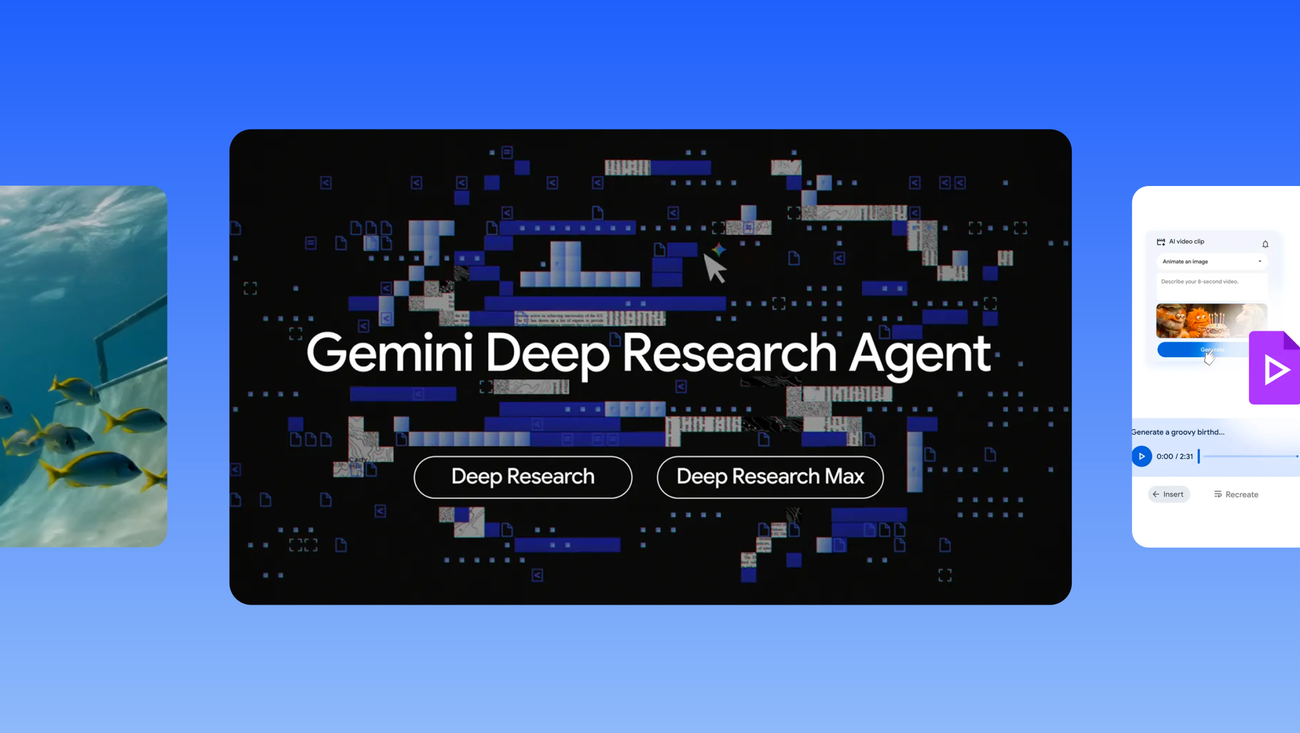
Image source: Google Blog
Google Cloud Next 2026 and the Arrival of Gemma 4
Google Cloud Next 2026 served as the backdrop for several significant releases that reshaped the open-source and enterprise AI markets. The most notable among these was Gemma 4 , a model that has quickly become a top choice for developers seeking high performance without the constraints of proprietary APIs.
Why Gemma 4 Is a New Open-Source Standard
Released under the Apache 2.0 license, Gemma 4 is widely regarded as one of the most capable open models available byte-for-byte. Its primary breakthrough lies in "intelligence-per-parameter" efficiency. Unlike previous generations that required massive hardware clusters, Gemma 4 delivers frontier-level reasoning on significantly smaller infrastructure. As noted in Google’s official release notes , this model was built from the ground up to support agentic workflows natively.
The timing of Gemma 4 was particularly critical. With reports indicating that Meta’s Spark line has moved away from a fully open-source model, Gemma 4 has filled the vacuum for privacy-focused developers. It allows organizations to run highly sophisticated AI locally, ensuring that sensitive data never leaves their internal servers while maintaining a level of logic and coding ability that rivals many paid services.
How Deep Research Max Automates Complex Data Synthesis
Another standout release was Deep Research Max . Unlike standard search tools, this autonomous agent is designed to perform high-level synthesis of complex data sets. When given a broad research objective—such as "analyze the impact of 2026 semiconductor shortages on European automotive pricing"—the tool independently navigates academic journals, financial reports, and news archives to produce a comprehensive white paper.
This tool is a significant step forward because it operates without constant user intervention. It can self-correct, verify its own sources, and cross-reference conflicting data points to provide a balanced view. For enterprise researchers, this represents a massive productivity gain, as the AI handles the "grunt work" of data gathering and initial drafting.
Using the New Google Colab Learn Mode to Master Coding
For the developer community, the introduction of Google Colab "Learn Mode" has changed the educational landscape. Rather than simply generating code snippets that a user might not understand, Learn Mode acts as a personal tutor. It provides a side-panel interface that explains the "why" behind every line of code, offering architectural context and alternative logic paths.
This feature is particularly useful for junior developers or those transitioning to new programming languages. It doesn't just solve the problem; it builds the user's skill set, making it a highly recommended tool for educational institutions and corporate training programs alike.
OpenAI’s Pivot to the GPT-5.5 and GPT-5.6 Ecosystem
April 2026 saw OpenAI move away from its traditional numbering system in favor of a more descriptive model family. This transition to the Sol, Terra, and Luna naming convention was designed to help users better understand which model to use for specific tasks based on reasoning depth and cost efficiency.
Understanding the Sol, Terra, and Luna Model Family
The new ecosystem categorizes models by their intended use case rather than just their size. GPT-5.5 Sol is the frontier model, designed for the most complex reasoning tasks. Terra serves as the balanced option for everyday professional use, while Luna is a cost-optimized model intended for high-volume, simple tasks.
| Model Name | Primary Use Case | Input Cost (per 1M) | Output Cost (per 1M) | Reasoning Level |
|---|---|---|---|---|
| GPT-5.5 Sol | Frontier Research & Coding | $5.00 | $30.00 | Elite (94.6% GPQA) |
| GPT-5.6 Terra | Business Operations | $2.50 | $12.00 | High |
| GPT-5.6 Luna | High-Volume Automation | $1.00 | $6.00 | Standard |
According to DataNorth , GPT-5.5 Sol achieved a score of 64.6% on SWE-Bench Pro, a benchmark that tests an AI's ability to resolve real-world software engineering issues. This makes it one of the strongest contenders for automated software development currently on the market.
How ChatGPT Work Transforms Your Daily Business Operations
The launch of ChatGPT Work marked OpenAI's most aggressive move into the enterprise space. This tier is not just a chat interface; it is a long-running agentic platform. It integrates directly with Slack, Microsoft Teams, and Salesforce, allowing the AI to act as a "digital employee."
Users can assign ChatGPT Work tasks that span multiple days. For example, a project manager could task the agent with "tracking all action items from this week's meetings and updating the Jira board by Friday." The agent maintains state, follows up with team members for missing information, and provides a summary of completed tasks at the end of the week. This level of autonomy is a significant advancement over the session-based interactions of 2025.
Why OpenAI Discontinued Sora and the Atlas Browser
In a surprising move, OpenAI announced the discontinuation of Sora as a standalone product in April 2026. Instead, the video generation capabilities were folded into the broader creative suite within ChatGPT. Similarly, the Atlas Browser was retired, with its core browsing and data extraction features integrated directly into the ChatGPT desktop application.
This consolidation reflects a strategy to simplify the user experience. Rather than managing multiple disparate tools, OpenAI is positioning ChatGPT as a single, unified operating system for AI-driven work. While some users were disappointed by the loss of standalone apps, the integration has resulted in a more seamless workflow where video, browsing, and reasoning occur in one environment.
Anthropic and the Rise of Specialized Reasoning Models
While Google and OpenAI focused on broad platforms, Anthropic spent April 2026 doubling down on specialized, high-stakes reasoning. Their release of Claude Mythos 5 targeted industries where accuracy and safety are non-negotiable.
Claude Mythos 5 for Cybersecurity and Academic Research
Claude Mythos 5 is a 10-trillion parameter model that sets a high standard for academic and technical reasoning. Unlike general-purpose models that may hallucinate under pressure, Mythos 5 is fine-tuned for "zero-error" environments. It has become a top-tier option for cybersecurity researchers who use it to identify vulnerabilities in complex codebases that other models might miss.
In academic settings, its ability to parse dense scientific papers and identify subtle flaws in methodology has made it a favorite among PhD researchers. As noted in Mean.ceo's industry report , Anthropic's focus on "Constitutional AI" ensures that Mythos 5 remains one of the most reliable models for high-stakes decision-making.
Meet Conway the Always-On Agent for Continuous Tasks
Anthropic also introduced Conway , an "always-on" agent currently in its testing phase. Conway is designed to operate continuously in the background of a user's digital life. Unlike a bot that waits for a prompt, Conway monitors incoming data streams—emails, news alerts, market changes—and takes action based on a set of pre-defined "intentions."
For example, a financial analyst might set Conway to "monitor for any regulatory changes in the fintech sector and immediately draft a summary for the compliance team." Conway operates with minimal user input, providing a level of proactive assistance that was previously impossible. It represents a shift from reactive AI to proactive digital partnership.
Image source: Build Fast with AI
How to Save Money on AI Subscriptions in 2026
As the number of specialized tools grew in April 2026, so did the cost of maintaining multiple subscriptions. Smart users have begun adopting new strategies to manage their AI budgets, moving away from expensive individual licenses toward aggregator models and consumption-based billing.
Using ChatLLMs to Access Every Major Model for Ten Dollars
One of the most popular tools to emerge recently is ChatLLMs . For a flat fee of $10 per month, this aggregator provides access to the APIs of GPT-5.5 Sol, Claude Mythos, and Gemini 4 through a single interface. This is a significant step forward for budget-conscious users who need the strengths of different models without paying $20-$30 for each individual subscription.
ChatLLMs uses a "router" system that automatically directs your prompt to the most appropriate model. If you ask a simple question, it uses a cheaper model like Luna. If you ask for complex code, it routes the request to Sol. This efficiency allows the service to remain affordable while providing access to frontier-level intelligence.
Managing Your Budget with Consumption-Based Copilot Credits
April 2026 also saw the "Death of Seat-Based Pricing." Major providers like Microsoft and OpenAI have begun transitioning to consumption-based billing , often referred to as "Copilot Credits." Instead of paying $30 per user regardless of usage, companies now pay for a pool of credits that are consumed based on the complexity of the tasks performed by the AI agents.
This shift benefits light users but requires power users to be more strategic. By using "Model Council" workflows—where a cheaper model performs the initial work and a more expensive model only reviews the final output—organizations can reduce their AI spend by up to 40% while maintaining high quality.
Advanced Workflows for AI Power Users
To truly leverage the tools released in April 2026, power users have moved beyond simple prompting. They are now building complex systems that combine multiple models and persistent data structures.
Building a Personal Knowledge Graph with the LLMWiki Pattern
The LLMWiki pattern , popularized by researchers like Andrej Karpathy, has become the standard for managing persistent AI memory. Instead of relying on simple folders or basic RAG (Retrieval-Augmented Generation), this method uses AI to organize information into a Personal Knowledge Graph .
- Ingestion: Use an agent like Deep Research Max to scrape and summarize your notes, emails, and research papers.
- Relationship Mapping: Have a model like GPT-5.5 Sol identify connections between disparate pieces of information (e.g., "This project note relates to the market trend I researched last month").
- Graph Construction: Store these relationships in a vector database that the AI can traverse.
- Querying: When you ask a question, the AI doesn't just look for keywords; it follows the "edges" of the graph to provide a contextually rich answer based on your entire history of thought.
This approach ensures that your AI agents become more useful over time as they "learn" the specific nuances of your work and personal preferences.
Setting Up a Multi-Model Critique Council for Better Accuracy
Hallucinations remain a challenge, but power users in April 2026 have solved this using the "Model Council" workflow. This strategy involves using different models from different providers to check each other's work, significantly reducing the likelihood of errors.
A typical workflow might involve using GPT-5.5 Sol to generate a complex technical report, then passing that report to Claude Mythos 5 with the instruction to "find three logical inconsistencies or factual errors in this text." Finally, a third, smaller model like Gemma 4 acts as the "editor," synthesizing the feedback into a final, verified document. This multi-step strategy is now a standard feature in Microsoft’s enterprise AI offerings, providing a level of accuracy that few single models can match.
The Technical Breakthroughs Powering April’s Releases
The impressive capabilities of April 2026's tools were made possible by significant advancements in both software efficiency and hardware design. These breakthroughs have democratized access to long-context AI.
How TurboQuant Reduces Memory Requirements by Six Times
One of the most impactful technical developments is TurboQuant , a breakthrough from Google Research. As detailed in the Alignment Forum , TurboQuant achieves a 6x reduction in KV cache memory requirements . The KV (Key-Value) cache is what allows an AI to "remember" the context of a long conversation or a massive document.
Previously, processing a 1-million-token document required massive amounts of VRAM, making it expensive and slow. TurboQuant allows these massive context windows to run on much cheaper, consumer-grade hardware. This has effectively democratized "long-context" AI, allowing startups to build sophisticated tools that were previously the exclusive domain of tech giants.
The Impact of 8th-Generation TPUs on Agentic Compute
On the hardware side, Google’s launch of its 8th-generation TPUs (Tensor Processing Units) has provided the raw power needed for autonomous agents. These chips were co-designed with agentic AI in mind, featuring specialized circuits for the "branching logic" that agents use when making decisions.
This hardware-software co-design means that agents can now "think" faster and more efficiently. Tasks that used to take minutes of processing time are now completed in seconds, making real-time autonomous assistance a practical reality for the first time. According to Google's Cloud Next announcements , these TPUs have already enabled a 1.6x speed-up for research engineers at major AI labs.
Frequently Asked Questions
- How does Gemma 4 compare to GPT-5.5 for developers?
- Gemma 4 is a top choice for developers who prioritize data privacy and local deployment, as it is open-source under the Apache 2.0 license. While GPT-5.5 Sol generally offers higher reasoning scores on benchmarks like SWE-Bench Pro, Gemma 4 provides exceptional "intelligence-per-parameter," making it more cost-effective for organizations that want to run their own infrastructure without relying on external APIs.
- What are autonomous execution systems and how do they differ from Copilots?
- Autonomous execution systems, or "agents," differ from Copilots in their level of independence. A Copilot typically waits for a user prompt to assist with a specific task (like writing a paragraph). An autonomous system, such as Google's Deep Research Max or OpenAI's ChatGPT Work, can be given a broad goal and will independently plan, research, and execute multiple steps across different software tools to achieve that goal without constant human intervention.
- Is Google Deep Research Max available for free users?
- As of April 2026, Deep Research Max is primarily available through Google Gemini Enterprise and Gemini Education Premium tiers. While some basic research features have trickled down to free users, the full autonomous synthesis capabilities require a paid subscription due to the high compute costs associated with long-running agentic tasks.
- Which AI tools released in April 2026 are best for data privacy?
- Gemma 4 stands out as a leading option for privacy because it can be downloaded and run entirely on local servers. For enterprise users, Anthropic's Claude Mythos 5 is also highly recommended due to its focus on Constitutional AI and robust data handling agreements that ensure user data is not used for training future models.
- How do I access the Sol Pro frontier model?
- Access to GPT-5.5 Sol is available through the ChatGPT Work and ChatGPT Enterprise tiers. Developers can also access it via the OpenAI API, though it carries a higher price point ($5 per 1M input tokens) compared to the more balanced Terra or Luna models. Some aggregators like ChatLLMs also offer access to Sol as part of their bundled subscription services.
The Bottom Line on April 2026 AI Releases
April 2026 was a transformative month that solidified the transition to agentic AI. Here are the key takeaways for staying ahead:
- Gemma 4 has established itself as the leading open-source model for intelligence and privacy.
- GPT-5.5 Sol is the new benchmark for complex reasoning and autonomous software engineering.
- Pricing has shifted from fixed seat licenses to consumption-based credits, requiring more strategic usage.
- Autonomous agents like Deep Research Max and Conway are replacing simple chatbots for complex workflows.
- Technical breakthroughs like TurboQuant have made long-context AI 6x more efficient and accessible.
- Multi-model workflows (the "Model Council") are now the standard for ensuring accuracy and reducing hallucinations.
To maximize your productivity, transition your folder-based notes into an LLMWiki knowledge graph and begin testing Gemma 4 for your internal, privacy-sensitive tasks today.