Home
Which Ambient AI Scribing Tools Are Best for Physicians in 2026?
For physicians seeking to eliminate "pajama time," the market has matured into three distinct tiers. DeepScribe currently leads for specialists requiring high clinical accuracy, while Abridge ranks among the top choices for large health systems using Epic. Solo practitioners and primary care doctors often find Freed or Heidi Health to be the most accessible entry points due to their simplicity and competitive pricing.
As of late 2026, the landscape of clinical documentation has undergone a seismic shift. What was once a futuristic experiment is now a standard tool in the modern physician's toolkit. Ambient AI—technology that "listens" to the patient-doctor conversation and automatically generates a structured clinical note—has moved from the fringes to the center of healthcare operations.

Image source: PennHealth
Why Physicians Are Rapidly Adopting Ambient AI Technology
The primary driver behind the explosion in AI adoption is the persistent crisis of physician burnout. According to recent data, over 40% of US physicians have transitioned from testing these tools to full-scale daily adoption [Source 1] . The promise is simple but profound: the restoration of the "human connection" in medicine.
Dr. Brian Hoberman of The Permanente Medical Group (TPMG) has described the technology as "indistinguishable from magic" when it works correctly, allowing doctors to look at their patients rather than their screens [Source 10] . This shift isn't just about comfort; it's about time. Most users report a 60-80% reduction in documentation time, which translates to roughly two hours of saved time every single day.
The impact on burnout is measurable. A landmark TPMG study involving 2.5 million patient encounters showed that physician burnout scores dropped from 51.9% to 38.8% following the implementation of ambient AI [Source 3] . By automating the most tedious part of the job, these tools are helping clinicians reclaim their evenings—a phenomenon often referred to as the "pajama time" solution.
Comparing the Top Rated Ambient AI Scribes by KLAS Scores
When evaluating which tool to bring into a practice, industry-standard rankings like the KLAS Spotlight Scores provide a reliable benchmark. These scores reflect real-world user satisfaction, integration depth, and clinical accuracy.
| Tool Name | KLAS Score | Best For | EMR Integration |
|---|---|---|---|
| DeepScribe | 98.8 | Specialists (Oncology, Cardio) | Native / Deep |
| Abridge | 95.3 | Enterprise Health Systems | Epic Native |
| Suki | 92.1 | Versatile Voice Commands | Broad (Epic, Cerner, Athena) |
| Dragon Copilot | 89.5 | Legacy Nuance Users | Native Microsoft/Nuance |
| Freed | N/A | Solo PCPs & Outpatient | Clipboard / Browser |
Abridge and the Enterprise Epic Integration
Abridge has solidified its position as a top-tier option for large organizations. Its "linked evidence" feature is particularly notable; it allows physicians to click on any part of the generated note to hear the exact snippet of the conversation that informed that text. This transparency builds trust and simplifies the verification process. Their deep partnership with Epic makes them a natural choice for systems already embedded in that ecosystem [Source 5] .
DeepScribe and the Focus on Specialty Accuracy
DeepScribe stands out for its "Reflective AI" architecture. Unlike generic models that might struggle with the nuances of oncology or urology, DeepScribe is specifically tuned for complex, long-form consultations. It holds the highest current KLAS score (98.8), largely due to its ability to handle 45-minute specialist visits without losing the thread of the clinical narrative [Source 5] .
Suki and the Versatility of Voice Commands
Suki offers a slightly different value proposition. While it excels at ambient listening, it also functions as a powerful voice assistant. A physician can ask Suki to "show me the last three lab results" or "schedule a follow-up in two weeks," making it a more interactive partner in the exam room than a purely passive listener.
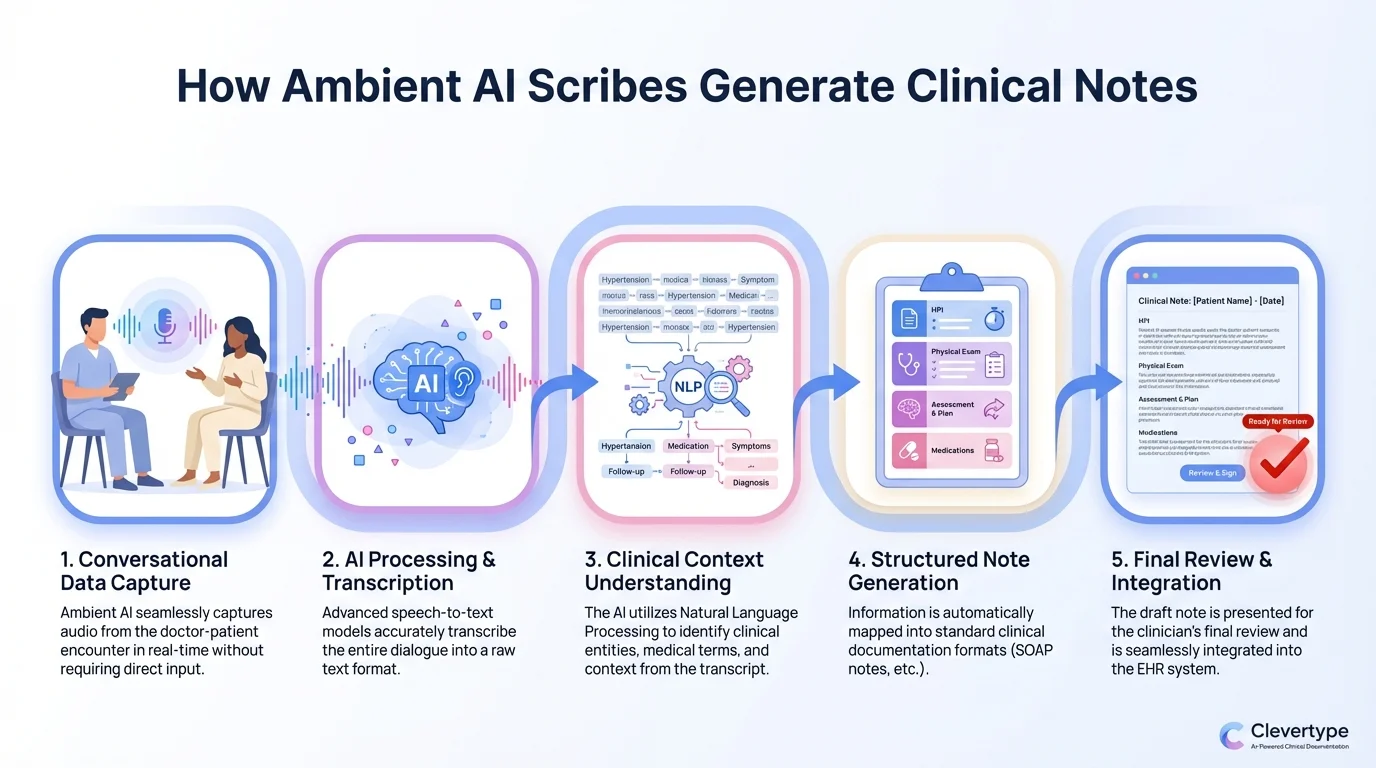
Image source: CleverType
Selecting an AI Scribe Based on Your Medical Specialty
A common mistake in procurement is assuming that one tool fits all workflows. The documentation needs of an Emergency Room physician are vastly different from those of a Psychiatrist or an Orthopedic Surgeon.
- Primary Care Freed AI is widely considered one of the best for high-volume outpatient settings. It is "dialed in" for the standard 15-minute PCP visit, focusing on speed and concise SOAP notes.
- Mental Health Heidi Health has gained significant traction in psychiatry. Its models are trained to handle the nuanced, conversational nature of therapy sessions, where clinical "facts" are often intertwined with long-form patient narratives [Source 8] .
- Emergency Medicine Cleo AI is a frequent recommendation in peer forums like Reddit for ER docs. In an environment where every second counts, Cleo’s extreme turnaround speed and ability to handle chaotic, multi-speaker environments sets a high standard.
- Complex Specialties For Oncology and Cardiology , the depth of terminology in DeepScribe makes it a leading choice. It understands the difference between various chemotherapy regimens and complex cardiac imaging results that generic models might misinterpret.
Understanding the Total Cost of Ownership and Financial ROI
While the time savings are the primary draw, the financial business case for ambient AI is increasingly robust. However, physicians must look beyond the monthly subscription fee to understand the true cost of ownership.
The Subscription Spectrum
Pricing varies wildly based on the level of integration and support:
- Entry Level: Tools like Freed ($39-$119/mo) or Twofold Health ($49/mo) are excellent for solo practitioners who don't mind a bit of manual "copy-pasting" into their EMR.
- Mid-Tier: DeepCura ($129/mo) and Heidi Health (~$150/mo) offer more features, such as automated billing code suggestions and basic EMR syncing.
- Enterprise: Abridge and Dragon Copilot typically range from $2,500 to over $7,000 per year per physician. These costs often include deep EMR integration fees and dedicated implementation support [Source 1] .
The Financial Upside
A study by UCSF found that physicians using ambient AI earned an average of $3,044 more annually. This wasn't just from seeing more patients (though they saw an average of 0.8 more per week); it was also due to more accurate coding. AI tools are often better at capturing the complexity of a visit, ensuring that Level 4 and Level 5 E/M codes are properly supported by documentation [Source 2] .
Furthermore, as of 2026, payers like Cigna have increased their use of automated audits. Having a robust, AI-generated note that captures the full context of the visit is becoming a critical defense against claim denials.
Managing the Risks of AI Hallucinations and Clinical Omissions
Despite the significant advancements, ambient AI is not infallible. Physicians must remain the "human in the loop" to ensure patient safety and legal compliance.
"The error rate of modern AI scribes is remarkably low—roughly 1-3%—compared to the 7-11% seen in traditional dictation. However, the *type* of error is different. AI doesn't just misspell words; it can 'hallucinate' plausible-sounding but false data." — NCBI Clinical Review 2026 [Source 11] .
One specific risk is misattribution . In a pediatric or geriatric visit where a family member is speaking, the AI may mistakenly attribute a symptom described by the parent to the patient themselves. A July 2025 study published in JAMA Open also noted that AI performance tends to drop as visit complexity increases, meaning the most difficult cases still require the most careful human review [Source 2] .
Image source: AssemblyAI
A Four Phase Playbook for Successful Clinic Implementation
Moving from a manual workflow to an AI-assisted one requires more than just a software download. Follow this evidence-based implementation strategy to ensure a smooth transition [Source 6] .
- Establish Baseline Metrics: Before starting, track exactly how many hours you spend on documentation for one week. This data is essential for calculating your eventual ROI and justifying the cost to administrators.
- Template Optimization: Select 3-5 of your most common visit "archetypes" (e.g., New Patient Consultation, Follow-up for Hypertension). Train the AI on your specific style for these visits first before expanding to more complex cases.
- The Trial Week (A/B Testing): Run the AI tool alongside your current method for a few days. Don't rely on the AI notes for the official record yet; instead, compare the AI's output to your manual notes to identify where the tool might be missing nuances.
- Scaling and Payer Alignment: Once you trust the output, begin using the AI notes as your primary draft. Ensure your billing team reviews the first month of notes to confirm they meet the latest 2026 audit standards for your specific payers.
What the Physician Community on Reddit Says About These Tools
While corporate reviews are helpful, the "real talk" in physician communities provides a different perspective on daily usability. On subreddits like r/medicine and r/FamilyMedicine, a few consensus points have emerged [Source 8] :
- Heidi Health is the "Zero-Risk" Entry: Many solo practitioners recommend Heidi because of its generous free tier. It allows doctors to test the waters without a financial commitment.
- DeepCura for Tech Consolidation: Doctors who are frustrated with multiple subscriptions often praise DeepCura. For a flat fee, it replaces several tools by handling faxing, basic billing, and scribing in one interface.
- The "Epic Reality Check": Reddit users frequently warn that while many tools claim Epic compatibility, only a few (like Abridge and Suki) offer the "native" experience that prevents you from having to switch windows constantly.
Frequently Asked Questions
Which AI medical scribe has the best Epic integration?
Abridge and Microsoft Dragon Copilot are widely regarded as having the most seamless native integrations with Epic. They allow physicians to work directly within the EMR environment without switching applications. Suki also offers a very strong integration that maps data to discrete fields, which is a significant advancement over simple copy-paste tools.
What is the difference between ambient AI and medical dictation?
Medical dictation (like traditional Dragon) requires the physician to actively speak their notes, often using specific punctuation commands. Ambient AI is passive; it listens to the natural conversation between the doctor and patient and uses natural language processing to extract the relevant clinical facts and organize them into a SOAP note format automatically.
Do AI scribes require patient consent forms?
Yes. In most jurisdictions, you must obtain verbal or written consent from the patient before recording a visit. Most ambient AI vendors provide signage for the exam room and specific language for your consent forms to ensure you are compliant with state privacy laws and HIPAA regulations.
Can ambient AI handle multiple speakers like a parent and child?
Most top-tier tools can distinguish between different voices, but this is a known area for potential errors. As noted in recent clinical studies, there is a risk of misattribution where a parent's comment is assigned to the patient. Physicians should always review the "Social History" and "Subjective" sections carefully in multi-speaker encounters.
What is the average ROI for a private practice?
The ROI is typically realized through a combination of time savings and increased revenue. On average, physicians see a return of over $3,000 in annual earnings due to better coding accuracy and the ability to see roughly one additional patient per week. This is in addition to the "soft" ROI of saving 10-15 hours of documentation time per week.
Key Takeaways for Choosing Your Documentation Partner
- Ambient AI is no longer optional for high-volume practices facing significant burnout; it is a proven tool for reclaiming "pajama time."
- DeepScribe leads for specialists who require high-fidelity notes for complex, long-form consultations.
- Abridge and Suki are the top choices for enterprise users who need deep, native EMR integration with systems like Epic and Cerner.
- Freed and Heidi Health offer the best entry points for solo practitioners or those looking for a low-cost, high-speed solution.
- Integration depth is the biggest factor in actual time savings—always verify if a tool maps to discrete fields or just uses a clipboard.
- Human oversight remains mandatory to catch "hallucinations" or misattributions, especially in complex or multi-speaker visits.
Before committing to a long-term enterprise contract, start with a two-week trial of a mid-tier tool to see how it fits your specific clinical "voice" and workflow.