Home
Which AI Scribe Tools Are Best for Your Medical Practice in 2026?
As of late 2026, Abridge stands out as a top choice for large health systems requiring native Epic/Cerner integration, while Freed ranks among the most accessible options for solo practitioners due to its $99/mo price point. For organizations deeply embedded in the Microsoft ecosystem, Nuance DAX Copilot remains a premier option following significant 2026 price reductions.
The clinical landscape in 2026 has reached a tipping point. Ambient documentation—the technology that allows AI to listen to patient encounters and generate structured notes—is no longer a luxury. According to recent industry data, approximately 70% of large health systems in the United States have now deployed or are actively piloting ambient AI tools to combat a persistent burnout crisis [Source 8] .
Documentation remains a primary driver of physician exhaustion. Statistics from 2025 and 2026 indicate that primary care physicians spend roughly 13 hours per week on notes, often during "pajama time" after clinic hours [Source 1] . Ambient AI has transitioned from simple dictation to passive listening, allowing doctors to focus entirely on the patient while the software handles the heavy lifting of SOAP note generation.
Quick Comparison of the Top AI Medical Scribes
| Tool Name | Best For | Integration Type | 2026 Starting Price | Accuracy Score |
|---|---|---|---|---|
| Abridge | Enterprise Systems | Native API | Custom (Enterprise) | 92% - 95% |
| Freed | Solo Practitioners | Extension | $99 / month | 90% - 93% |
| Nuance DAX | Microsoft Ecosystem | Native API | $604 / month | 94% - 96% |
| Suki | Voice Commands | Native API | $299 / month | 91% - 94% |
| DeepCura | Practice Management | Copy-Paste | $129 / month | 89% - 92% |
| Heidi Health | Mental Health | Extension | Free / $199 | 90% - 93% |
Pricing data for 2026 shows a wide range of investment levels, from budget-friendly tools starting at $49 per month to high-end enterprise solutions that can reach $1,512 per user monthly depending on the level of human-in-the-loop support [Source 5] .
Why 70% of Health Systems Now Use Ambient AI Scribes
The rapid adoption of these tools is driven by concrete evidence of clinical and financial ROI. A landmark study published in late 2025 by Yale and JAMA researchers tracked 263 doctors and found that burnout rates dropped by 13.1% within just 30 days of implementing an ambient scribe [Source 1] . For many providers, this translates to saving 1.5 to 2.5 hours of documentation time every single day [Source 7] .
Beyond time savings, AI scribes offer a measurable revenue lift. By reducing the administrative burden, physicians are typically able to see an average of 0.8 more patients per week. At a conservative estimate of $75 per visit, this generates approximately $3,044 in additional annual revenue per doctor [Source 8] . When scaled across a large medical group like Permanente Medical Group—which reported saving 15,791 hours in a single year—the impact is transformative.
Furthermore, the shift from "dictation" (where a doctor speaks into a device) to "ambient" (where the device listens to the conversation) has improved patient satisfaction. Patients report feeling more "heard" when their physician is not tethered to a computer screen during the encounter.
In-Depth Reviews of Leading AI Scribe Tools
Abridge
Widely regarded as a top-tier option for large Integrated Delivery Networks (IDNs), Abridge focuses on deep, native API integration with Epic and Cerner. It doesn't just generate a note; it writes data back into discrete EHR fields.
- Pros: Exceptional accuracy in complex multi-speaker environments.
- Cons: Higher price point and longer implementation cycles for enterprise.
Freed
Freed has become a popular choice for solo practitioners who need a "plug-and-play" solution. It operates primarily through a browser extension or mobile app, making it incredibly easy to set up without IT department intervention.
- Pros: Affordable $99/mo tier; learns user style over time.
- Cons: Lacks native "write-back" capabilities in most EHRs.
Nuance DAX Copilot for Enterprise-Scale Systems
As a Microsoft-owned entity, Nuance DAX Copilot offers a level of security and ecosystem integration that few competitors match. In May 2026, Nuance implemented a significant price cut—reducing costs by nearly 57% for certain tiers—to remain competitive against agile startups. This move has made it a much more viable option for mid-sized groups that previously found the "Dragon" ecosystem cost-prohibitive.
Suki for Voice-Enabled Clinical Assistance
Suki differentiates itself by combining ambient listening with an active voice assistant. While tools like Abridge are passive, Suki allows doctors to use voice commands to pull up patient charts, check lab results, or place orders. This makes it a strong contender for surgeons or specialists who need hands-free access to the EHR during or immediately after procedures.
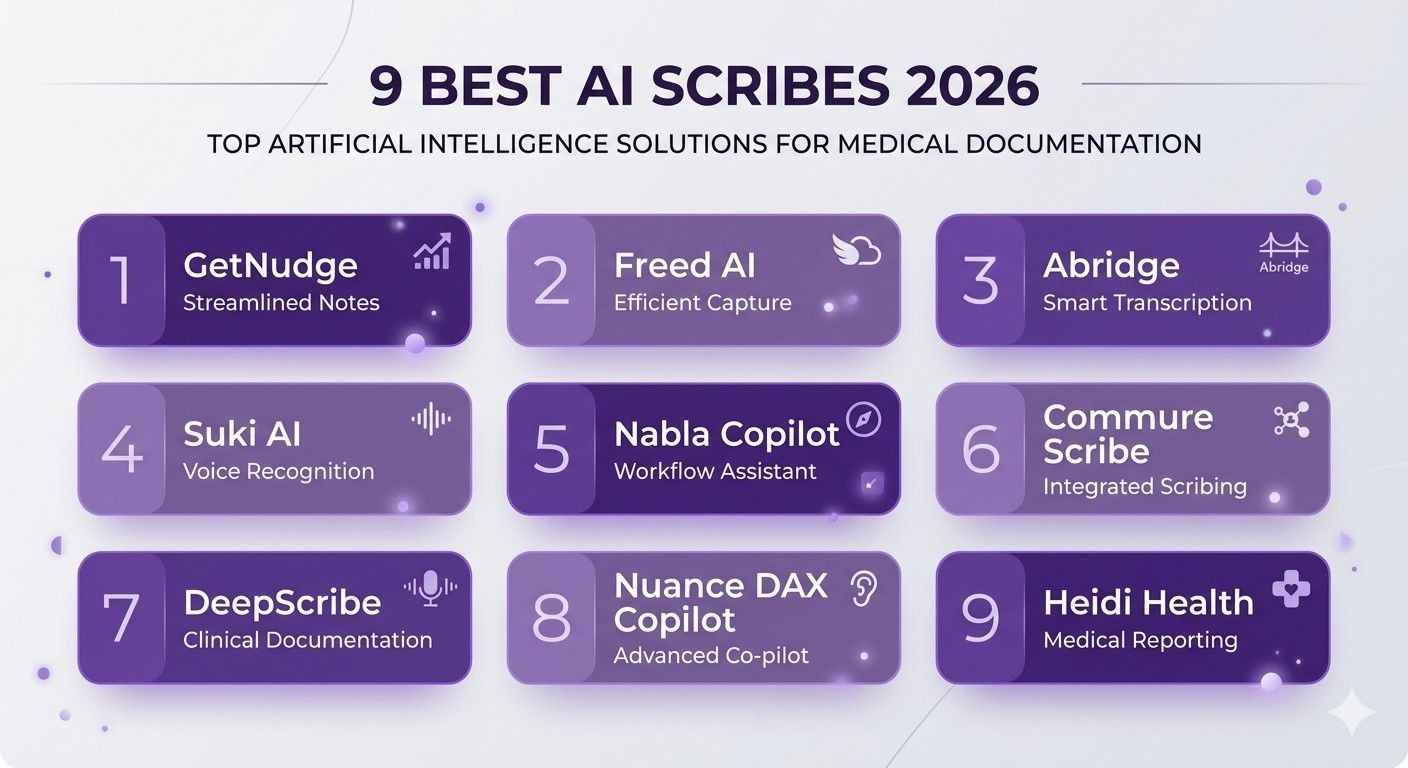
Image source: Nudge AI
How to Test an AI Scribe During a Messy Patient Visit
Marketing materials often showcase "clean" visits: one doctor, one patient, and a straightforward complaint. However, real-world medicine is messy. To find a tool that truly works, you must subject it to the "Messy Visit Stress Test." This involves testing the AI in scenarios involving geriatric patients with multiple comorbidities, oncology consultations with emotional interruptions, or encounters where the patient has a heavy accent.
A critical metric to track during these trials is "Note Drift." Note drift occurs when the AI loses the thread of the conversation or begins to hallucinate details to fill in gaps. According to a July 2025 JAMA Open study, no tool is currently 100% error-free, especially as visit complexity increases [Source 1] .
The 10-Visit Trial Methodology: Instead of measuring "Generation Time," focus on "Editing Time per Note." If an AI generates a note in 10 seconds but requires 5 minutes of manual correction to fix errors, it may not be providing the ROI you expect. A top-performing tool should require less than 60 seconds of editing for a standard level-4 visit.
Does Your AI Scribe Actually Integrate with Epic or Cerner?
Dr. Giri Rajtosh Purohit of OmniMD warns that "compatibility" is often used loosely in the industry [Source 1] . In 2026, integration exists on a spectrum:
- Native API Write-back: This is the gold standard. The AI identifies specific data points (like blood pressure or a new medication) and populates the corresponding discrete fields in Epic or Cerner. Abridge and Nuance DAX are leaders here.
- Browser Extensions: Tools like Freed use browser overlays to "inject" text into the EHR. This is highly effective for web-based EHRs but can face security friction in high-security hospital environments where browser plugins are restricted.
- Copy-Paste / Virtual Clipboard: The most basic form of integration. The AI generates a note in a separate window, and the doctor manually copies it into the EHR. While less efficient, this remains the only option for many legacy or "closed" EHR systems.
What Does an AI Scribe Actually Cost in 2026?
The market has bifurcated into three distinct pricing tiers as of late 2026. Understanding these tiers is essential for practice managers trying to balance a budget with clinical needs.
Tools like Twofold ($49) and Heidi Health offer entry-level pricing. These are excellent for residents, small clinics, or those testing the waters. DeepCura ($129) also fits here, offering bonus features like an AI receptionist [Source 5] .
This is where most professional-grade tools like Suki and Freed's premium versions sit. These tools offer better security, more templates, and more reliable support for group practices.
Nuance DAX and Abridge (at scale) occupy this space. The high cost often includes "Human-in-the-Loop" (HITL) review, where a human editor double-checks the AI's work before it reaches the doctor.
How to Protect Your Practice from AI-Generated Audit Risks
As AI scribes make it easier to document high-level visits, insurance payers are fighting back. In October 2025, Cigna began deploying its own AI algorithms specifically designed to flag and deny Level 4 and 5 E/M claims that appear to be "templated" or "AI-generated" without sufficient medical necessity [Source 1] .
To audit-proof your practice, ensure your AI tool allows for dynamic personalization . Avoid tools that produce identical-sounding "Medical Necessity" sections for every patient with the same diagnosis. Furthermore, legal risks are mounting; a November 2025 class-action lawsuit against Sharp HealthCare highlighted the dangers of recording patient encounters without explicit, documented consent [Source 1] .
Patient Consent Checklist:
- Obtain verbal consent at the start of every recorded visit.
- Include a signed AI Consent Form in the patient's permanent intake file.
- Verify that your vendor has a "Zero-Retention" policy for raw audio once the note is generated.
- Ensure the vendor provides a Business Associate Agreement (BAA).
Building a Modern Clinical Stack with Scribes and Evidence Engines
The most innovative practices in 2026 are moving beyond simple documentation. They are building a "Clinical Stack" that pairs an ambient scribe with a Clinical Decision Support (CDS) engine. In this workflow, the scribe (like Abridge or Freed) listens to the encounter, while a tool like Vera Health or Glass Health analyzes the conversation in real-time [Source 2] .
For example, if a patient mentions a specific set of symptoms, the CDS engine can subtly nudge the doctor with the latest evidence-based guidelines or suggest a specific lab test that might be overlooked. This transforms the AI from a "secretary" into a "clinical co-pilot," ensuring that the final note is not only accurate but also reflects the highest standard of care [Source 8] .
Frequently Asked Questions
- Which AI medical scribes integrate directly with Epic and Cerner?
- Abridge and Nuance DAX Copilot are the primary leaders in native API integration for Epic and Cerner. These tools allow for "write-back" capabilities, meaning they can populate specific data fields within the EHR rather than just providing a block of text for the doctor to copy and paste. Suki also offers strong native integration for many health systems.
- Is an AI scribe cheaper than a virtual human scribe?
- Yes, significantly. A virtual human scribe typically costs between $1,500 and $2,500 per month per physician. In contrast, most AI scribe tools range from $99 to $600 per month. While human scribes may handle complex nuances better, the 2026 generation of AI has closed the accuracy gap enough to make the 70-80% cost savings highly attractive for most practices.
- What is the best AI scribe for mental health professionals?
- Heidi Health and Freed are frequently cited as top choices for mental health. These tools offer specialized templates for psychiatric evaluations and therapy sessions, which differ significantly from standard medical SOAP notes. Heidi Health, in particular, offers a flexible pricing model that appeals to independent therapists.
- Do I need patient consent to use an ambient AI scribe?
- Absolutely. Legal precedents set in 2025, including the Sharp HealthCare lawsuit, emphasize that recording a clinical encounter without explicit consent can lead to significant liability. Most practices use a combination of a sign in the waiting room, a line in the intake paperwork, and a brief verbal confirmation at the start of the visit.
- How do AI scribes handle heavy accents or multiple speakers?
- Top-tier platforms like Abridge and Nuance DAX use advanced diarization (the ability to distinguish between different voices) to handle multiple speakers. While accuracy has improved to over 90%, heavy accents can still cause "Note Drift." It is recommended to use a high-quality external microphone rather than a built-in phone mic to improve clarity in these situations.
The Bottom Line on Choosing an AI Scribe
Selecting an AI scribe in 2026 is no longer about finding "the best" overall tool, but rather the one that fits your specific integration needs and budget. Here are the key takeaways:
- Prioritize Integration: If you use Epic or Cerner in a hospital setting, native API write-back (Abridge/DAX) is worth the premium cost.
- Test for Note Drift: Don't trust a demo; run a 10-visit trial on your most complex, "messy" patient encounters to see the true editing time.
- Verify Payer Compliance: Ensure your tool generates unique, medically necessary documentation to avoid being flagged by automated insurance audits.
- Solo vs. Enterprise: Solo practitioners should look at Freed or Heidi Health for ease of use, while groups should look at Suki or Nuance for scalability.
- Consider the Stack: Look for tools that can eventually pair with Clinical Decision Support (CDS) engines like Vera or Glass Health.
To begin your transition, select two tools from the comparison matrix above and initiate a 7-day trial during your busiest clinic week to measure the actual impact on your daily "pajama time."